


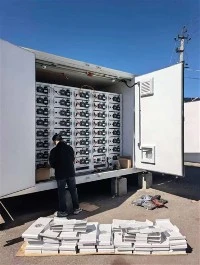
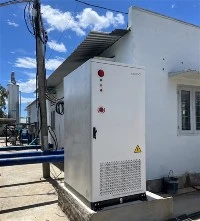
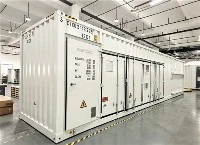
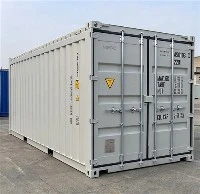
There are currently two main structures for battery compartments: containerized and commercial cabinet type. The most basic unit of an energy storage system is the battery cell, and multiple battery cells combined together form a battery module. Multiple battery modules are combined with a casing BMS, A battery pack is composed of wiring harness, heat dissipation, etc. Multiple battery packs are strung together, combined with battery management BCU, structure, heat dissipation, wiring harness, etc. to form a battery cluster. One or more battery clusters, energy management system EMS, thermal management system, fire safety system, etc., form a DC side energy storage battery compartment. Combined with bidirectional PCS, it can form an AC output energy storage battery compartment.
1 Basic structure of battery compartment
According to the shape of the battery compartment, it can be divided into two structural types: container type and industrial and commercial cabinet type. Energy storage containers use multiple battery clusters connected in parallel, with a capacity generally above MWh. Industrial and commercial energy storage cabinets generally use a cluster one PCS management method, with a capacity generally below MWh.
1.1 Container type
Containerized energy storage, also known as centralized energy storage, uses standard or non-standard containers with high-strength steel shells that combine fire resistance, waterproofing, and impact resistance, making it easy to transport and deploy quickly. It is suitable for large-scale energy storage power stations and distributed energy projects. Container type energy storage is generally DC side energy storage, with batteries installed inside the box and a small number of PCS installed. This type of capacity is relatively small, such as a 20 foot container with a capacity of about 500kW/1000kWh.

There are three commonly used cabinet sizes: 10 feet, 20 feet, and 40 feet, as well as 15 foot and 30 foot cabinets
The standard 20 foot container size is 6058 * 2438 * 2896mm, which is a container filled with batteries and weighs approximately 32-45 tons. The standard 40 foot cabinet size is 12192 * 2438 * 2896mm.
1.2 Cabinet style
Cabinet type energy storage, also known as string type energy storage, distributed energy storage, modular energy storage, generally refers to a battery cluster as an independent cabinet, with an internal or external PCS connected, using a cluster management approach. Cabinet type energy storage compartments are mainly used in industrial and commercial energy storage projects, with single unit capacities of 50kW/100kWh, 100kW/215kWh, 110kW/233kWh, 125kW/250kWh, 372kWh and other models.

Main advantages of commercial energy storage cabinets:
High system efficiency: Implementing one cluster one management improves the balance and charging and discharging efficiency of battery packs.
Easy maintenance: Single cluster overall operation and maintenance, accurate positioning of single cluster in case of system failure.
High safety: Each battery cluster is individually controlled for charging and discharging, avoiding the influence of circulating currents and achieving fault isolation. Adopting a cluster based efficient thermal management system with good temperature uniformity, long battery life, and stable system operation
Strong flexibility: With a small single cabinet size, it is convenient for transportation and installation, suitable for various application scenarios such as industrial and commercial users, shared energy storage, and new energy distribution and storage; The system supports the mixing of old and new batteries, and can be flexibly expanded or recharged according to actual needs, greatly improving the flexibility and maintainability of the system.
2 Main equipment
A battery compartment usually consists of several parts, including the cabin body, battery system, temperature control system, fire protection system, electrical system, etc. The cabin adopts a containerized design, which has good sealing and seismic resistance, and can effectively protect internal equipment from external environmental influences. The battery system is the core of the prefabricated cabin, consisting of multiple sets of lithium-ion batteries responsible for storing and releasing electrical energy. The temperature control system ensures that the battery system operates within a suitable temperature range through air conditioning and ventilation equipment, preventing thermal runaway of the battery. The fire protection system is equipped with smoke detectors, fire extinguishers, and other devices. Once a fire occurs, the fire extinguishing program can be quickly activated to control the fire within the minimum range. The electrical system includes PCS, BMS, Electrical connections, communication, etc. are responsible for connecting prefabricated cabins to the external power grid and achieving input and output of electrical energy.
2.1 Battery System
Composed of lithium-ion batteries (such as lithium iron phosphate) or sodium ion batteries in series and parallel, forming modules or battery clusters to provide core energy storage functions.
2.2 Electrical System
Battery Management System (BMS). Three level architecture (module level, cluster level, system level), real-time monitoring of parameters such as voltage, temperature, SOC/SOH, optimizing charging and discharging strategies, and warning of faults.
The power conversion system (PCS) achieves bidirectional conversion between AC and DC power. During charging, it rectifies AC power into DC power and stores it in the battery. During discharging, it inverts and outputs AC power for use by the load.
Busbars and distribution cabinets ensure the stability of current transmission;
2.3 Fire Protection System
The fire-fighting facilities used for energy storage battery compartments are generally as follows: first, ventilation devices; Secondly, combustible gas detectors; Thirdly, fire extinguishers; The fourth is the fire sand box; The fifth is the fire alarm system; The sixth is the gas automatic fire extinguishing system.
The gas automatic fire extinguishing system consists of gas cabinets, pipelines, nozzles, pressure relief devices, fire alarms, and other facilities. The cabinet is usually located at one end of the cabin and connected to all gas nozzles installed on the top of the cabin through a pipe network, forming an automatic gas fire extinguishing system. At the same time, heptafluoropropane changed from liquid to gas after injection, and the pressure inside the cabin rapidly increased. When any electrical fire occurs in the prefabricated battery compartment, the gas fire extinguishing system will first be activated, and all gas nozzles will spray fire extinguishing agents to extinguish the initial fire through a fully submerged application.
2.4 Thermal Management System
The thermal management system of the energy storage compartment mainly consists of an air conditioning system, a liquid cooling system, and a BMS temperature control system.
The purpose of thermal management is to ensure that high-energy batteries operate within a suitable temperature range and have a relatively uniform temperature distribution, thereby improving the efficiency and lifespan of the battery, while also considering safety and preventing abnormal heating of the battery from causing safety fires. Therefore, the first step in thermal management is to design a well-designed air conditioning and ventilation system, as well as a battery cell liquid cooling system. Based on the layout inside the battery compartment, efficient airflow organization is designed using thermal simulation software to ensure the safe and stable operation of the battery.
The battery compartment generally adopts an air conditioning system, which is usually used to ensure that the ambient temperature of the battery compartment is around room temperature. The liquid cooling unit exchanges heat between the air and water to remove the heat from the battery cells, ensuring that the temperature difference between the batteries can also be controlled within 5 ℃.
3 Core role
3.1 Peak shaving and valley filling
Charging during low load periods and discharging during peak periods of the power grid, balancing power supply and demand, and reducing electricity costs.
3.2 Renewable energy grid connection
Stabilize the volatility of photovoltaic/wind power, increase the proportion of clean energy consumption, and help achieve carbon neutrality goals.
3.3 Emergency power supply
As a backup power source for critical locations such as hospitals and data centers, it ensures power continuity in case of sudden power outages.
3.4 Grid peak shaving, frequency regulation, black start, etc
Quickly respond to frequency fluctuations, improve the stability of power grid operation, and reduce the frequency regulation pressure of traditional thermal power units.