125kWh Outdoor‑Type Large‑Scale Energy‑Storage System | MECC Full Case Study
Aug 21, 2026
Leave a message
Project Overview
125kWh Large‑Scale Energy‑Storage System
- Outdoor model
- 50kW converter
- 125kWh battery
Target application scenarios: government‑led projects, emergency‑response engineering, commercial and industrial energy storage.
Optional capacity range: 100kWh‑1000kWh.
Designed for field‑deployment scenarios such as government emergency support, on‑site C&I power optimisation and temporary disaster‑relief power supply, this outdoor‑rated energy‑storage unit integrates a 50kW power converter and 125kWh battery pack within a single compact cabinet. The product portfolio supports flexible capacity scaling ranging from 100kWh up to 1000kWh to match diverse project requirements for public‑sector and private commercial‑industrial end‑users.
When deploying outdoor energy‑storage hardware for government emergency projects and industrial sites, operators frequently encounter two prominent practical challenges, even with well‑specified hardware configurations. These obstacles may degrade real‑world performance, limit emergency‑response reliability and raise long‑term maintenance burdens.
Key Technical & Operational Pain Points
Pain Point 1: Harsh outdoor environmental interference threatens equipment stability for emergency‑mission hardware
Most government emergency‑engineering sites are located in open‑air outdoor environments without dedicated equipment rooms. The system must withstand wide temperature swings, high humidity, dust accumulation and occasional rain splash throughout the whole year. Ordinary indoor‑adapted energy‑storage equipment suffers condensed moisture inside cabinets, dust contamination of power electronics and inconsistent operating temperature for battery modules.
For emergency‑response projects, reliability is non‑negotiable. If the cabinet lacks sufficient environmental protection and targeted thermal management, battery and converter performance will degrade gradually. When unexpected blackouts or disaster events occur, the storage system may fail to activate as expected, which directly compromises emergency power guarantee for key public facilities and industrial critical loads.
Pain Point 2: Conflicting functional requirements between daily commercial‑industrial operation and sudden emergency backup mode
This outdoor ESS is expected to serve dual purposes. Under normal conditions, it executes C&I tasks such as peak‑load shaving and load shifting to cut enterprise energy expenditure. Meanwhile, it must be ready to switch instantly into emergency‑backup mode whenever grid failure takes place. Many generic outdoor storage solutions adopt fixed charge‑discharge logics. During daily peak‑valley arbitrage, batteries may be fully discharged for economic benefits, leaving zero reserved energy for emergency use.
Without intelligent mode‑switching logic for mixed‑use government‑commercial projects, asset owners face a dilemma: either sacrifice economic returns by keeping large‑volume battery capacity idle for emergency standby, or risk losing backup capability when actual power outages strike. In addition, many public‑sector projects require flexible capacity expansion; traditional fixed‑capacity units cannot adapt to phased construction demands of government emergency engineering.
MECC Targeted Technical & Functional Solutions
Solution 1: Enhanced outdoor‑grade cabinet protection plus adaptive thermal management for reliable field‑site operation
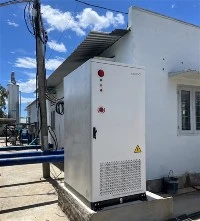
This 50kW/125kWh outdoor‑type energy‑storage cabinet adopts high‑level outdoor enclosure protection grade. The cabinet body is structurally sealed against dust, rainfall and moisture ingress, eliminating risks of internal condensation and dust pollution for power‑conversion hardware and battery modules.
Built‑in intelligent thermal management automatically adjusts cooling and heating functions according to ambient temperature. It keeps battery modules and 50kW converter working within optimal temperature windows in both hot summer and cold winter conditions. All core components including battery modules, BMS and converter are fully pre‑integrated inside the cabinet before factory delivery. On‑site work only includes positioning and cable connection, enabling rapid deployment for emergency‑engineering missions without building special air‑conditioned equipment rooms.
Solution 2: Multi‑mode intelligent EMS control balancing daily economic operation and emergency standby readiness, with flexible modular‑capacity expansion
The embedded energy‑management system supports configurable emergency‑reserve SOC thresholds. In regular grid‑connected commercial‑industrial operating mode, the system carries out peak‑shaving and load‑shifting to reduce electricity expenses, yet will stop arbitrage‑oriented discharging once battery state‑of‑charge reaches the pre‑set emergency reserve limit. Sufficient energy is always preserved for sudden grid‑outage events.
Upon detecting mains power loss, the system completes rapid grid‑to‑off‑grid switching and delivers stable emergency power for critical loads such as government command facilities, disaster‑relief sites or factory safety‑related equipment. To satisfy phased‑investment requirements for public‑sector projects, the platform supports flexible capacity selection from 100kWh to 1000kWh. Users can start with the baseline 125kWh unit and add extra cabinets later according to project development. Standardised communication and power interfaces guarantee seamless interconnection of expanded units, avoiding complicated on‑site re‑programming work.
Project Functions & Industry Impact
For end‑users covering government agencies and commercial‑industrial enterprises, this outdoor‑type 50kW/125kWh energy‑storage system delivers dual‑value output. In daily operation, it optimises power consumption profiles, lowers peak‑demand charges and improves energy efficiency for factories and commercial premises. For emergency‑engineering scenarios, it provides fast‑deployable, reliable backup power support for disaster rescue, public‑facility power guarantee and grid‑maintenance temporary power supply. Its wide optional‑capacity range (100kWh‑1000kWh) accommodates small‑scale emergency points as well as medium‑sized public‑sector energy‑storage construction.
From an industry perspective, this outdoor ESS offers a proven reference model for public‑sector emergency‑response energy‑storage and mixed‑use C&I outdoor‑deployment projects. It demonstrates how environmental‑hardened hardware together with multi‑objective intelligent control can resolve the contradiction between daily economic operation and emergency standby requirements. MECC's integrated outdoor‑storage solution lowers the technical barrier for government emergency‑project implementation, accelerates the adoption of safe, rapid‑deployable energy‑storage equipment for public‑safety purposes and supports global progress toward more resilient urban and industrial energy infrastructure.
125KW 241kWh Battery Energy Storage System Cabinet
The BESS 125KW 241kWh Lithium Battery Energy Storage Cabinet is a high-power, large-capacity integrated energy storage solution engineered for medium-to-large commercial, industrial, and utility-scale applications. It integrates a 125kW high-performance bidirectional inverter, a 241kWh lithium iron phosphate (LiFePO4) battery bank, and a full-featured intelligent energy management system (EMS) into a modular cabinet design. This system enables efficient renewable energy storage, peak shaving, load shifting, grid frequency regulation, and emergency backup power supply. Ideal for large factories, shopping malls, industrial parks, utility-scale solar/wind farms, and microgrids, it enhances energy independence, reduces high grid demand charges, and supports the stable integration of high-penetration renewable energy into the grid.