



Two assets can cut a demand charge: solar panels that generate through the peak hours, or a battery that discharges into them. Facilities teams often arrive at this comparison with the intuition that they are substitutes - pick the cheaper one. They are not substitutes. They solve the peak problem with opposite strengths: solar is cheap but unreliable at exactly the moment that counts, storage is reliable but expensive per kilowatt, and hybrid peak shaving exists because each asset covers the other's weakness.
The comparison turns on two questions. First, does your peak even occur when the sun is up - and more precisely, does it occur when your array is producing? Second, does your tariff forgive a single bad interval, or does it bill the worst moment of the month? The answers select the architecture more reliably than any price sheet.
This article completes our peak shaving cluster: it is about choosing the asset mix, while our companion pieces cover the value mechanics of peak shaving with batteries, the site-level tactics for industrial loads, and the control algorithms inside the dispatch layer.

The Timing Problem That Defines Everything
Solar generation and building demand live on different clocks, and the overlap between them is the entire solar-only case.
A commercial building's demand typically peaks in the mid-to-late afternoon - cooling load accumulates through the day, occupancy peaks after lunch, and in summer the thermal lag pushes the maximum to 3 or 5 pm. A solar array peaks at solar noon, and by the time the building's demand curve crests, the array has already slid well down its output curve. The overlap that matters is not "is the sun up at the peak" but "how much of the peak does the array cover on the worst day of the month" - a question answerable only with a year of coincident load and irradiance data.
Where the overlap is genuinely strong - hot, clear-sky climates where cooling load and solar output rise together, with the peak landing early afternoon - solar can carry a large share of peak reduction. Where the peak is driven by occupancy schedules, production shifts or evening EV charging, the array produces little or nothing during the critical window, and solar-only peak shaving is a category error.
And one failure mode above all others defines the limit: cloud transients. A bank of cumulus cloud crossing the array at 3:40 pm on the hottest day of the month can drop array output by 60 to 80 percent in under a minute. If that moment coincides with the month's demand maximum, the load spikes through the unprotected gap, the utility books the single highest interval, and the entire month's demand charge is set by the worst fifteen seconds of solar weather. Demand billing is unforgiving by construction - it rewards reliability, not averages.
What Each Option Actually Delivers
Solar-only reduces the average daytime demand and generates cheap energy, but it cannot cap the peak. On cloudy peak days the reduction vanishes precisely when it is billed. Treat solar-only as load reduction with a coincident-peak discount, not as demand charge control. Its honest metric is expected peak reduction across the year, not guaranteed peak reduction in any month.
Storage-only caps the peak with near-certainty. A battery with a competent algorithm holds the demand at a setpoint through the critical hours regardless of weather, and in single-interval billing markets that guarantee is the product. The costs are the familiar ones: capital per kilowatt-hour, cycle degradation, and the space and interconnection the battery needs. Its limit is energy duration - a two-hour battery cannot defend a setpoint through a six-hour afternoon plateau, so sizing becomes a negotiation between the worst peak shapes and the budget.
Hybrid pairs them, and the pairing is not merely additive. The solar supplies most of the daytime energy reduction and offloads the routine, predictable share of the peak. The battery is sized only for the residual - the gap between the load net of expected solar and the target demand - plus the transient cover that solar cannot provide. On a typical commercial site, this cuts the required battery size by a third to a half compared with storage-only, and the battery's real job narrows to what it is uniquely good at: firming the cloud transients and covering the post-sunset tail of the peak.

The Economics, Framed Honestly
The unit economics differ in kind, not just in magnitude, and the comparison should be made per kilowatt of reliable peak reduction.
Solar's cost per kilowatt of generation is now low enough that it beats storage on raw energy in almost every market. But its cost per kilowatt of dependable peak reduction depends on the coincidence factor - on a site where the array covers only half the peak-hour demand on the worst days, its effective price per firm kilowatt doubles. Storage's cost per firm kilowatt is high but stable, because its output does not depend on the sky.
The hybrid arithmetic usually lands where the following three conditions hold, and fails where they do not:
A solar array is already present or clearly justified on energy grounds alone - in which case the battery's marginal cost is the only new capital, and hybrid is nearly always the answer.
The peak is long relative to practical battery duration - a four-hour afternoon plateau that no affordable battery can cover alone - in which case solar must take the base of the peak and the battery the shoulders.
The tariff bills single intervals or steep ratchets - in which case the guarantee premium of storage is worth paying, and solar-only is not in the running regardless of its cost per panel.
Sizing the Hybrid: The Residual Method
The correct way to size a hybrid system is to work with the residual, not the averages.
Take a year of coincident interval data - site load and array output, hour by hour. Compute the net load: demand minus solar, moment by moment. The peak shaving target then applies to the net load curve, and the battery is sized against the worst net-load peaks - which are shorter and lower than the gross peaks, because solar has already removed the predictable share.
Two sizing corrections keep the model honest. First, size against a cloudy-day net load, not an average one: use the worst solar production months and the worst coincidence days, or the battery will be sized for weather you will not get. Second, hold a transient reserve - the algorithm must keep enough charge to cover cloud ramps, which our peak shaving control article treats as a SOC budgeting layer. A battery sized without a cloud reserve will be caught mid-response exactly once per season, and once is enough.
The power-to-energy ratio also shifts in hybrid designs: because the battery's residual peaks are shorter, a higher-power, shorter-duration configuration often outperforms the energy-heavy sizing a storage-only project requires.
Control: The Priority Stack
Hybrid operation needs an explicit dispatch hierarchy, because the two assets can otherwise work against each other - most visibly when the battery charges from the grid at midday while solar is curtailed or exported cheaply.
The priority stack that works in practice runs: serve the load directly from solar first; hold the battery's charging demand inside the solar surplus wherever possible; discharge the battery only above the net-load setpoint, with the transient reserve protected beneath it; and only then release surplus energy to arbitrage or export, subject to the interconnection limits. The battery charging from solar instead of the grid changes the economics quietly but decisively - it converts cheap daytime electrons into expensive evening peak reduction, which is the highest-value transformation in the building.
On sites with export restrictions, the stack matters even more, because solar that cannot be exported must be consumed or stored in real time - and the battery becomes the mechanism that makes a larger array permissible on a constrained connection.
Sequencing the Retrofit
Most hybrid installations are not designed together; they accrete. Solar first, storage later - and that order is usually correct, because the array's first year of operating data becomes the battery's sizing input, replacing forecasts with measurements.
But the reverse consideration belongs in the solar design phase even if the battery is years away: conduit routes, switchgear spare ways, plant room or yard space, and a control platform that can accept a second asset. A modest amount of provision during the solar installation removes most of the cost of adding storage later. Retrofitting provision after the fact is exactly the kind of avoidable expense this site's procurement guides are written to prevent.
The Selection Logic, Compressed
Three questions select the architecture.
Where is the peak, and does the sun coincide with it on the worst days? Strong coincidence and forgiving billing lean solar-heavy; weak coincidence makes solar-only peak reduction largely illusory.
Does the tariff bill the worst interval or an average? Single-interval and ratchet tariffs demand the storage guarantee; averaged-demand tariffs let solar carry more of the load.
Is the array already there, or justified anyway? Existing solar makes the hybrid battery the cheapest firm kilowatt on the table; a greenfield with no energy case for solar defaults to storage.
Solar alone reduces what you pay for energy. Storage alone guarantees what you pay for demand. Hybrid peak shaving does both, and it is the correct architecture whenever the peak is long, the tariff is strict, and the sun is at least partially on your side. For most commercial sites that check all three boxes, it is not a compromise between the alternatives - it is the design the other two options were approximating.
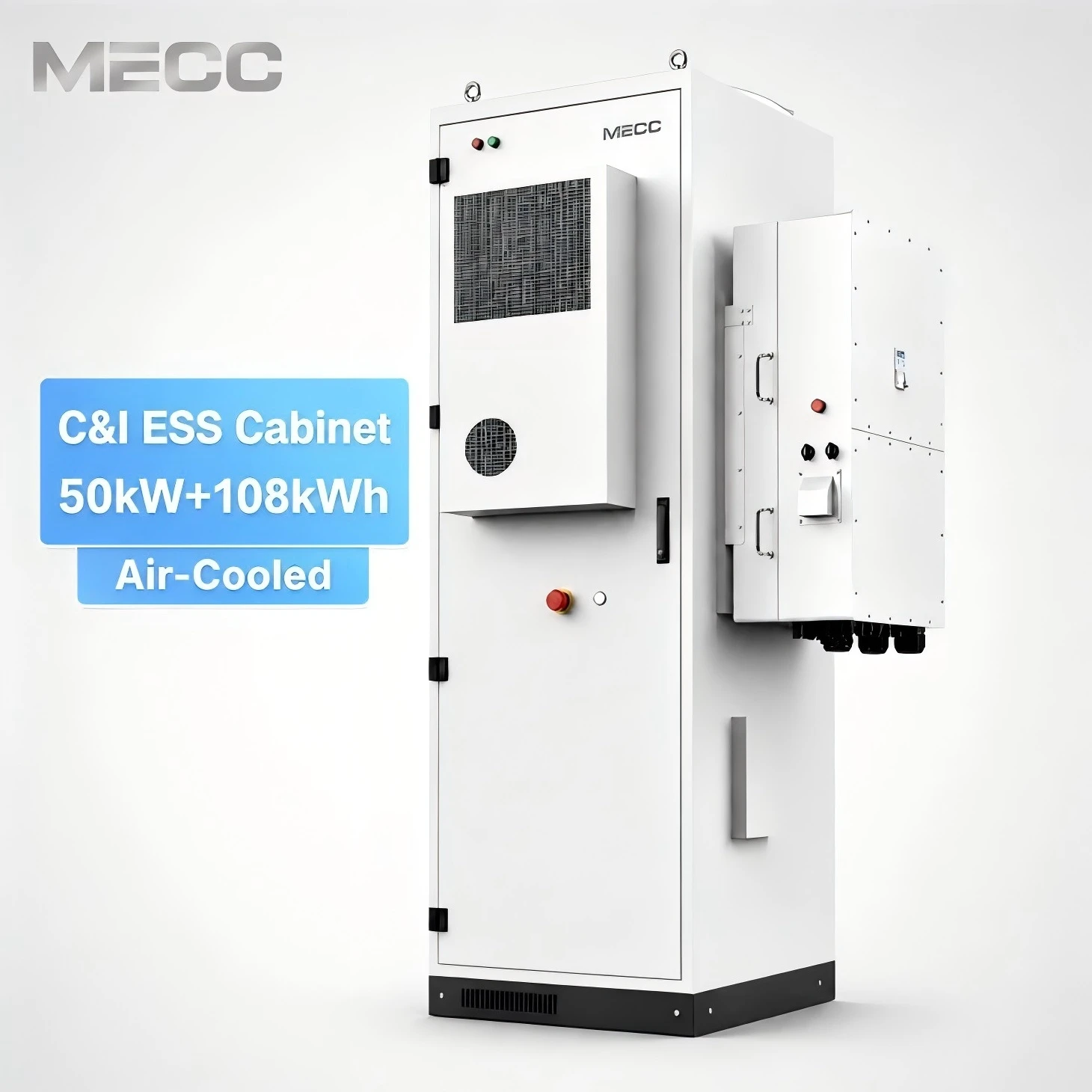
MECC 50KW 108KWH BESS Battery Energy Storage System
The MECC 50kw 108kWh Battery Energy Storage Cabinet is a high-capacity energy storage solution designed for industrial and commercial applications. Featuring 345.6V, 314Ah lithium iron phosphate (LiFePO4) battery, it ensures long-lasting, safe, and efficient energy storage.
High-efficiency 50kW/108kWh Industrial and Commercial Energy Storage System (C&I ESS). Features LiFePO4 battery, peak shaving, and smart EMS. Reduce operational costs and ensure power backup. Inquire for custom BESS solutions.
Designed with a compact footprint of less than 1.2 square meters, this 108kWh cabinet features a pre-integrated all-in-one design, reducing on-site installation time by 40% compared to modular rack systems.