1. Project Overview & Design Objectives
This customized photovoltaic and energy storage integrated solution is tailored for commercial and industrial scenarios. Based comprehensively on on-site power consumption characteristics, installation conditions and grid-connected access requirements, the system is configured with a 39kWp high-efficiency PV array, a 30kW three-phase high-voltage energy storage inverter and a 60kWh lithium iron phosphate energy storage battery pack. Designed with a daily power generation capacity of 195kWh, the system supports three core functions: on-site PV self-consumption, peak-valley tariff arbitrage, and off-grid emergency power backup. It fully meets operational requirements for long-term safety, stability and high energy efficiency.
Adopting the industry-standard high-voltage DC common bus architecture, the solution integrates PV modules and energy storage batteries on the inverter DC side. The simplified system structure effectively reduces power transmission losses, lowers grid electricity purchase costs, and realizes intelligent energy scheduling including off-peak charging and on-peak discharging for additional economic benefits. In case of grid anomalies, the system achieves seamless mode switching to sustain uninterrupted power supply for critical production loads. All core equipment is precisely matched without redundant configuration, forming an optimal balance between initial investment and long-term return, and adapting flexibly to rooftop and ground-mounted commercial installation scenarios.
2. System Architecture & Technical Route
The system adopts an integrated topological structure of PV array + energy storage battery pack + high-voltage energy storage inverter + grid + local load. Its core technical route features high-voltage DC transmission, maximum power point tracking (MPPT), and AC/DC bidirectional coordinated control, enabling high-efficiency PV power conversion, intelligent charge-discharge scheduling and grid-friendly interaction.
The PV array converts solar energy into DC power and connects directly to the inverter MPPT terminals through optimized series-parallel configuration. The embedded MPPT algorithm dynamically tracks the maximum power point under variable irradiance and temperature conditions to maximize power generation efficiency. The energy storage battery pack is connected in parallel to the common DC bus to store surplus PV power and off-peak grid electricity, and supplements power supply during peak grid tariff periods, insufficient PV generation or grid failures. The inverter AC side connects to the factory low-voltage distribution cabinet to realize bidirectional energy interaction between PV, storage, grid and local loads. Equipped with comprehensive protection and intelligent logic, the system automatically switches operating modes according to real-time lighting, load demand and grid status to ensure stable and safe full-condition operation.
Compared with traditional AC-coupled architectures, this design reduces redundant AC/DC conversion links, minimizes energy loss and fault points, and lowers line current via high-voltage DC transmission. It effectively reduces cable investment and line losses, improving overall system efficiency by 3%–5% and making it highly suitable for medium and small commercial PV-storage scenarios.
3. Core Equipment Selection & Parameter Verification
3.1 PV Array Design & Electrical Verification
Module Selection: High-efficiency N-type double-sided double-glass PV modules are adopted, with a single-module peak power of 650W and a conversion efficiency of ≥23%. Featuring excellent low-light response, low attenuation and superior weather resistance, the modules operate stably within -40℃~85℃ and maintain ≥85% of initial power output after 25 years, fully adapting to harsh outdoor commercial operating environments.
Series-Parallel Configuration Optimization: The PV array adopts a layout of 10 modules per string × 6 parallel strings, achieving a total installed capacity of 39kWp. The PV-to-inverter power ratio is 1.3:1, which falls within the optimal industrial design range. This configuration ensures full inverter utilization under variable solar irradiance while avoiding excessive power redundancy, balancing power generation efficiency and capital investment.
Voltage Compliance Verification: The standard open-circuit voltage per module is 41.5V, resulting in a string open-circuit voltage of 415V. The inverter MPPT operating voltage ranges from 160V to 1000V, providing sufficient margin for safe operation. Even under extreme low-temperature conditions, the maximum string open-circuit voltage does not exceed 480V, which remains well within the inverter's safe operating window. The design guarantees effective MPPT tracking even during weak-light periods such as sunrise and sunset, maximizing overall energy output.
3.2 Energy Storage System Selection & Voltage Adaptation
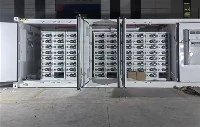
This solution adopts modular 5kWh small-capacity battery packs instead of large-capacity single packs, aiming to enhance system stability and operational reliability. Modular design delivers higher flexibility, finer load matching, lower single-point failure impact and more precise charge-discharge control, perfectly supporting uninterrupted power supply for critical commercial loads. The system consists of 12 sets of high-voltage rack-mounted lithium iron phosphate batteries, forming a total capacity of 60kWh with a rated voltage of 614.4V. Featuring ≥8000 cycle life, high safety, wide temperature adaptability and low self-discharge rate, the battery pack supports high-current fast charging and discharging to fully meet peak-valley arbitrage, capacity backup and emergency power demand.
Voltage Matching & Startup Verification: The inverter battery operating voltage range is 600V–800V. The battery's rated voltage of 614.4V achieves precise matching without additional DC booster equipment, simplifying system structure significantly. The minimum battery operating voltage is maintained above 600V, fully meeting the inverter startup threshold and enabling stable system activation and operation under normal battery status. High-voltage dedicated DC cables reduce line losses and further improve overall system efficiency.
3.3 Inverter Selection & Grid Access Verification
Inverter Model: A three-phase high-voltage energy storage inverter with a rated AC output power of 30kW is deployed. Equipped with two independent MPPT channels and a maximum conversion efficiency of 98%, the device supports high-voltage PV and battery access. Integrated with comprehensive over-voltage, over-current, short-circuit and anti-islanding protection functions, as well as advanced four-party coordinated control logic for PV, energy storage, grid and loads, it fully complies with commercial grid-connected technical standards.
Access Capacity Compliance: Each MPPT channel supports up to 3 strings of PV modules, with a total maximum access capacity of 6 strings - precisely matching the project's PV layout. The design eliminates the need for additional DC combiner boxes, reducing system fault points and line losses. Independent MPPT tracking avoids power mismatch between strings and maximizes individual module power generation performance, ensuring long-term stable system output.
4. System Operating Modes & Control Logic
According to real-time solar irradiance, on-site load demand, grid tariff periods and battery SOC status, the system automatically switches between four intelligent operating modes to achieve full-scenario optimized operation.
1. PV Self-Consumption & Surplus Storage Mode During daytime high-irradiance periods, PV power supplies local loads preferentially. Excess power is automatically stored in the energy storage system. When PV generation is insufficient to meet load demand, the battery discharges dynamically to compensate power shortage, realizing 100% local PV consumption and minimizing grid electricity purchase.
2. Peak-Valley Arbitrage Mode In accordance with local time-of-use tariff policies, the system charges the battery during grid off-peak hours when SOC is below the threshold. During grid peak tariff periods, stored power is discharged to supply on-site loads, avoiding high-cost peak grid electricity and creating stable arbitrage benefits.
3. Off-Grid Emergency Backup Mode In the event of grid failure or voltage abnormality, the system achieves millisecond-level seamless off-grid switching. The PV and energy storage system jointly power critical loads to ensure uninterrupted production. When grid power is restored, the system automatically switches back to grid-tied mode without manual intervention, realizing fully intelligent unattended operation.
4. MPPT Maximum Power Tracking Mode The inverter's real-time MPPT algorithm monitors PV voltage and current continuously and dynamically adjusts operating points to maintain maximum power output under all weather conditions, including cloudy days and low-light morning/evening periods, ensuring optimal daily power generation efficiency.
5. Power Generation & System Efficiency Calculation
The system is designed with a daily power generation capacity of 195kWh, calculated based on the following authoritative parameters:
Basic Configuration: 39kWp PV array with high-efficiency 650W modules meeting standard industrial performance parameters.
Effective Sunshine Hours: Based on local annual solar resource statistics and comprehensive consideration of low-light performance and temperature attenuation, the system adopts an effective daily power generation duration of 5 hours. Daily theoretical generation = 39kW × 5h = 195kWh.
Comprehensive System Efficiency: Taking into account module mismatch loss, line transmission loss, inverter conversion loss, dust and temperature attenuation, the overall system efficiency is calculated at 85%. The guaranteed daily effective output power is no less than 165kWh, fully covering daily power demand for small and medium-sized commercial facilities.
The system achieves an annual power generation of over 58,000kWh and a 25-year cumulative power generation exceeding 1.4 million kWh, delivering stable long-term energy-saving and economic benefits.