





1 What is polycrystalline silicon?
Polycrystalline Silicon (Poly Si or Polysilicon) is a semiconductor material commonly used in the manufacture of photovoltaic cells and electronic components. It is composed of multiple grains (crystal particles) that are interconnected at the boundaries, but the atomic arrangement inside each grain is ordered. Polycrystalline silicon is widely used in the manufacturing of solar photovoltaic cells. In photovoltaic modules, polycrystalline silicon cells are connected in series and parallel to form solar panels. These solar panels are used to convert solar energy into electrical energy.
In addition, it is also used to manufacture gate materials for certain electronic components such as transistors and integrated circuits.

Characteristics of polycrystalline silicon:
Polycrystalline structure: Polycrystalline silicon is composed of multiple grains, with atoms arranged in an orderly manner within each grain, but atoms arranged randomly at the boundaries between grains. These grains have different sizes and orientations.
Relatively low cost: The production process of polycrystalline silicon is relatively simple and cost-effective, making it suitable for large-scale production. This gives polycrystalline silicon photovoltaic cells a price advantage in the market.
Low efficiency: Due to the presence of grain boundaries, the photoelectric conversion efficiency of polycrystalline silicon photovoltaic cells is usually lower than that of monocrystalline silicon photovoltaic cells. Defects at grain boundaries can cause carrier recombination, thereby reducing battery efficiency.

Polycrystalline silicon production process:
Raw material purification: The production of polycrystalline silicon usually starts with metallurgical grade silicon (MG Si), which first needs to be purified to remove impurities from the silicon and produce high-purity silicon raw materials. The commonly used method is the Siemens process, which obtains high-purity polycrystalline silicon through chemical vapor deposition (CVD).

Reduction process: Metallurgical grade silicon reacts with hydrogen chloride to produce trichlorosilane (HSiCl₃), which is then purified by distillation. Finally, trichlorosilane is reduced at high temperature to produce high-purity polycrystalline silicon.
Reaction process: Metallurgical grade silicon reacts with hydrogen chloride (HCl) to produce trichlorosilane (HSiCl₃) and other by-products. Si+3HCL→HSiCl₃+H₂
Ingot: High purity polycrystalline silicon is melted and cast into large chunks of polycrystalline silicon ingots. After cooling, these ingots are composed of multiple silicon grains with different orientations.


Slicing: Polycrystalline silicon ingots are cut into thin slices by a slicer, which are called wafers and used to manufacture photovoltaic cells.
Detection and grading of polycrystalline silicon wafers
Optical inspection: Use optical inspection equipment to inspect the surface quality and crystal structure of polycrystalline silicon wafers.
Electrical performance testing: Testing the electrical properties of polycrystalline silicon wafers, such as minority carrier lifetime, conductivity, etc.
Quality grading: Based on the test results, polycrystalline silicon wafers are graded according to quality and performance to ensure that high-quality silicon wafers are used for efficient photovoltaic cell manufacturing.

2 What is monocrystalline silicon
Monocrystalline silicon is a high-purity silicon material composed of a single crystal structure. The atomic arrangement of single crystal silicon is orderly, the crystal structure is complete, and it has excellent electrical properties and mechanical strength. Monocrystalline silicon photovoltaic cells are currently one of the most efficient photovoltaic cells on the market, with high photoelectric conversion efficiency and suitable for various photovoltaic power generation systems. Can be used as the main material for manufacturing semiconductor devices such as integrated circuits (ICs), microprocessors, memories, sensors, etc. In addition, high-purity monocrystalline silicon wafers (wafers) are cut, doped, etched, and packaged to produce various electronic components and chips. Monocrystalline silicon is also used to manufacture optical lenses, infrared windows, laser devices, and more.

Production process:
1. Raw material preparation: The raw material for monocrystalline silicon is high-purity silicon, usually using purified metallurgical grade silicon.
2. Production method:
Czochralski method (CZ method):
Step: Melt high-purity silicon in a crucible, insert a single crystal silicon seed crystal with the desired crystal orientation, then slowly rotate and pull the seed crystal to allow the silicon melt to crystallize on the seed crystal, gradually forming a single crystal silicon rod.
Characteristics: CZ method can produce large-diameter and high-purity monocrystalline silicon rods, but it is prone to introducing oxygen and other impurities.
Floating Zone (FZ):
Step: Use high-frequency induction heating to melt a local area of the silicon rod without a crucible, and then move the melting zone on the silicon rod by moving the induction coil, gradually transforming polycrystalline silicon into monocrystalline silicon.
Features: Single crystal silicon produced by FZ method has higher purity and lower impurity content, making it suitable for manufacturing high-performance semiconductor devices.
3. Cutting and processing
Cutting: Using a diamond wire saw to cut a single crystal silicon rod into thin slices, known as wafers.
Grinding and polishing: Grinding and polishing the cut silicon wafer to remove surface defects and improve its flatness and cleanliness.

3 The difference between monocrystalline silicon and polycrystalline silicon
The main differences between monocrystalline silicon and polycrystalline silicon lie in their structure, properties, and applications. Monocrystalline silicon is composed of a single crystal structure, with ordered atomic arrangement and high photoelectric conversion efficiency (18% -24%). It has superior electrical properties and is suitable for high-performance photovoltaic cells and semiconductor devices, but the production cost is relatively high. Polycrystalline silicon is composed of multiple grains with grain boundaries, resulting in low photoelectric conversion efficiency (15% -20%) and poor electrical properties. It is mainly used for large-scale photovoltaic applications with low production costs. Monocrystalline silicon has a uniform appearance and good aesthetics, while polycrystalline silicon has an uneven appearance.
MECC Mono Solar Panels Manufacturer:

MECC410W-B

MECC550W-BI

MECC550W-MO

MECC580W-B

MECC590W
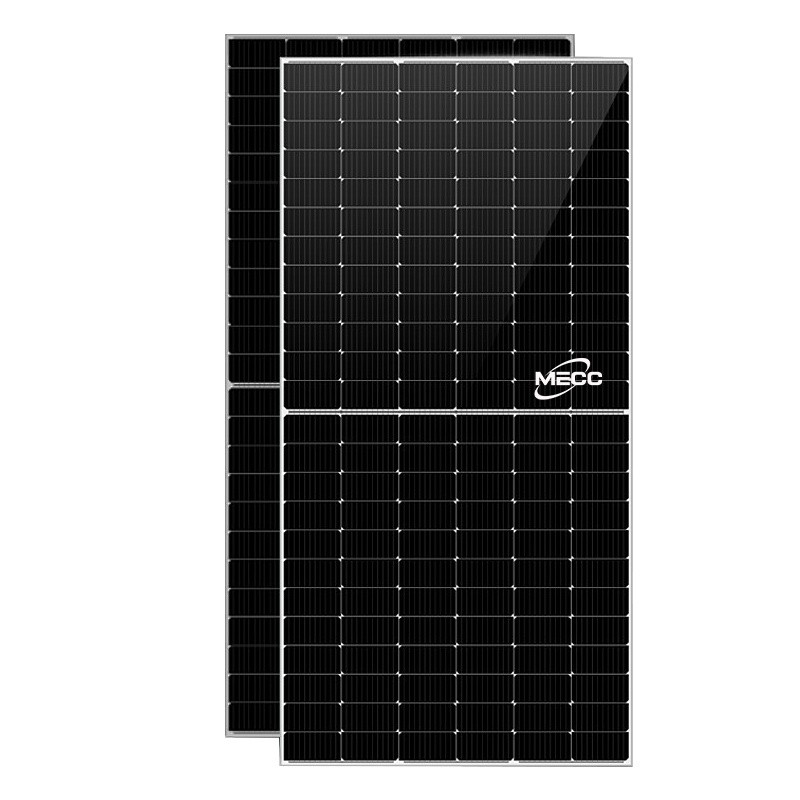
MECC600W-BI