


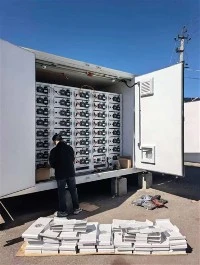
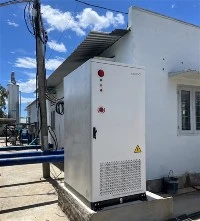
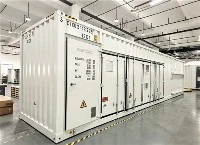
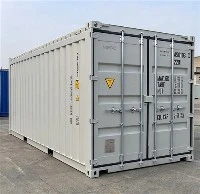
Industrial and commercial energy storage containers have higher safety risks and compliance requirements than ordinary energy storage equipment due to their characteristics of "high density, high power, and long-term operation". Global enterprises have established a "full lifecycle safety control" system, adapted to safety standards in different countries/regions (such as NFPA 855 in the United States, EN 62933 in the European Union, and GB/T 36276 in China), and established risk warning and emergency response mechanisms to control the probability of accidents below 10 ⁻⁸ times/hour, laying a solid safety line for the large-scale application of industrial and commercial energy storage and promoting the transformation of the industry from "wild growth" to "standardized development".
1 Security Design: Avoiding Risks from the Source
China's "three-level fire and explosion prevention" design. A certain brand's 20 foot commercial and industrial energy storage container adopts a three-level protection system of "battery cell module cabin": the battery cells are made of lithium iron phosphate (with a thermal runaway temperature of 600 ℃, 300 ℃ higher than ternary lithium), and the modules are equipped with independent explosion-proof valves (opening pressure of 0.3MPa) and fireproof cotton (flame retardant grade V-0); The cabin is divided into a battery compartment and an equipment compartment (physically isolated). The battery compartment is equipped with a heptafluoropropane fire extinguishing system (spraying completed within 10 seconds), and a directional pressure relief channel is also set up (high-temperature gas is discharged to the top of the cabin for more than 10 meters). This design has passed the most rigorous tests of GB/T 36276-2023 (needle puncture, compression, fire). In simulated thermal runaway scenarios, only the faulty module was damaged and did not spread to other areas. The cabin structure is intact.
Electrical Safety and Lightning Protection Design in the United States. A commercial energy storage container project in California strictly follows the NFPA 855 standard: the electrical circuit adopts "double insulation" (wire insulation layer+metal sleeve), and the grounding resistance is controlled below 4 Ω; Equipped with a three-level lightning protection system (external lightning rod, cabin lightning arrester, internal surge protector), capable of withstanding 100kA lightning current. At the same time, the "arc detection" technology (sampling frequency 1MHz) is used to identify electrical circuit arc faults within 10ms, immediately cut off the power supply, and start extinguishing the fire. The project has been running for 3 years without any electrical safety accidents, and has passed the UL 9540A certification in the United States, becoming a California industrial and commercial energy storage safety demonstration project.

2 Compliance Adaptation: Localized Implementation of Global Standards
CE certification and environmental compliance in Europe. A German industrial and commercial energy storage container enterprise has developed "fully environmentally compliant" products for the EU market: the battery uses cobalt free lithium iron phosphate (compliant with the EU RoHS directive), the electrolyte does not contain fluoride (reducing environmental pollution), and the shell material can be recycled up to 90% (compliant with the EU WEEE directive). Simultaneously passing CE certified EMC testing (electromagnetic compatibility, radiation limit ≤ 54dB μ V/m) to avoid electromagnetic interference to precision equipment in the factory. In the application of this product in German automotive factories, the electromagnetic compatibility score reaches A level, without causing any interference to production equipment, and meets the EU carbon footprint requirements (full lifecycle carbon emissions ≤ 50kg CO ₂ eq/kWh).
Compliance with high temperature and high humidity environments in Southeast Asia. In response to the high temperature of 50 ℃ and 90% high humidity environment in Southeast Asia, a commercial energy storage container has passed the local TISI (Thai Industrial Standards Institute) certification: it adopts "dual circulation liquid cooling" (microchannel between battery cells+cabin air conditioning) to control the temperature inside the cabin within 35 ℃; The electrical interface adopts IP68 protection (waterproof and dustproof), and is equipped with a dehumidifier inside (humidity control below 60%); The battery is made of high-temperature resistant lithium iron phosphate (with a cycle life of 3000 times at 45 ℃). In the application of a rubber processing plant in Thailand, the energy storage container has been running continuously for 2 years, with a failure rate of only 0.5% in high temperature and high humidity environments, far lower than the industry average of 5%, meeting the strict environmental compliance requirements of the local area.

3 Risk management: Safe operation throughout the entire lifecycle
China's' AI Security Monitoring Platform '. A 200MWh energy storage container cluster in an industrial park has deployed an "AI safety monitoring system": each container is equipped with 10 temperature sensors (accuracy ± 0.5 ℃) and 5 gas sensors (detecting CO, H ₂ HF), Two smoke detectors with real-time data uploaded to the cloud platform. The AI algorithm is trained on 500000 sets of fault data and can predict the risk of thermal runaway 1 hour in advance (with an accuracy rate of 92%), while automatically generating disposal plans (such as reducing the charge and discharge rate and initiating local heat dissipation). The platform also supports remote emergency control. When a serious malfunction is detected, the power supply to the container can be cut off within 10 seconds and the fire can be extinguished. In 2023, it successfully warned of three potential thermal runaway risks to avoid accidents.
Third party security audit in the United States. California requires industrial and commercial energy storage containers to undergo third-party safety audits annually, including battery health (SOH) testing, fire protection system functional testing, electrical circuit insulation resistance measurement, emergency plan drills, etc. A certain energy storage operator hired UL (Underwriters Laboratories) to conduct an annual audit and found that the pressure of the fire extinguishing system in two containers was insufficient (10% lower than the standard value). The components were immediately replaced; At the same time, through SOH testing, battery modules with remaining capacity below 80% are utilized in a hierarchical manner to avoid safety risks caused by old batteries. Third party auditing ensures excellent safety operation records of the project, gaining additional grid trust from the power grid company and enabling participation in higher revenue ancillary service markets.
The "safety and compliance" system for industrial and commercial energy storage containers is shifting from "passive compliance with standards" to "active risk prevention". In the future, with the application of digital twins (virtual simulation security testing) and blockchain authentication (tamper proof security records), a full lifecycle closed-loop management of "design compliance operational security retirement environmental protection" will be achieved, providing "security guarantees" for the global and large-scale development of industrial and commercial energy storage, and promoting the healthy and sustainable growth of the industry.