


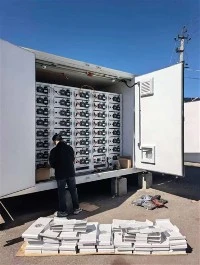
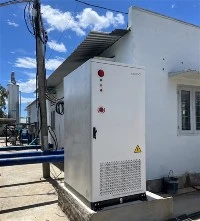
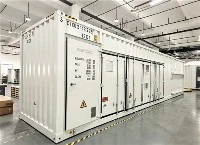
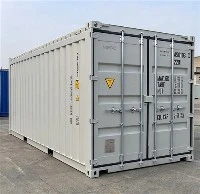
With the diversification of industrial and commercial energy demand, standardized energy storage containers are no longer able to meet the personalized needs of enterprises. Customized services provide precise energy solutions for enterprises through flexible configuration, functional integration, and scenario adaptation, becoming a new competitive focus in the energy storage market.

Modular design: flexible adaptation to different capacity requirements
Modular design is the foundation of customization. The container energy storage system modularizes components such as battery clusters, inverters, BMS, etc., allowing enterprises to combine them as needed. Due to the expansion of the production line, the existing 500kWh energy storage system of a certain automobile manufacturing factory cannot meet the new load. By adding two 250kWh battery modules, the capacity can be expanded to 1MWh without replacing the core equipment, meeting production needs. This "building block" expansion avoids the high cost of overall replacement and increases response speed by 70%.
The demand for energy storage capacity varies significantly among different industries. Commercial places such as shopping malls consume a large amount of electricity during the day and need to focus on their discharge capacity; Data centers have higher requirements for continuous power supply time. Customized services can optimize battery capacity and power ratio based on the enterprise's electricity consumption curve. A large shopping mall has customized a 1.2MWh energy storage system to increase the discharge power to 800kW, fully meeting the load requirements of air conditioning, lighting, etc. during peak electricity consumption periods, saving 40% of electricity bills.

Function integration: Creating a one-stop energy solution
Customized services meet the diverse needs of enterprises through functional integration. In a certain cold chain logistics park, energy storage containers integrate functions such as refrigeration unit power supply, backup power supply, and harmonic control. During the day, the energy storage system charges and suppresses grid harmonics to ensure stable operation of refrigeration equipment; Nighttime discharge power supply, while also serving as a backup power source to cope with sudden power outages and avoid loss of goods. This integrated solution improves the energy efficiency of the park by 35% and reduces equipment failure rates by 50%.
Customized solutions combined with new energy generation are becoming increasingly popular. A certain industrial park integrates photovoltaic power stations with energy storage containers, and automatically adjusts energy storage charging and discharging strategies based on light intensity and electricity load. When there is an excess of photovoltaic power generation, priority should be given to storing electrical energy; When there is a shortage, the energy storage system will replenish electricity to increase the energy self-sufficiency rate of the park to 70%. A customized energy management system that can also be integrated with enterprise ERP systems to achieve visualization and intelligent management of energy data.

Scenario adaptation: responding to special environments and industry needs
Special environments impose higher requirements on energy storage containers. In the hot and humid southern region, customized design requires enhanced heat dissipation and moisture resistance. The energy storage container of a coastal factory adopts a dual cycle liquid cooling system to control the temperature fluctuation of the battery within ± 2 ℃, and is equipped with moisture-proof coating and sealing structure, reducing the equipment failure rate by 80%. In cold regions, electric heating devices should be added to ensure normal operation in an environment of -30 ℃.
The security standards of different industries also need to be customized to meet. Chemical companies have strict requirements for explosion-proof levels, and energy storage containers must use explosion-proof battery compartments, flame-retardant materials, and explosion-proof designs. The customized explosion-proof energy storage system in a chemical industrial park has passed the Ex d IIC T6 explosion-proof certification, ensuring safety while achieving peak valley electricity price arbitrage, saving over 300000 US dollars in electricity bills annually.