



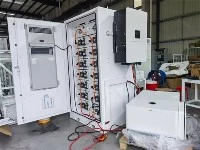
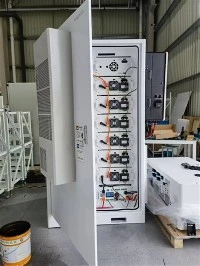
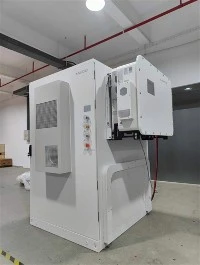
The energy efficiency of high-voltage rack mounted lithium batteries not only affects operating costs, but also determines their competitiveness in high-power scenarios - for every 1% increase in energy efficiency, annual electricity bills can be saved by tens of thousands of yuan. Global manufacturers have optimized high-voltage power conversion, reduced line losses, and coordinated energy storage scheduling to improve the energy efficiency of high-voltage rack lithium battery systems from 90% to over 96%. This has achieved the dual value of "high energy efficiency+low cost" in scenarios such as data centers and industrial and commercial energy storage, making it the core choice for high-power energy systems.
1 High voltage power conversion: reducing energy loss links
China's "SiC MOSFET High Voltage Converter" technology. The energy storage converter (PCS) equipped with a 480V high-voltage rack mounted lithium battery uses all silicon carbide (SiC) MOSFET devices, with a switching frequency increased to 50kHz (traditional silicon-based IGBT is 20kHz) and a 60% reduction in switching losses; Simultaneously adopting a "three-level topology", the voltage stress is reduced from 1200V to 600V, further reducing conduction losses. The conversion efficiency of this PCS reaches 98.5% (European efficiency standard), which is 2.5 percentage points higher than traditional silicon-based PCS. According to actual tests at a data center in Shenzhen, a 1MWh high-voltage rack mounted lithium battery system paired with this PCS can reduce annual energy loss by 25000 kWh. Calculated at an industrial electricity price of 0.8 yuan/kWh, the annual electricity cost savings are 20000 yuan, and the additional investment in PCS can be recovered within 3 years.
The design of "high voltage direct supply and low voltage compatibility" in Europe. A 600V high voltage rack lithium battery system in Germany has developed a dual-mode architecture of "high voltage direct supply+built-in DC/DC": for high voltage loads such as data center servers and industrial and commercial motors (400V/600V), high voltage power supply is directly used (reducing AC/DC conversion links and reducing losses by 3%); Low voltage loads such as lighting and sensors (12V/24V) are powered by a built-in high-efficiency DC/DC converter (with an efficiency of 97%). This design improves the overall energy efficiency of the system to 95%, reducing energy loss by 5% compared to the "high voltage to low voltage full compatibility" solution. The application of a smart manufacturing factory in Munich shows that the system has an annual power supply of 100000 kWh, saving 5000 kWh of energy loss compared to traditional low-voltage systems, simplifying distribution lines, and reducing construction costs by 15%.

2 Line loss optimization: reducing high-voltage transmission losses
Low impedance conductors and topology optimization in the United States. A certain 800V high-voltage rack mounted lithium battery energy storage project in California adopts a "high-purity copper bar+optimized wiring" solution: the copper bar uses T2 purple copper (conductivity 98% IACS), the thickness increases from 3mm to 5mm, the cross-sectional area increases by 67%, and the impedance decreases by 40%; At the same time, a "star topology" is adopted instead of the traditional "chain topology" to ensure that the distance between each module and the busbar is consistent (error<5cm), the current distribution is uniform, and local line overload is avoided. This optimization reduces the system line loss from 3% to 1.2%, reduces the annual loss of the 1GWh energy storage system by 180000 kWh, and saves $144000 in electricity costs annually. At the same time, the surface of the copper bar is treated with tin plating (thickness 5 μ m), which increases the antioxidant capacity by 5 times and extends the service life of the circuit to 15 years.
Optimization of High Voltage Cables and Connectors in China. For long-distance transmission between high-voltage rack lithium batteries and loads (such as new energy heavy-duty truck charging stations, with a distance of 50 meters), a "low smoke halogen-free flame-retardant high-voltage cable" is used (conductor is multi stranded copper wire, insulation layer is cross-linked polyethylene, impedance<0.1 Ω/100m), which reduces impedance by 25% compared to traditional cables; The cable joint adopts a double fixing method of "crimping+welding" (contact resistance<5m Ω) to avoid contact loss caused by looseness. The test of a certain heavy-duty truck charging station shows that when a 100 meter cable transmits 800V/500A current, the line loss is reduced from 5kW to 3.75kW, the transmission efficiency is improved by 25%, and the cable temperature resistance level reaches 125 ℃, meeting the heating requirements of high-power charging.

3 System collaborative scheduling: maximizing energy efficiency benefits
Japan's' High Voltage Energy Storage and Load Coordination '. The 480V high-voltage rack lithium battery (2MWh) in a data center in Tokyo operates in conjunction with the IT load (total power 5MW): Through the "load power prediction algorithm" (based on historical data and real-time load, with a prediction error of<5%), when the predicted load drops to 3MW, the energy storage system reduces the charging power (from 1MW to 0.5MW) to avoid excess energy conversion losses; When the load reaches 5MW, the energy storage releases 0.5MW of power, reducing grid power supply (lowering grid side transformer losses). This collaboration improves the overall energy efficiency of the system to 96%, reduces annual energy loss by 30000 kWh, and participates in grid demand response (releasing energy storage during peak hours), with an additional annual revenue of 120000 yuan.
Energy Efficiency Optimization of Multi High Voltage Energy Storage Clusters in Europe. Three 600V high-voltage rack mounted lithium battery systems (with a total capacity of 3MWh) in a certain industrial park in Germany form a cluster, and through the "energy efficiency priority scheduling algorithm": during the noon photovoltaic peak (the park's photovoltaic output is 2MW), priority is given to charging energy storage with low load rates (reducing losses caused by charging current fluctuations); During the peak load in the evening, priority should be given to using energy storage with high SOC for discharge (to avoid efficiency degradation caused by deep discharge). At the same time, the cluster realizes "reactive power sharing" by adjusting the power factor of each energy storage (0.9 leading to 0.9 lagging), compensating for the reactive power loss of inductive loads (such as motors) in the park, increasing the power factor of the park from 0.85 to 0.98, and reducing grid fines (saving 50000 yuan annually). This cluster scheduling improves overall energy efficiency by 3% compared to independent operation and saves 60000 yuan in electricity bills annually.
The energy efficiency optimization of high-voltage rack lithium batteries is shifting from "single component upgrade" to "full system collaboration". In the future, with the application of GaN devices (further increasing switching frequency) and AI energy efficiency algorithms (real-time dynamic optimization), the system energy efficiency is expected to exceed 98%. At the same time, through the deep integration of "high-voltage direct supply+intelligent scheduling", "near zero loss" power supply can be achieved in data centers, new energy heavy-duty trucks and other scenarios, promoting the transformation of high-power energy systems towards "ultimate energy efficiency".