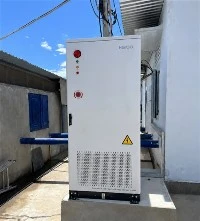
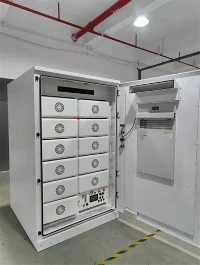
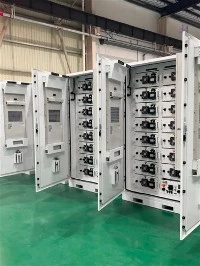
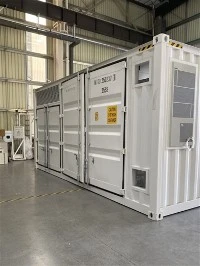
This is an energy‑storage system project for the industrial park of a joint‑stock limited company. The system consists of 14 parallel‑connected 261 kWh lithium‑iron‑phosphate integrated energy‑storage cabinets. Each cabinet integrates a 125 kW PCS (Power Conversion System). The PCS module supports up to 32‑unit parallel operation under grid‑tied mode and 16‑unit parallel operation under off‑grid mode. The project generates arbitrage benefits by taking advantage of peak‑valley tariff gaps to offset high power consumption during production peak hours. Meanwhile, it provides buffered power support for other electrical loads within the industrial park.
The manufacturing park runs continuous multi‑shift production. Large‑scale production equipment brings volatile and heavy power loads. During daytime peak‑price periods, the overall power consumption surges sharply. Without energy‑storage regulation, the enterprise has to purchase large‑volume high‑cost grid power, which creates heavy pressure on operational expenditure. In addition, the park contains diverse loads covering production workshops, office facilities and auxiliary utilities. Load superposition may cause instantaneous power impact on the on‑site distribution network. Although the hardware supports large‑scale parallel connection of multiple PCS units, actual site operation still faces practical challenges brought by multi‑machine parallelism and complex load conditions.
Built on 14 sets of 125 kW PCS integrated cabinets in parallel, the energy‑storage system realizes peak‑valley arbitrage by charging during low‑tariff off‑peak periods and discharging during production peak hours. It delivers buffered power for the whole park, optimizes power consumption structure and relieves the economic pressure brought by high‑cost peak‑time electricity.
Core System Operation Logic
During grid off‑peak hours with low electricity prices, 14 integrated energy‑storage cabinets absorb grid power for charging under unified scheduling. When the industrial park enters high‑load production phases at peak tariff periods, the PCS cluster discharges in parallel to share part of the park's power demand. It reduces power drawn from the utility grid and realizes peak‑valley arbitrage. Thanks to strong parallel expansion capability, the 125 kW PCS supports 32‑unit grid‑tied parallel and 16‑unit off‑grid parallel. For this project under grid‑tied condition, 14 cabinets operate synchronously. When unexpected load surges occur inside the park, the energy‑storage system outputs buffered power rapidly to ease impact on transformers and distribution equipment. If the utility grid fails, the system can switch to off‑grid mode to maintain power supply for key loads within the park.
Key On‑site Technical Pain Points & MECC Targeted Solutions
Pain Point 1: Stable power distribution and suppression of circulating current under large‑scale multi‑PCS parallel operation
Problem description
Fourteen 125 kW PCS integrated cabinets work in parallel in this project. In practical industrial‑park scenarios, inconsistent cable impedance among parallel branches, together with frequent sharp fluctuation of manufacturing loads, may induce circulating current between multiple PCS units. Uncontrolled circulating current will increase module loss, trigger local overheating, and even lead to protective shutdown of individual cabinets. Once partial PCS units exit operation, the total discharge capacity declines, weakening peak‑valley arbitrage income and the buffering capability for park‑wide loads.
MECC Solution
MECC adopts optimized master‑slave synchronous parallel control for large‑scale PCS clusters. The industrial‑grade EMS serves as the upper dispatching core, issuing unified power set‑points to all 14 integrated cabinets. Each 125 kW PCS module is embedded with high‑precision circulating‑current suppression algorithm. Real‑time sampling is performed on output current of every single unit, and closed‑loop adjustment is carried out for output to restrain inter‑module circulating current caused by cable impedance deviation.
Uniform power‑ramp‑rate limitation is applied for the whole cluster during charge‑discharge switching and load jumping. Even when the park's manufacturing load changes drastically, each PCS maintains balanced output. The system avoids abnormal tripping caused by circulating current, ensures that all 14 cabinets participate in charge‑discharge normally, and guarantees the designed total capacity for peak‑valley arbitrage and park‑wide power buffering.
Pain Point 2: Battery performance divergence among numerous parallel cabinets reduces long‑term available capacity
Problem description
Fourteen 261 kWh integrated cabinets operate in parallel for a long time. Influenced by environmental temperature difference, component manufacturing tolerance and cycle ageing, gaps in internal resistance and capacity gradually emerge among different cabinets. Without cabinet‑level independent monitoring and adjustment, SOC deviation keeps accumulating. Some cabinets reach charge or discharge cut‑off thresholds ahead of others. The whole energy‑station cannot make full use of its rated capacity. Consequently, the actual arbitrage benefit decreases year by year, and the buffering effect for park loads cannot reach design expectation.
MECC Solution
Benefiting from the integrated cabinet design with independent 125 kW PCS for each battery cabinet, MECC EMS realizes cabinet‑by‑cabinet monitoring for voltage, temperature and SOC. The system executes cross‑cabinet AC‑side equalization scheduling. During off‑peak charging, cabinets with lower SOC are allocated higher charging power. For cabinets showing slight ageing tendency, corresponding PCS implements moderate adaptive derating.
Each cabinet operates independently on charge and discharge control, avoiding the cask‑barrel effect of traditional DC parallel architecture. SOC deviation among all 14 cabinets is kept within a reasonable range throughout the lifecycle. The energy‑storage station preserves high‑effective usable capacity, stably delivering expected peak‑valley arbitrage returns and reliable buffered power support for the industrial park.
Project Functions & Industry Impact
For the joint‑stock manufacturing enterprise, the parallel cabinet‑type energy‑storage system takes full advantage of peak‑valley tariff differences. It cuts the purchase of high‑priced grid electricity during production peak periods and brings stable arbitrage revenue. The system provides flexible buffered power for multi‑type loads across the whole park, relieves impact stress for transformers and distribution facilities, and improves the stability of on‑site power consumption.
Technically, the project validates the reliability of large‑scale parallel deployment of 125 kW PCS integrated cabinets in high‑energy‑consumption industrial‑park scenarios. It verifies core technologies including multi‑unit parallel circulating‑current suppression and cabinet‑level refined energy management. It delivers replicable engineering experience for large‑capacity behind‑the‑meter energy‑storage projects in similar manufacturing parks.
From the industry perspective, this case offers a proven solution for large manufacturing parks to reduce energy cost through user‑side energy storage. It demonstrates the outstanding parallel expansion capability of string‑type integrated cabinet products, and promotes the large‑scale application of behind‑the‑meter energy‑storage in industrial manufacturing fields.
Liquid Cooling 125KW 261kWh Lithium Battery Energy Storage Cabinet
The IP55 Protected All-in-One Solar Energy Storage Cabinet is a high-performance, integrated energy solution engineered for outdoor commercial, industrial, and utility-scale solar applications. It integrates a 125kW Power Conversion System (PCS), a 261kWh lithium iron phosphate (LiFePO4) battery bank, an advanced liquid cooling system, and a intelligent Battery Management System (BMS) into a single cabinet with IP55 weatherproof protection. Designed to withstand harsh outdoor environments while delivering efficient energy conversion and storage, it supports solar energy absorption, peak shaving, load shifting, grid auxiliary services, and emergency backup power. Ideal for utility-scale solar farms, industrial parks, large commercial complexes, and remote microgrids, it provides a reliable, space-saving, and low-maintenance solution for large-scale renewable energy integration.