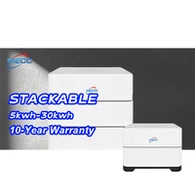
5-30KWH Stacked Lithium Batteries
Capacity & Power Output: With a nominal voltage of 48V (typically 51.2V for LiFePO4 chemistry) and a 200AH capacity, this battery provides 9.6kWh of energy (48V × 200AH)-sufficient to power:
A small home's essential appliances (refrigerator, LED lighting, TV, Wi-Fi router) for 12–24 hours
A 3–5kW solar system's daily surplus energy, ensuring reliable off-grid operation
Commercial equipment (security systems, POS terminals, small machinery) during grid outages.
It supports a continuous discharge current of up to 100A (4.8kW) and peak surges of 200A (9.6kW), making it compatible with 48V inverters, MPPT charge controllers, and grid-tie systems.
Stacked Modular Design: Built with a modular stacked configuration, the battery consists of interconnected lithium modules (usually LiFePO4) that combine to reach 200AH. This design offers:
Scalability: Users can start with this 200AH unit and expand further by adding identical modules in parallel (e.g., two units for 400AH/19.2kWh), adapting to growing energy needs without overhauling the system.
Space Efficiency: Stackable vertically or horizontally, it occupies a compact footprint (~0.3–0.5㎡), fitting easily in utility rooms, basements, or equipment closets.
Serviceability: Individual modules can be inspected, repaired, or replaced independently, reducing maintenance costs compared to monolithic batteries.
Advanced BMS Protection: The integrated 48V Battery Management System (BMS) is a cornerstone of its reliability, providing:
Cell Balancing: Ensures uniform charging and discharging across all cells, preventing overvoltage or undervoltage in individual modules-critical for extending cycle life.
Comprehensive Safeguards: Protects against overcharging, over-discharging, short circuits, overcurrent, and thermal runaway (via built-in temperature sensors and passive cooling).
Smart Monitoring: Tracks key metrics like state of charge (SoC), cycle count, voltage, and temperature via a digital display or mobile app, enabling users to optimize performance and plan maintenance.
Inverter Compatibility: Syncs with 48V inverters to prioritize solar energy usage, minimize grid dependency, and prevent overloads during high-demand periods.