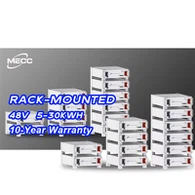
5-30KWH Stacked Lithium Batteries
Capacity & Power Output:
The 200Ah model provides 9.6kWh of energy (48V × 200Ah), sufficient to power essential home appliances (fridge, lights, TV) for 12–24 hours or support a 3–4kW solar system's daily storage needs.
The 100Ah model offers 4.8kWh (48V × 100Ah), suitable for smaller setups like cabins, RVs, or backup for critical devices (medical equipment, security systems).
Both variants support continuous discharge currents of up to 100A (4.8kW) and peak surges of 200A (9.6kW), compatible with 48V inverters, MPPT charge controllers, and grid-tie systems.
Stacked Modular Design: Featuring a modular stacked configuration, these batteries use interconnected lithium modules (typically LiFePO4) to reach their rated capacity. This design offers:
Scalability: Users can combine 100Ah modules to scale up to 200Ah (or beyond) by adding units in parallel, adapting to growing energy needs without replacing the entire system.
Space Efficiency: Stackable vertically or horizontally, they occupy minimal floor space (e.g., a 200Ah unit fits in ~0.3–0.5㎡), ideal for tight utility rooms or basements.
Easy Maintenance: Individual modules can be serviced or replaced independently, reducing repair costs compared to monolithic batteries.
Advanced BMS Protection: The integrated 48V Battery Management System (BMS) ensures safe, efficient operation with:
Cell Balancing: Equalizes charge/discharge across all cells to prevent overvoltage/undervoltage, extending battery life.
Comprehensive Safeguards: Protects against overcharging, over-discharging, short circuits, overcurrent, and thermal issues (via temperature sensors and passive cooling).
Monitoring & Compatibility: Tracks state of charge (SoC), cycle count, and voltage via a digital display or app, while syncing with inverters to prioritize solar input or grid power.
- How can you tell if a lithium - ion battery is damaged?
Signs may include swelling, reduced capacity, or abnormal heating during charging or discharging.
- Can a damaged lithium - ion battery be repaired?
In some cases, minor issues might be fixed, but severe damage usually requires professional assessment.
- What is the role of the electrolyte in a lithium - ion battery?
It enables the transport of lithium ions between the electrodes.
- How does the anode and cathode in a lithium - ion battery function?
The anode stores lithium during charging, and the cathode releases or accepts lithium during the charge - discharge process.
- Are there any environmental concerns related to lithium - ion batteries?
Yes, improper disposal can cause environmental pollution, especially if the heavy metals and chemicals in them are not properly handled.
- What are the common applications of lithium - ion batteries?
They are widely used in mobile phones, laptops, and electric vehicles.