


The function of energy storage inverters is not only beneficial for improving the efficiency and operational stability of energy storage systems, but also serves as an information platform for various information transmission, processing, and real-time human-machine interaction in the entire energy storage system, making it a crucial equipment.

Inverter is the heart of energy storage. The primary function of an energy storage inverter is to convert DC into AC power needed for daily life, and the core components that achieve this function are power semiconductors (such as IGBT and MOSFET).

These power semiconductors can switch thousands or even tens of thousands of times per second, and then control the circuit changes through signals to convert direct current into sinusoidal alternating current.
Through statistical analysis of well-known inverter companies such as Sunac Power, Gudewei, and Jinlang Technology, structural components account for 23% of the cost, IGBT and MOS account for 20% of the cost, magnetic components account for 17% of the cost, and chip integrated circuits account for 10% of the cost. Among them, IGBT, chip integrated circuits, capacitors, sensors, PCB boards and other products in inverters belong to the field of power electronics.
It can be seen that power electronic devices account for 46% of the cost of inverters and are the main component.
Therefore, it is worth noting that the semiconductor devices used in energy storage inverters include IGBT, MOS transistor, MCU, power management chip, capacitor, PCB board, etc. Among them, IGBT, MOS transistor, and power management IC have a high proportion and large quantity in energy storage inverters, and are essential devices.

It can be predicted that with the improvement of energy storage prosperity, the demand for semiconductor devices in inverters will be driven, which is a great opportunity for semiconductor device companies to layout the energy storage market in the future.
1. IGBT
The main functions of IGBT in the field of energy storage are voltage transformation, frequency conversion, alternating current conversion, etc. It is an indispensable device in energy storage applications.

IGBT is a composite fully controlled voltage driven power semiconductor device composed of BJT (Bipolar Transistor) and MOS (Insulated Gate Field Effect Transistor), which combines the advantages of MOSFET's high input impedance and GTR's low conduction voltage drop. IGBT is the core component for energy conversion and transmission, commonly known as the "CPU" of power electronic devices.

IGBT competitive landscape
Due to the high design and process requirements of IGBT, as well as the lack of IGBT related technical talents, weak process foundation, and late start of enterprise industrialization in China, the IGBT market has long been monopolized by large foreign multinational enterprises.
Since 2015, China's IGBT self-sufficiency rate has exceeded 10% and is gradually increasing. It is expected that China's IGBT self-sufficiency rate will reach 40% by 2024. Based on the requirement of domestication of core components proposed in relevant national policies, domestic substitution has become the development trend of the domestic IGBT industry.
At present, the domestic IGBT market is mainly dominated by overseas manufacturers such as Infineon, Mitsubishi Electric, and Fuji Electric. The top three companies in the Chinese IGBT market share are Infineon, Mitsubishi Electric, and Fuji Electric. Among them, Infineon has the highest proportion at 15.9%.

2. MOS transistor
MOSFET is a type of FET with an insulated gate, where the voltage determines the conductivity of the device. The invention of MOSFETs was to overcome the drawbacks of FETs, such as high drain resistance, moderate input impedance, and slow operation. So MOSFETs can be called the advanced form of FET.

MOSFETs are commonly used for switching or amplifying signals. The ability to change conductivity with applied voltage can be used to amplify or switch electronic signals.

MOSFETs are the most common transistors in digital circuits to date, as memory chips or microprocessors may contain hundreds or millions of transistors.

Due to their ability to be made of p-type or n-type semiconductors, complementary MOS transistors can be used to manufacture switch circuits with very low power consumption in the form of CMOS logic.
In digital and analog circuits, MOSFETs are now even more common than BJTs.

3. Power management chip
A power management chip is a chip in electronic device systems that is responsible for the conversion, distribution, detection, and other management of electrical energy. Mainly responsible for identifying the amplitude of CPU power supply, generating corresponding short torque waves, and driving the power output of the subsequent circuit.

Some of the main power management chips are dual in-line chips, while others are surface mount packages. Among them, the HIP630x series chip is a classic power management chip designed by the well-known chip design company Intersil.

It supports two/three/four phase power supply, supports VRM9.0 specification, voltage output range is 1.1V-1.85V, can adjust output for intervals of 0.025V, switch frequency up to 80KHz, and has the characteristics of large power supply, small ripple, and low internal resistance. It can precisely adjust the CPU power supply voltage.
Common power management chips include HIP6301, IS6537, RT9237, ADP3168, KA7500, TL494, etc.

All electronic devices have power supply, but different systems have different requirements for power supply. In order to maximize the performance of electronic systems, it is necessary to choose the most suitable power management method.
The scope of power management is quite broad, including both individual energy conversion (mainly DC to DC, i.e. DC/DC), individual energy distribution and detection, as well as systems that combine energy conversion and energy management.
Correspondingly, the classification of power management chips also includes these aspects, such as linear power chips, voltage reference chips, switch power chips, LCD driver chips, LED driver chips, voltage detection chips, battery charging management chips, etc.

4. PCB board
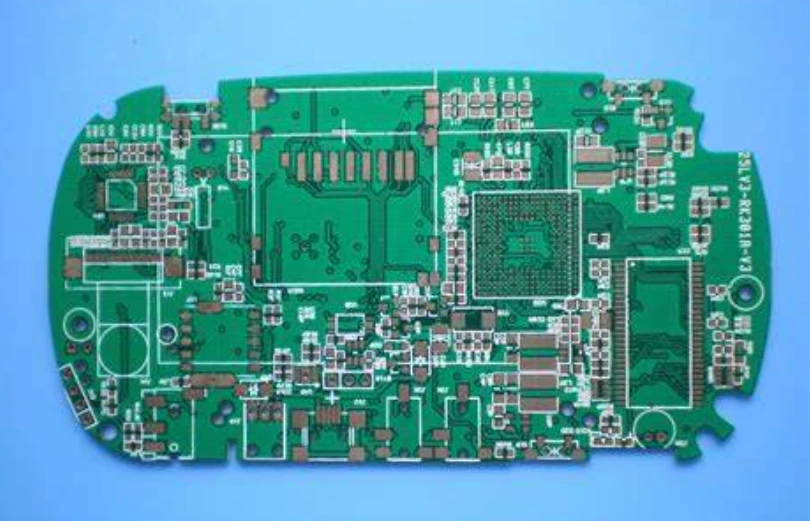
Printed circuit board, abbreviated as PCB, also known as printed circuit board, printed circuit board, printed circuit board.
The conductive pattern formed by printing circuits, printed components, or a combination of both on an insulating substrate according to a predetermined design is usually called a printed circuit, while the conductive pattern that provides electrical connections between components on an insulating substrate is called a printed circuit.
Segmented product structure
At present, the subdivision products of printed circuit boards in China mainly include six types: multilayer boards, flexible boards, HDI (high-density interconnect boards), double-sided boards, single panels, and packaging substrates.

Data shows that multi-layer boards account for the largest proportion of segmented printed circuit board products in China, reaching 45.97%, far exceeding other products; Next is the soft board, accounting for 16.68%; The proportion of HDI is 16.59%. In addition, the proportions of double-sided panels, single panels, and packaging substrates are 11.34%, 6.13%, and 3.29%, respectively.
5.MCU
MCU chip refers to a microcontroller unit (MCU), also known as a single-chip microcomputer or microcontroller. It reduces the frequency and specifications of the central processing unit appropriately, and integrates peripheral interfaces such as memory, counter, USB, A/D conversion, UART, PLC, DMA, and even LCD driver circuit on a single chip to form a chip level computer, which can perform different combinations of control for different application scenarios. Therefore, MCU chip is a microcontroller chip.

In terms of MCU suppliers, many inverter manufacturers will use TI's C2000 series MCUs. Now, with the rise of micro inverters, some manufacturers are also starting to use Arm core 32-bit MCUs for main control.
Therefore, the main suppliers of MCU include foreign manufacturers such as TI, NXP, ST, Microchip, Infineon, Renesas, as well as domestic manufacturers such as Zhaoyi Innovation.

6. Sensors
In energy storage inverters, it is necessary to detect the current and select appropriate current sensors. We can divide current detection into several ranges.
1) Detect DC or AC currents ranging from 5A to 70A.
Chip based Hall current sensors, such as CH701 current sensor IC, are generally used to detect DC or AC currents ranging from 5A to 50A. They are an economical and accurate solution for AC or DC current sensing in industrial, automotive, commercial, and communication systems. Small packaging is an ideal choice for space constrained applications, while also saving costs by reducing circuit board area. Typical applications include motor control, load detection and management, switching power supplies, and overcurrent fault protection.
2) Detect DC or AC currents ranging from 50A to 200A.
Direct insertion type current sensors can be selected

CH704 is an isolated integrated current sensing chip developed specifically for high current detection applications. CH704 has a built-in primary conductor resistor of 0.1 m Ω, effectively reducing chip heating and supporting high current detection: ± 50A, ± 100A, ± 150A, ± 200A. It integrates a unique temperature compensation circuit internally to achieve good consistency of the chip in the full temperature range of -40 to 150 degrees. The chip has been calibrated for sensitivity and static (zero current) output voltage before leaving the factory, providing a typical accuracy of ± 2% over the entire temperature range.
3) Detect DC or AC currents above 200A to 1000A.
Linear Hall and magnetic ring can be used, and programmable Hall sensors can be used to achieve current detection up to 1500A.

For example, CHI612 programmable linear Hall chip supports 5V single power supply. 120 kHz bandwidth,<3us response time, programmable 0.8-24 mV/G, 2% accuracy can be achieved within the full temperature range of -40 to 150 degrees. The chip completes the calibration of static (zero current) output voltage before leaving the factory.