



Battery Management System (BMS) is a technology specifically designed to supervise battery packs, which are components of battery cells that are electrically organized in a row column matrix configuration to provide a target range of voltage and current for expected load conditions over a period of time.
The supervision provided by BMS usually includes:
- Monitoring battery
- Provide battery protection
- Estimate the working status of the battery
- Continuously optimizing battery performance
- Report operational status to external devices
Here, the term 'battery' means the entire battery pack; However, monitoring and control functions are specifically applied to individual batteries or battery packs referred to as modules within the entire battery pack assembly. Lithium ion rechargeable batteries have the highest energy density and are the standard choice for many consumer battery packs, from laptops to electric vehicles. Although they perform well, they can be quite ruthless if operated outside of the typically tight secure operating area (SOA), with results ranging from damaging battery performance to completely dangerous consequences. The job description of BMS is undoubtedly challenging, as its overall complexity and scope of supervision may involve multiple disciplines such as electrical, digital, control, thermal, and hydraulic.
How does the battery management system work?
There is no fixed or unique standard that must be adopted for battery management systems. The scope of technical design and the characteristics of implementation are usually related to the following:
- The cost, complexity, and size of battery packs
- The application of batteries and any safety, lifespan, and warranty issues
- The certification requirements of various government regulations, if functional safety measures are not in place, cost and penalties are crucial
BMS has many design functions, and battery pack protection management and capacity management are two basic functions. We will discuss here how these two functions work. There are two key areas of battery pack protection management: electrical protection, which means that batteries are not allowed to be damaged when used outside of SOA; Thermal protection, which involves passive and/or active temperature control to maintain or bring the battery pack into SOA.
MECC Commercial And Industrial BESS Products
We offer different kinds of battery energy storage system solutions for customer's requirements on commercial/industrial/farming


Electrical management protection: current
Monitoring the current of the battery pack and the voltage of the battery or module is a way to achieve electrical protection. The electrical SOA of any battery cell is constrained by current and voltage. Figure 1 shows a typical lithium-ion battery SOA, where a well-designed BMS will protect the battery pack by preventing it from operating outside the manufacturer's battery rating. In many cases, further derating can be applied within the SOA safety zone to extend battery life.

Lithium ion batteries have different charging current limits and discharging current limits, and both modes can handle higher peak currents, even though the time is short. Battery manufacturers typically specify maximum continuous charging and discharging current limits, as well as peak charging and discharging voltage limits. BMS that provides current protection will definitely apply maximum continuous current. However, sudden changes in load conditions may be taken into account before this; For example, sudden acceleration of electric vehicles. BMS can combine peak current monitoring by integrating the current and deciding to reduce the available current or completely interrupt the group current after Δ time. This allows BMS to have almost instantaneous sensitivity to extreme current peaks, such as short circuit situations that do not attract any resident fuse attention, but can also tolerate high peak demands as long as they are not excessive for too long.
Electrical management protection: voltage
Figure 2 shows that lithium-ion batteries must operate within a certain voltage range. These SOA boundaries will ultimately be determined by the inherent chemical properties of the selected lithium-ion battery and the temperature of the battery at any given time. In addition, due to the large amount of current cycling, discharge due to load demand, and charging from various energy sources that any battery pack undergoes, these SOA voltage limitations are often further restricted to optimize battery life. BMS must know what these limitations are and make decisions based on the proximity of these thresholds. For example, when approaching the high voltage limit, BMS can request a gradual decrease in charging current, or if the limit is reached, it can request a complete termination of charging current. However, this limitation is often accompanied by additional inherent voltage hysteresis considerations to prevent control oscillations regarding the turn off threshold. On the other hand, when approaching the low voltage limit, the BMS will request critical active non compliant loads to reduce their current demand. In the case of electric vehicles, this can be achieved by reducing the allowable torque available to the traction motor. Of course, BMS must prioritize driver safety and protect the battery pack from permanent damage.
Thermal management protection: Temperature
On the surface, lithium-ion batteries have a wide operating temperature range, but due to significantly slower chemical reaction rates, the overall capacity of the battery decreases at low temperatures. In terms of ability at low temperatures, their performance is indeed much better than lead-acid or NiMh batteries; However, temperature management is crucial as charging below 0 ° C (32 ° F) is physically problematic. During sub freezing charging, the electroplating phenomenon of metallic lithium may occur on the anode. This is a permanent damage that not only leads to a decrease in capacity, but also increases the likelihood of battery failure if subjected to vibration or other stress conditions. BMS can control the temperature of the battery pack through heating and cooling.

The implementation of thermal management depends entirely on the size and cost of the battery pack, performance goals, BMS design standards, and product units, which may include considerations for the target geographic area. Regardless of the type of heater, it is usually more efficient to extract energy from an external AC power source or from alternative resident batteries used to operate the heater when needed. However, if the electric heater has moderate current consumption, the energy from the main battery pack can be siphoned to heat itself. If a hot hydraulic system is used, an electric heater is used to heat the coolant pumped and distributed throughout the entire component.
Undoubtedly, BMS design engineers have some skills in the design industry to drip thermal energy into battery packs. For example, various power electronic devices dedicated to capacity management within BMS can be turned on. Although not as efficient as direct heating, it can still be utilized no matter what. Cooling is particularly important for minimizing the performance loss of lithium-ion battery packs. For example, perhaps a given battery operates best at 20 ° C; If the packaging temperature is increased to 30 ° C, its performance efficiency may decrease by 20%. If the battery pack is continuously charged and recharged at a temperature of 45 ° C (113 ° F), the performance loss may be as high as 50%. If continuously exposed to overheated environments, especially during rapid charging and discharging cycles, battery life may also age and degrade prematurely. Cooling is usually achieved through two methods, passive or active, and both techniques can be used. Passive cooling relies on the movement of airflow to cool the battery. As for electric vehicles, this means they are only driving on the road. However, it may be more complex than it looks, as the air velocity sensor can be integrated together to strategically automatically adjust the deflection air dam to maximize air flow. The implementation of active temperature controlled fans may be helpful at low speeds or when the vehicle is stopped, but all of this is just to keep the battery pack at the same temperature as the surrounding environment. If the weather is hot, this may increase the initial temperature of the packaging. Hot hydraulic active cooling can be designed as a supplementary system, typically using ethylene glycol coolant with a specified mixing ratio, circulating through pipes/hoses, distribution manifolds, cross flow heat exchangers (radiators), and cooling plates against battery pack components using an electric pump. BMS monitors the temperature of the entire battery pack and opens and closes various valves to maintain the temperature of the entire battery within a narrow temperature range to ensure optimal battery performance.
Capacity management
Maximizing the capacity of the battery pack can be considered one of the most important battery performance characteristics provided by BMS. If this maintenance is not carried out, the battery pack may eventually become useless. The root of the problem lies in the fact that the "stacking" of battery packs (battery series arrays) is not completely equal and essentially has slightly different leakage or self discharge rates. Leakage is not a defect of the manufacturer, but rather the chemical properties of the battery, although it may be statistically affected by minor manufacturing process changes. Initially, battery packs may have well matched batteries, but over time, the similarity between batteries further decreases, not only due to self discharge but also influenced by charge/discharge cycles, temperature rise, and general calendar aging. With this in mind, recalling the previous discussion, lithium-ion batteries perform well, but may be quite ruthless if operated outside of strict SOA. We have previously learned about the required electrical protection, as lithium-ion batteries cannot handle overcharging well. Once fully charged, they cannot accept more current, any additional energy will be converted into heat, and the voltage may rapidly rise, potentially reaching dangerous levels. This is not a healthy condition for cells, and if it persists, it may cause permanent damage and unsafe operating conditions.
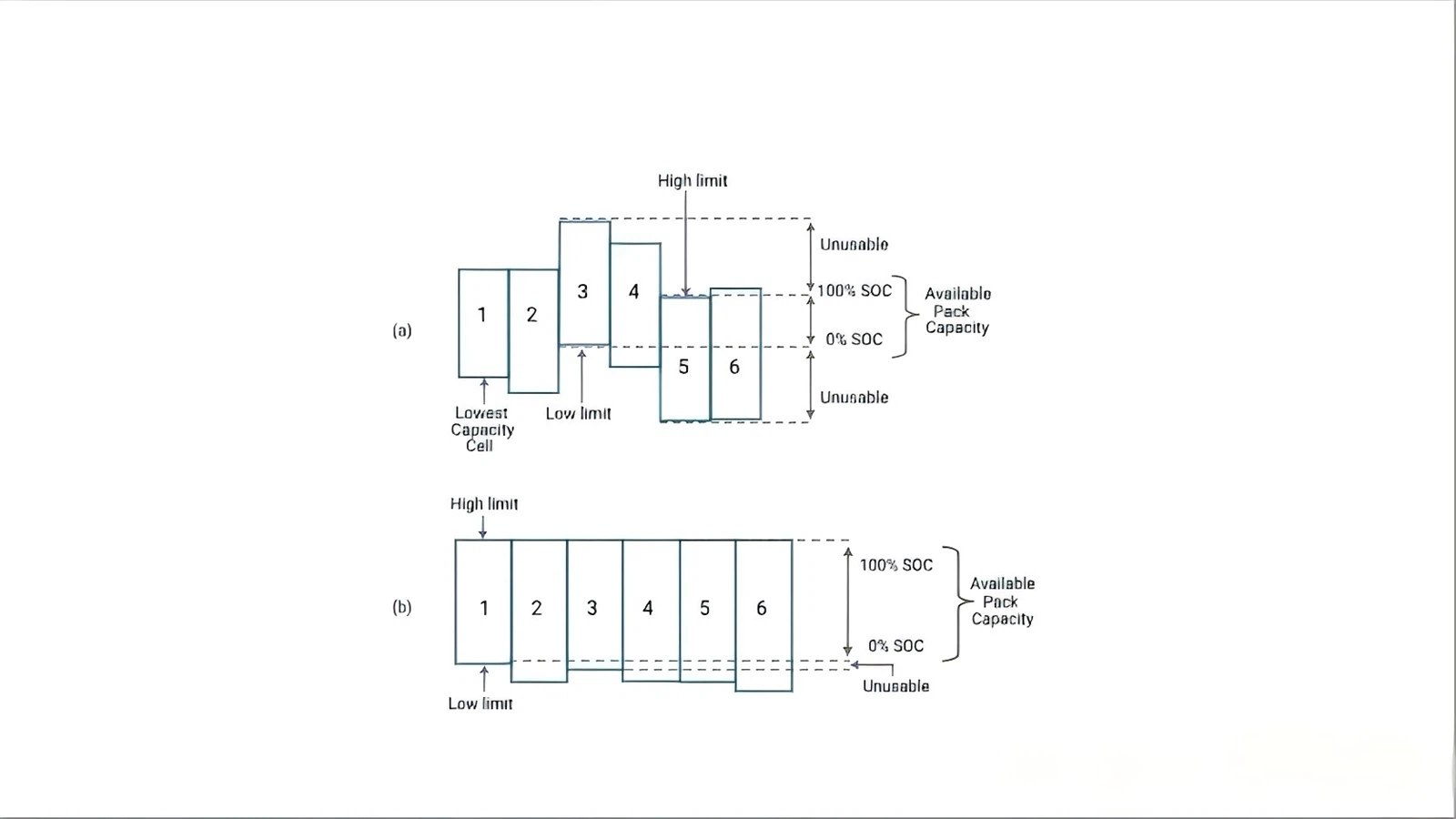
The series connection of battery arrays determines the voltage of the entire battery pack, and the mismatch between adjacent batteries can cause difficulties when attempting to charge any battery pack. Figure 3 shows why this is happening. If a person has a completely balanced set of batteries, then everything is fine because each battery will charge in an equal way, and the charging current can be cut off when the 4.0 voltage upper threshold is reached. However, in an unbalanced situation, the top battery will reach its charging limit ahead of schedule, and the charging current of the branch needs to be terminated before other bottom batteries are charged to full capacity.

To demonstrate its working principle, a key definition needs to be explained. The state of charge (SOC) of a battery or module at a given time is directly proportional to the available power relative to the total power when fully charged. Therefore, a battery at 50% SOC means it has been charged 50%, similar to the quality factor of a power meter. BMS capacity management is to balance the SOC changes of each stack in the battery pack. Since SOC is not a directly measurable quantity, it can be estimated through various techniques, and the balancing scheme itself is usually divided into two categories: passive and active. There are many variations of themes, each with its own advantages and disadvantages. The BMS design engineer decides which one is most suitable for the given battery pack and its application. Passive balance is the easiest to achieve and can also explain the general concept of balance. Passive methods allow each battery in the battery pack to have the same charging capacity as the weakest battery. It uses relatively low current to transfer a small amount of energy from high SOC batteries during the charging cycle, so that all batteries can be charged to their maximum SOC. Figure 4 illustrates how BMS achieves this. It monitors each battery and utilizes transistor switches and appropriately sized discharge resistors in parallel with each battery. When the BMS detects that a given battery is approaching its charging limit, it will guide the excess current around it in a top-down manner to the next battery below.

The endpoints of the balancing process before and after are shown in Figure 5. In summary, BMS allows the batteries or modules in the battery pack to see charging currents that are different from the battery pack current to balance the battery pack through one of the following methods:
Removing charge from the most charged battery provides headroom for additional charging current to prevent overcharging and allows less charged batteries to receive more charging current
Repositioning some or almost all of the charging current around the most charged battery, allowing less charged batteries to receive charging current for a longer period of time
Types of battery management systems
The battery management system can adopt various technologies from simple to complex to achieve its main instructions of "taking care of the battery". However, these systems can be classified based on their topology, which is related to their installation and operation on the batteries or modules of the entire battery pack.
Centralized BMS architecture
There is a central BMS in the battery pack assembly. All battery packs are directly connected to the central BMS. The structure of centralized BMS is shown in Figure 6. Centralized BMS has some advantages. It is more compact and often the most economical because there is only one BMS. However, centralized BMS also has drawbacks. Due to all batteries being directly connected to the BMS, the BMS requires many ports to connect all battery packs. This means that there are a large number of wires, cables, connectors, etc. in large battery packs, which makes troubleshooting and maintenance complex.
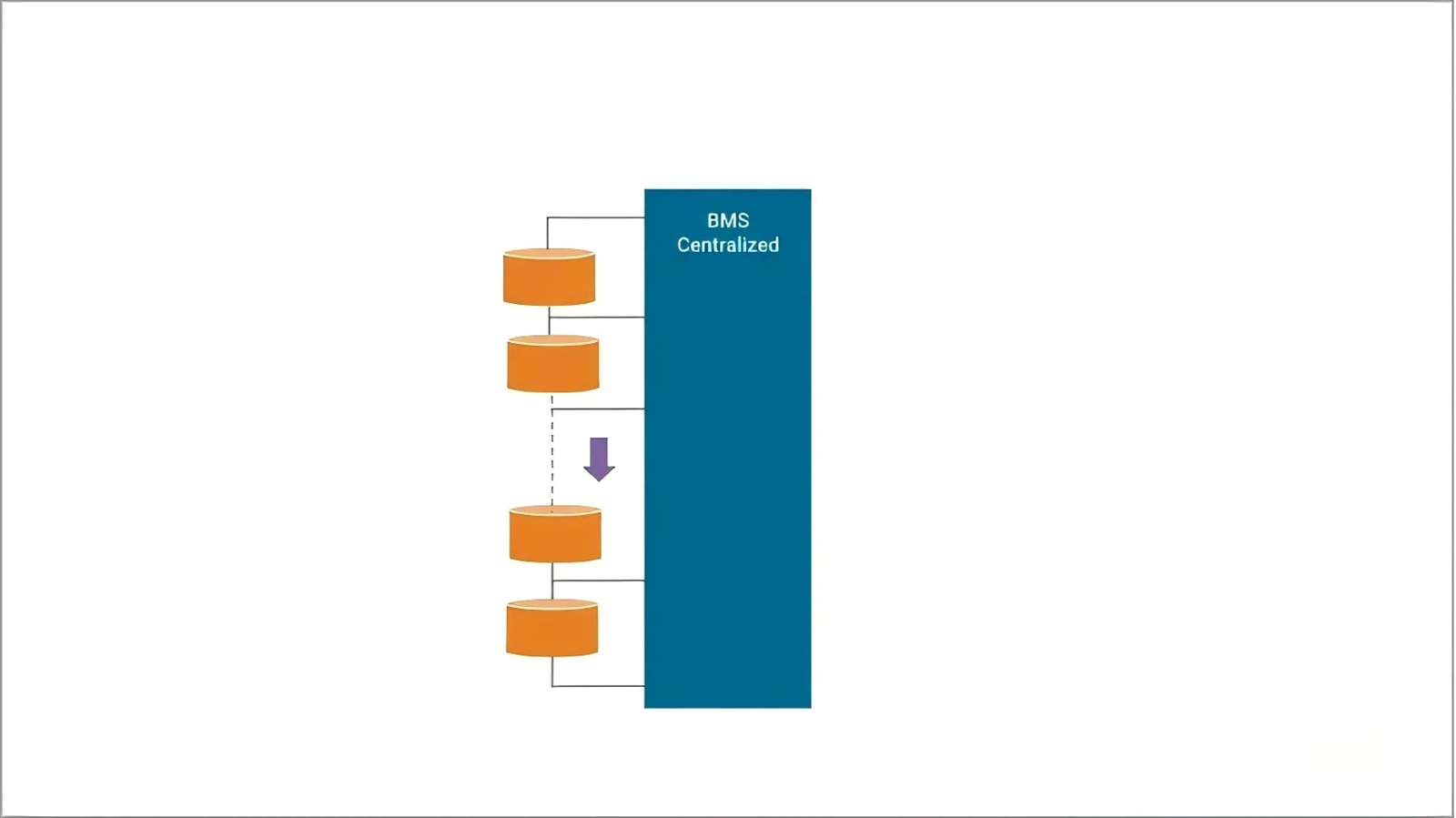
Modular BMS topology
Similar to centralized implementation, BMS is divided into several repetitive modules, each with a dedicated bundle of wires and connected to adjacent designated parts of the battery pack. See Figure 7. In some cases, these BMS submodules may be under the supervision of the main BMS module, whose function is to monitor the status of the submodules and communicate with peripheral devices. Due to repeated modularization, troubleshooting and maintenance are easier, and it is also easy to expand to larger battery packs. The disadvantage is that the overall cost is slightly higher, and there may be duplicate unused features depending on the application.

Primary/Secondary BMS
However, conceptually similar to modular topology, in this case, the slave devices are more limited to only relaying measurement information, while the master devices are dedicated to computation and control as well as external communication. Therefore, although similar to modular types, the cost may be lower because the functionality of the device is often simpler, the overhead may be lower, and there may be fewer unused features.

Distributed BMS architecture
Unlike other topologies, in other topologies, electronic hardware and software are encapsulated in modules, which are connected to the battery through wiring harnesses. Distributed BMS integrates all electronic hardware onto a control board directly placed on the monitored battery or module. This reduces the extensive wiring of a few sensor wires and communication wires between adjacent BMS modules. Therefore, each BMS is more independent and handles computation and communication as needed. However, despite this obvious simplicity, this integrated form does make troubleshooting and maintenance a potential issue as it is located deep within the shielded module components. The cost is often higher because there are more BMS in the entire battery pack structure.

The Importance of Battery Management System
In BMS, functional safety is the most important. It is crucial to prevent the voltage, current, and temperature of any battery or module under supervision and control from exceeding the specified SOA limits during charging and discharging operations. If the limit is exceeded for a period of time, not only will potentially expensive battery packs be affected, but there may also be dangerous thermal runaway situations. In addition, in order to protect lithium-ion batteries and ensure functional safety, strict monitoring of lower voltage threshold limits is also required. If lithium-ion batteries are kept in this low voltage state, copper dendrites may eventually grow on the anode, which could lead to an increase in self discharge rate and potential safety issues. The cost of high energy density in lithium-ion power systems is that there is almost no room for battery management errors. Thanks to improvements in BMS and lithium-ion batteries, this is one of the most successful and safe battery chemicals available today.
The performance of the battery pack is the second most important function of BMS, which involves electrical and thermal management. In order to optimize the overall battery capacity electrically, all batteries in the battery pack need to be balanced, which means that the SOC of adjacent batteries in the entire component is roughly equal. This is very important because it not only achieves optimal battery capacity, but also helps prevent widespread degradation and reduce potential hotspots for overcharging weak batteries. Lithium ion batteries should avoid discharging below the low voltage limit, as this may lead to memory effects and significant capacity loss. Electrochemical processes are highly sensitive to temperature, and batteries are no exception. When the ambient temperature drops, the capacity and available battery energy will significantly decrease. Therefore, BMS can connect external online heaters located on liquid cooling systems such as electric vehicle battery packs, or turn on resident heating plates installed under modules of battery packs in helicopters or other aircraft. In addition, since charging low-temperature lithium-ion batteries is not conducive to the battery's lifespan performance, it is important to first fully increase the battery temperature. Most lithium-ion batteries cannot be charged quickly below 5 ° C and should not be charged at all below 0 ° C. In order to achieve optimal performance during typical operational use, BMS thermal management typically ensures that the battery operates within a narrow Goldilocks operating area (e.g. 30-35 ° C). This can protect performance, extend lifespan, and cultivate healthy and reliable battery packs.
The benefits of battery management system
A complete battery energy storage system, commonly known as BESS, can be strategically assembled from dozens, hundreds, or even thousands of lithium-ion batteries, depending on the application. The rated voltage of these systems may be less than 100V, but may reach up to 800V, with a battery pack power supply current range of up to 300A or greater. Any poor management of high-voltage battery packs can lead to catastrophic disasters that endanger lives. Therefore, BMS is crucial for ensuring safe operation. The benefits of BMS can be summarized as follows.
Functional safety. It goes without saying that for large-sized lithium-ion battery packs, this is particularly cautious and necessary. But as is well known, even smaller formats used in laptops can catch fire and cause significant damage. The personal safety of users of products containing lithium-ion power systems leaves little room for battery management errors.
Lifespan and reliability. Battery pack protection management, electrical and thermal, ensuring that all batteries are used within the declared SOA requirements. This subtle supervision ensures the safe use and fast charging and discharging cycles of the battery, and inevitably generates a stable system that may provide years of reliable service.
Performance and scope. BMS battery pack capacity management, which uses inter battery balancing to balance the SOC of adjacent batteries on the battery pack components, allowing for optimal battery capacity. Without this BMS function to consider changes in self discharge, charge/discharge cycles, temperature effects, and general aging, the battery pack may ultimately become useless.
Diagnosis, data collection, and external communication. The supervision task includes continuous monitoring of all battery cells, where data recording itself can be used for diagnosis, but is typically used for computational tasks to predict the SOC of all batteries in the component. This information is used for balancing algorithms, but can be shared with external devices and displays to indicate available resident energy, estimate expected range or range/lifespan based on current usage, and provide the health status of the battery pack.
Reduce costs and warranty. The introduction of BMS in BESS increases costs, and the battery pack is expensive and potentially dangerous. The more complex the system, the higher the security requirements, therefore requiring more BMS supervision. However, BMS's protection and preventive maintenance in terms of functional safety, lifespan and reliability, performance and scope, diagnosis, etc. ensure that it will reduce overall costs, including warranty related costs.
Conclusion
Simulation is a valuable ally in BMS design, especially when applied to explore and solve design challenges in hardware development, prototyping, and testing. With an accurate lithium-ion battery model, the simulation model of BMS architecture is recognized as an executable specification for virtual prototypes. In addition, simulation allows for painless investigation of variants of BMS monitoring functions for different battery and environmental operating scenarios. Implementation issues can be identified and investigated early on, allowing for validation of performance and functional safety improvements before implementation on actual hardware prototypes. This reduces development time and helps ensure that the first hardware prototype is robust. In addition, when conducted in embedded system applications, many authentication tests can be performed on BMS and battery packs, including worst-case scenarios.