


In the vast and boundless desert, neatly arranged photovoltaic panels shine brightly in the sunlight, like a blue ocean. These seemingly simple photovoltaic power plants are actually the crystallization of human intelligence and technology, changing the energy supply pattern in a unique way and lighting up the lights of thousands of households.
On the vast Gobi Desert, large photovoltaic power stations have sprung up one after another. Taking the million kilowatt photovoltaic power station in Dunhuang, Gansu Province as an example, it covers an area equivalent to the size of 1500 standard football fields, with nearly a million photovoltaic panels laid out in an orderly manner in the desert. During the day, countless photovoltaic panels are like diligent "sunshine catchers", greedily absorbing every ray of sunlight and converting it into electrical energy. Each photovoltaic panel is like a tiny energy factory, converting the energy of photons into the directional movement of electrons through the photoelectric effect of semiconductor materials, thereby generating current. Under ideal lighting conditions, a single 550 watt photovoltaic panel can generate over half an kilowatt hour of electricity. These currents converge and are converted by inverters from direct current to alternating current that meets the requirements of the power grid. They then pass through hundreds of kilometers of ± 800 kilovolt high-voltage transmission lines, crossing mountains and rivers, and finally reaching eastern coastal cities, providing electricity for millions of households in Shanghai, Zhejiang, and other places for daily life and production.
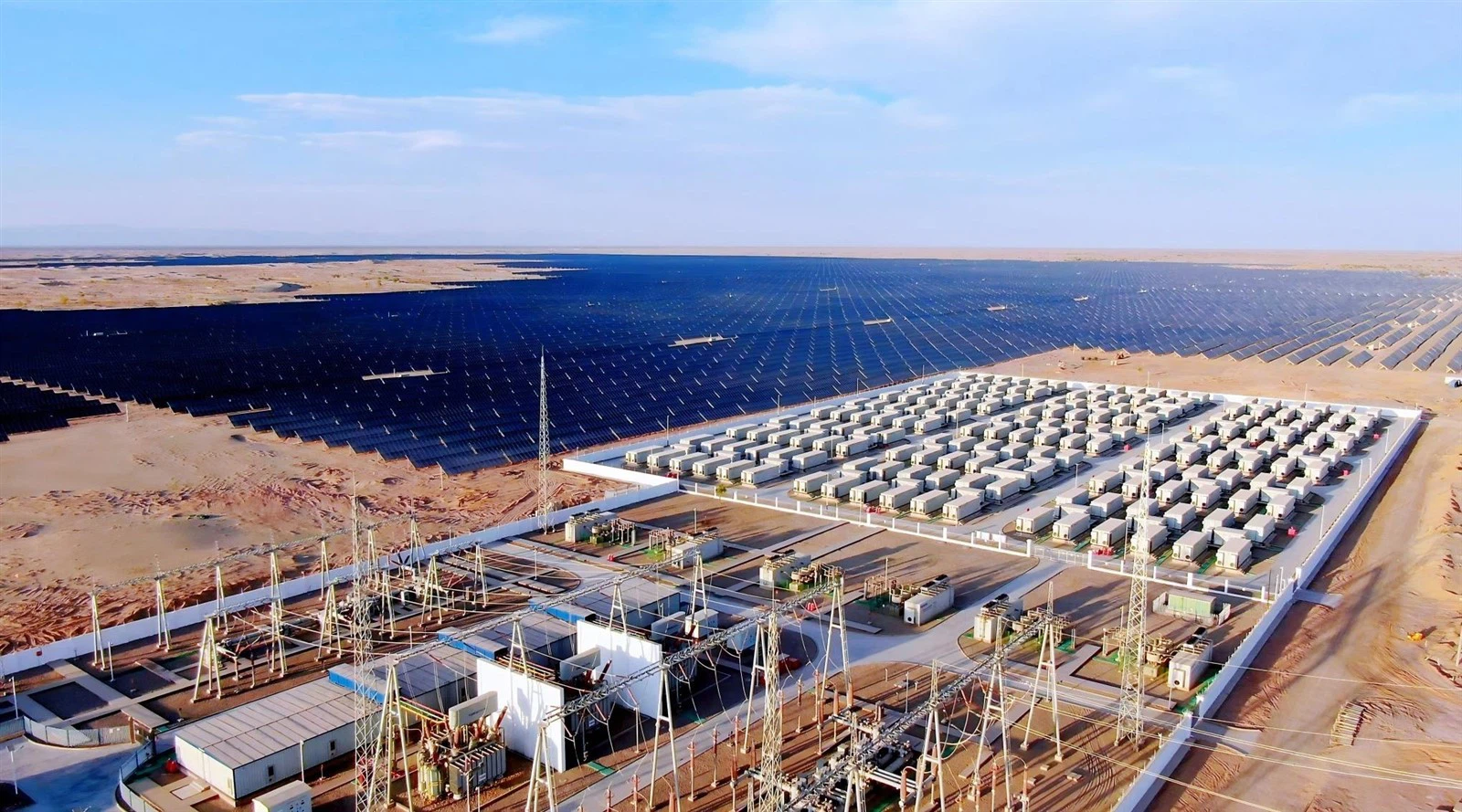
The construction of photovoltaic power plants is not an easy task. From the beginning of site selection, it is necessary to comprehensively consider various factors such as lighting resources, land conditions, and grid access. A professional site selection team will use NASA satellite data to analyze the radiation levels over the past decade and select areas with annual sunshine hours exceeding 3000 hours. Land conditions are equally crucial, not only requiring flat and open terrain, but also avoiding sensitive areas such as ecological protection zones and water sources. Taking Talatan in Qinghai Province as an example, it has a high altitude, sufficient sunlight, and vast unused desert land, making it an excellent choice for building photovoltaic power stations. After determining the site selection, a large amount of machinery and manpower are required for the preliminary site leveling work. Bulldozers, rollers and other equipment roar day and night, leveling and compacting the undulating sand dunes, laying the foundation for subsequent construction. Subsequently, the bracket installation is carried out. Nowadays, fixed adjustable brackets are commonly used, and workers need to adjust the angle precisely to the millimeter level to ensure that the photovoltaic panel can obtain the best light in different seasons. The laying process of photovoltaic panels is even more precise, with each panel firmly connected to a bracket through bolts, while ensuring that the gap error between panels does not exceed 2 millimeters to avoid affecting the overall power generation efficiency. During the construction process, workers have to overcome harsh natural environments. In summer, temperatures can reach over 40 ℃, and surface temperatures can even exceed 70 ℃. The sand under their feet is so hot that it is difficult to stand; In winter, the cold wind is chilling, with strong winds carrying sand and dust, and visibility is less than 5 meters. However, it is their hard work that allows these "blue oceans" to shine in the desert.
Operation and maintenance are equally crucial. In order to ensure the efficient operation of photovoltaic power plants, staff need to regularly clean the photovoltaic panels, as dust and dirt can affect the absorption of sunlight by the panels and reduce power generation efficiency. At the photovoltaic power station in Hami, Xinjiang, after the spring sandstorm season every year, the operation and maintenance team carries out large-scale cleaning operations. In traditional manual cleaning, workers need to carry cleaning equipment weighing tens of pounds, step on specialized anti slip shoes, and carefully move between photovoltaic panels, wiping them one by one. Each person can only clean a maximum of 300-500 photovoltaic panels per day. Nowadays, intelligent cleaning robots are gradually becoming popular. They can automatically walk along the photovoltaic panels and complete the cleaning work of more than 1000 photovoltaic panels per hour by rotating brushes and high-pressure water spray devices, improving efficiency several times. In addition to cleaning, equipment monitoring has also been upgraded from manual inspections in the past to intelligent monitoring systems. In the central control room of the power station, a huge electronic screen displays real-time data such as voltage, current, temperature, etc. of each photovoltaic panel. Once a parameter is abnormal, the system will immediately issue an alarm. By using drones for inspection, large areas of photovoltaic cells can be quickly scanned. Equipped with high-definition cameras and infrared thermal imagers, it can accurately identify photovoltaic panels with abnormal temperatures and poorly connected circuits, and promptly detect potential problems; By utilizing big data analysis, combined with historical power generation data, meteorological data, etc., equipment failures can be predicted and maintenance can be carried out in advance, greatly reducing operation and maintenance costs and improving power generation efficiency. According to statistics, after adopting intelligent operation and maintenance technology, the average fault repair time of photovoltaic power plants has been shortened by 70%, and the power generation efficiency has been improved by 8% -10%.

These photovoltaic power stations rising in the desert not only provide us with clean electricity, but also change the local ecological environment to a certain extent. The installation of photovoltaic panels reduces ground water evaporation and creates conditions for vegetation growth. In the photovoltaic power station in the Kubuqi Desert of Inner Mongolia, people have attempted to plant drought resistant plants such as Salix and Haloxylon ammodendron, and raise livestock such as sheep and camels under the grid, gradually forming a three-dimensional ecological model of "grid power generation, inter grid planting, and grid farming". On the board, photovoltaic power stations can generate hundreds of millions of kilowatt hours of electricity annually, reducing carbon dioxide emissions by hundreds of thousands of tons; The vegetation planted between the boards effectively solidifies sand, and the vegetation coverage rate has increased from less than 5% in the past to over 20%; Under the board, the raised livestock bring additional income to local herdsmen, achieving a win-win situation of economic and ecological benefits.
In the future, with breakthroughs in new photovoltaic technologies such as perovskite cells, the photoelectric conversion efficiency of photovoltaic panels is expected to increase from around 23% to over 35%, and the power generation capacity of photovoltaic power plants will be significantly enhanced. At the same time, the development of energy storage technology will also solve the intermittent problem of photovoltaic power generation, allowing these "blue oceans" in the desert to provide clean energy for humanity more stably and sustainably, play a greater role in the energy field, and become an important force in promoting green development.