


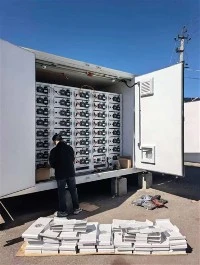
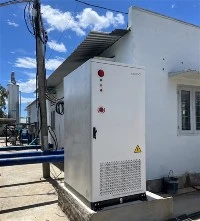
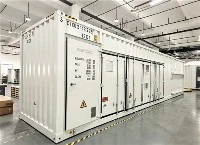
In recent years, more and more industrial and commercial users have chosen to install photovoltaic systems. However, in actual operation, many companies have found that pure photovoltaic power generation is difficult to fully absorb, and the returns are not ideal in the context of significant fluctuations in electricity prices.
At this point, industrial and commercial energy storage has become the best partner for photovoltaic systems, helping companies transform "sunshine" into higher economic value. So, how to optimize the combination of industrial and commercial energy storage with photovoltaic systems to truly maximize profits?

1 Why should photovoltaics be paired with industrial and commercial energy storage?
First of all, we need to clarify that the revenue model of a single photovoltaic system is very simple, that is, during the day, the power generation enterprise uses it for its own use, and the excess electricity is sold to the grid. But the actual situation is not so ideal:
The spontaneous self use rate is not high: the daytime electricity load of enterprises fluctuates significantly, and there is often a large amount of waste in photovoltaic power generation;
The peak valley electricity price difference is significant: many regions' power grids implement peak valley price difference policies (high peak electricity prices, low valley electricity prices), and a single photovoltaic system cannot effectively utilize this price difference.
Therefore, combining photovoltaic systems with industrial and commercial energy storage can achieve energy management optimization and maximize the economic benefits of photovoltaic power generation.
2 Detailed explanation of the profit optimization model of photovoltaic+energy storage
The core logic of combining industrial and commercial energy storage with photovoltaics is to improve energy flexibility and achieve "peak valley arbitrage", which is reflected in the following aspects:
(1) Improve the spontaneous self use rate of photovoltaics
After the photovoltaic power generation system is equipped with energy storage, excess electricity can be stored during the day when there is sufficient sunlight, avoiding energy waste. Releasing during nighttime or peak load periods significantly increases the enterprise's self use rate.
For example:
The daytime photovoltaic power generation of a certain enterprise is 1000kWh, and the self use load is 600kWh. The remaining 400kWh could only be sold to the power grid at a low price (0.35 yuan/kWh). After introducing an energy storage system, these 400kWh can be stored in batteries, and the enterprise can use them again during the peak electricity consumption period at night (electricity price of 0.85 yuan/kWh), which is equivalent to an additional income of 200 yuan/day, increasing the annual income by 73000 yuan.
(2) Peak valley arbitrage enhances economic benefits
Through energy storage systems, enterprises can charge at low prices during valley hours (such as 0.3 yuan/kWh for valley electricity) and discharge at high prices during peak hours (such as 0.9 yuan/kWh for peak electricity), with an arbitrage of up to 0.6 yuan per kilowatt hour.
Taking the 500kWh energy storage system as an example:
One charge discharge cycle per day can generate arbitrage profits of up to 500 kWh x 0.6 yuan/kWh=300 yuan, with an annual income of nearly 100000 yuan.

3 Real case: How can energy storage and photovoltaics achieve a 3-year return on investment?
Taking a photovoltaic energy storage project in an industrial park as an example:
Photovoltaic scale: 200kWp rooftop photovoltaic
Energy storage capacity: 100kWh energy storage battery pack
Initial investment: 1.2 million yuan (800000 yuan for photovoltaics and 400000 yuan for energy storage)
Project benefit analysis:
Annual photovoltaic power generation: approximately 220000 kWh
Before the increase in self use rate: 60%; After improvement: 85%
Photovoltaic increases revenue: additional self use ratio of 25%, peak electricity price of 0.85 yuan, annual additional revenue of approximately 46750 yuan
Peak Valley Arbitrage Profit: Conduct peak valley arbitrage once a day, with an annual profit of approximately 36500 yuan
Policy subsidy: The local government has issued a special subsidy for the integration of solar energy and storage, providing a one-time support of 100000 yuan for the project
Comprehensive calculation:
Annual additional income (photovoltaic self use+peak valley arbitrage) of approximately 83250 yuan
Government subsidy of 100000 yuan, one-time subsidy
Investment payback period: Approximately 1.2 million yuan investment ÷ 83250 yuan ≈ 3 years to recover costs (including subsidy factors).

4 How can enterprises do well in photovoltaic energy storage projects?
To truly maximize the benefits of photovoltaic energy storage, enterprises need to pay attention to the following points:
Reasonably allocate energy storage capacity:
Based on its own load characteristics and the precise calculation of peak valley electricity price differences, determine the optimal energy storage capacity;
Introducing an Intelligent Energy Management System (EMS):
Intelligent EMS can monitor and optimize power dispatch strategies in real-time, achieving optimal economic benefits;
Pay attention to policy changes:
Always track the energy storage subsidies and electricity pricing policies introduced by local governments, and seize the policy window period.
5 Conclusion: Photovoltaic energy storage is the best solution for reducing costs and increasing efficiency in industry and commerce
Through the analysis in this article, it can be seen that the combination of industrial and commercial energy storage with photovoltaic systems is one of the best paths for enterprises to reduce energy costs and increase efficiency. Not only can it significantly increase photovoltaic revenue, but it can also achieve sustained revenue through peak valley arbitrage, truly achieving "maximum revenue".