


Energy is the cornerstone of human social development, and inverters are one of the core technologies for building new power energy conversion systems. In the family of inverters, single-phase inverters and three-phase inverters are the two main members. They each have their own characteristics and advantages and disadvantages.
Photovoltaic power generation systems are generally divided into single-phase grid connected power generation systems and three-phase grid connected power generation systems. Generally speaking, systems with less than 5KW generally use single-phase grid connected systems, while systems with more than 5KW generally use three-phase grid connected systems. So, what is the difference between single-phase inverters and three-phase inverters, and which side do you stand on in their love hate entanglements?
Before we begin, we need to understand what 'phase' is. In the power system, "phase" refers to the three-phase live wires (A, B, C or L1 L2,L3), Transformers typically output three live wires and one neutral wire (N wire). Note that the "live wire" here refers to a wire with a high current and the possibility of being charged, usually used for power transmission. And the 'neutral wire' is a wire connected to the ground for returning current. In addition, some transformers also lead out a ground wire (PE) to ensure the safe grounding of equipment and further guarantee personal safety.

What are single-phase and three-phase?
A single-phase inverter converts DC power into AC power output, and single-phase inverter converts the output AC voltage to single-phase, such as AC 220V or 230V.
There are three sockets at the interface of the single-phase inverter, labeled as "N", "L", and "PE" respectively.
L represents live wire (marked with the letter 'L' Live Wire) with red or brown wire.
N represents the neutral wire (marked with the letter 'N' Neutral wire) with a blue or white line.
PE represents the ground wire (marked with the letter 'E' Earth) with yellow and green alternating lines.
A three-phase inverter converts the output AC voltage into three phases, such as AC 380V or 400V. Three phase electricity is composed of three AC potentials with the same frequency, equal amplitude, and phase difference of 120 ° in sequence.
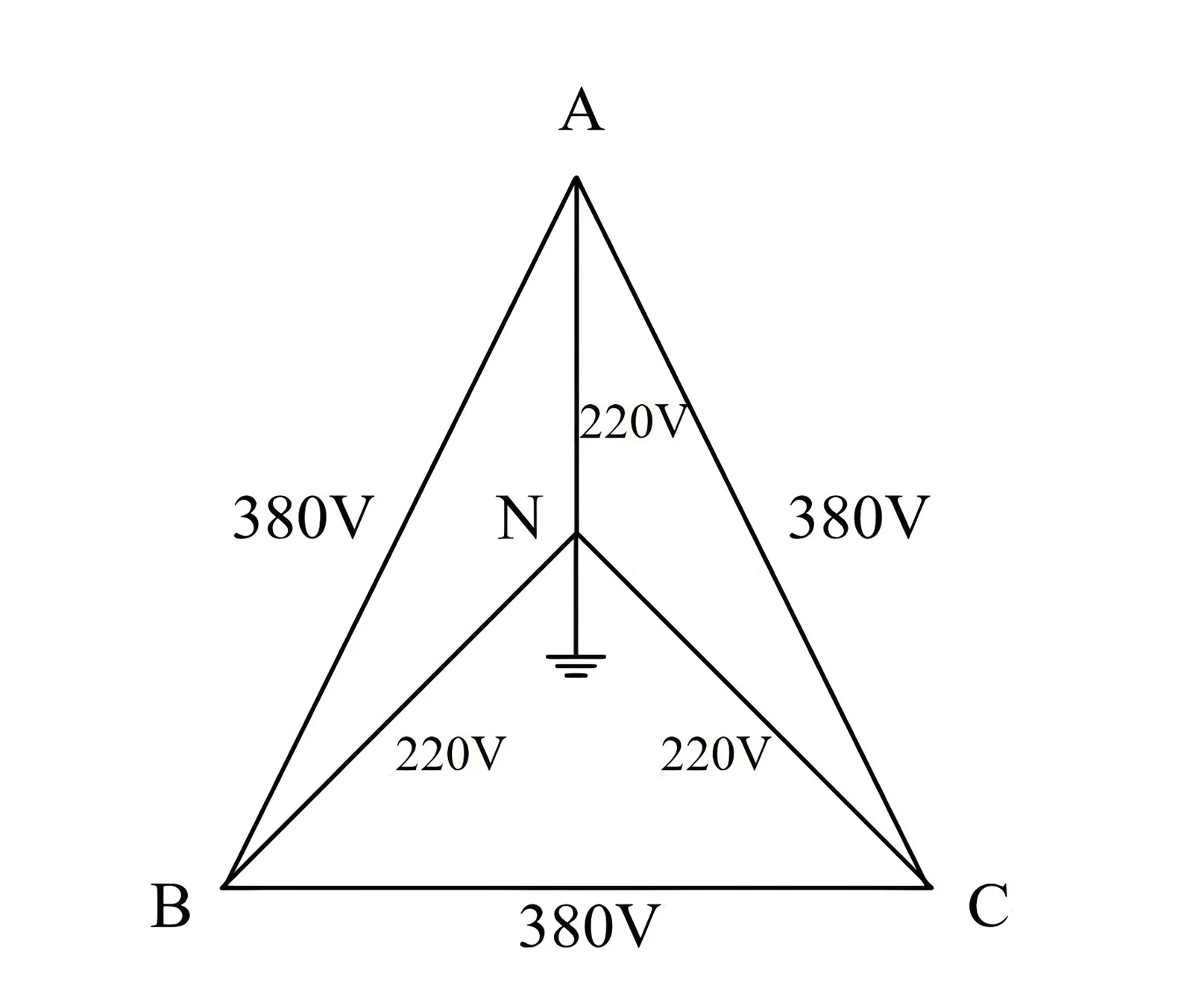
The interface of the three-phase inverter has five holes, namely A ,B,C ,N,PE. According to the national standard GB7947-2010, in a three-phase circuit, A is yellow, B is green, C is red, N represents the neutral wire, and blue or white wire is used; PE stands for ground wire, using yellow and green alternating lines. A. B and C phases are sometimes represented as L1 ,L2,L3, Or U, V,W.
Simply put, it is a 5-hole interface with a voltage level of 400V.
That's why when installing three-phase inverters, names such as three-phase four wire and three-phase five wire are often heard.
After saying 'phase', let's talk about 'line'. There are several common types:
Single phase dual line: one live wire and one neutral wire
Single phase three wire: one live wire+one neutral wire+one ground wire
Three phase three wire (TT system): Three live wires, mostly for lines above 10KV
Three phase four wire (TN-C system): Three live wires and one neutral wire, mainly used for 380V/220V (400V/230V) low-voltage lines, with the working neutral wire N also serving as the grounding protection wire PE, which can be called the protective neutral wire, represented by NPE, suitable for electric field stations with basic balance of three-phase loads.
Three phase five wire (TN-S system): a power supply system consisting of three live wires, one neutral wire, and one ground wire, which strictly separates the working neutral wire N from the dedicated protective wire PE. It is used in places where safety requirements are high and electrical equipment requires grounding.
In general, single-phase grid connected inverters are integrated into single-phase two-wire or single-phase three wire power grid lines.
The three-phase grid connected inverter is integrated into three-phase four wire and three-phase five wire power grid lines.
How to choose?
Starting from the application scenarios of distributed photovoltaics, matching inverters and selecting suitable inverters according to local conditions can maximize their effectiveness. How to choose a specific model? Should I use single-phase or three-phase?
It depends on the capacity of the power grid and system.
For roofs or courtyards with small installed capacity, single-phase string inverters are generally chosen; When the roof area is large, if the power grid has three phases, it is recommended to choose a small three-phase inverter; For industrial and commercial roofs, complex mountainous and greenhouse projects, large three-phase multi-channel MPPT string inverters are generally selected for scenarios with irregular orientation, easy occurrence of local obstruction, large installed capacity, and multiple grid connected voltages of low or medium voltage; For large ground and desert power stations, it is recommended to choose large series or centralized inverters.