


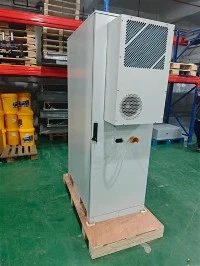
Multi-day backup storage
Most commercial battery systems are sized for hours, not days. A typical C&I installation rides through an outage for thirty minutes to four hours - enough to bridge until a generator starts, or to cover the short interruptions that dominate most grids. But for a growing set of sites, that is not enough. Coastal facilities facing typhoon seasons, rural operations at the end of fragile distribution lines, island businesses where grid restoration takes days, and manufacturers whose cold chain or process chemistry cannot tolerate a second interruption all share a harder requirement: multi-day backup storage - the ability to run critical operations for 48 to 96 hours or more without the grid.
Sizing for that requirement is a fundamentally different exercise from sizing peak-shaving capacity. This article walks through the method: how to think about outage risk honestly, how to cut your load to what actually matters, and how to assemble the hardware mix that makes multi-day autonomy affordable.

First, Define What "Multi-Day" Means for Your Site
Not every outage justifies multi-day design. The sizing conversation starts by sorting your outage history into three tiers.
Tier one: momentary and short interruptions - seconds to one hour. These are what a standard battery handles effortlessly, and they are the most common outage type on almost every feeder.
Tier two: half-day outages - two to twelve hours. Storm restoration, equipment faults, and planned maintenance windows live here. Many sites discover that their real painful events cluster in this tier, which sits at the edge of what a well-sized lithium system can cover alone.
Tier three: extended outages - one to five days. These are rare but catastrophic in impact: major storm damage, regional grid events, fuel logistics failures. This is the tier that drives the multi-day backup storage decision, and the tier where sizing discipline matters most, because every hour of autonomy adds cost.
Pull five years of outage data from your utility or site logs. If tier-three events have never occurred, you are buying resilience insurance against a scenario you have not experienced - a legitimate choice, but one that should be priced deliberately, not defaulted into.
The Critical Load Inventory: The Step Everyone Skips
The single biggest cost lever in multi-day sizing is not the battery - it is the load list. A facility that tries to back up "the building" needs a system ten times larger than one that backs up "what the building actually needs during an emergency."
Build the inventory by walking through an actual extended-outage scenario hour by hour:
Life-safety and code-required loads - emergency lighting, fire alarm, alarm systems. Non-negotiable, typically modest in size.
Process-critical loads - refrigeration for cold chain, server rooms, process baths that cannot solidify, ventilation for hazardous areas. These define your minimum survivable load.
Restart-sensitive loads - equipment where a second interruption after restart costs more than continuous operation (semiconductors, some chemical processes, certain printing or extrusion lines). Sometimes worth powering continuously; sometimes better shut down cleanly and restarted once.
Everything else - HVAC comfort zones, office lighting, general plugs. These flex down or off.
In practice, the critical load list at a typical industrial site lands between 10% and 30% of the facility's normal peak demand. That ratio is the foundation of affordable multi-day backup storage - 50 kW of true critical load for three days needs 3,600 kWh, which is achievable; 500 kW of whole-facility load for three days needs 36,000 kWh, which almost never pencils.

Sizing the Battery: Duration Math and Depth Discipline
With your critical load defined, the core calculation is simple in principle: average critical load in kW × target hours of autonomy = required usable kWh, then apply the margins.
Three adjustments make the difference between a system that works and one that disappoints:
Depth-of-discharge reserve. Plan to use no more than 80% of rated capacity in your design case. The final 20% is your margin for load estimation error, cold-weather derating, and cell aging over the system's life. Systems sized at 100% depth on day one fail their first real test five years later.
Inverter power versus battery energy. Multi-day autonomy is an energy problem, but the power rating still has to start your largest critical motor. Compressors and pumps draw six to eight times their running current at startup. If your inverter cannot deliver that surge, your sizing math is irrelevant. Check the start-requirements of every motor on the critical list before fixing the power electronics.
Recharge constraint. After a multi-day event drains the battery, it must refill before the next one. Review the charger or rectifier capacity relative to battery size - a three-day system that needs four days to recharge leaves you exposed to back-to-back events, which is exactly when multi-day resilience gets tested in the real world.
Solar Changes the Equation Radically
An off-grid battery sized for three days is enormous. A battery-plus-solar system sized for the same three days can be a fraction of that size, because the solar array refills the battery every day even while it serves load.
The sizing logic becomes a daily balance: daily solar generation must exceed daily critical consumption, with enough surplus to recharge storage after cloudy-day deficits. In sunny climates, a PV array modestly larger than your critical load, paired with two to three days of battery storage, achieves genuine indefinite autonomy through most weather patterns. The battery no longer needs to carry every hour itself - it only bridges the cloudy stretches.
For sites without meaningful roof or land for solar, hybrid architectures take its place - which brings us to the generator question.
Batteries, Generators, or Both?
Multi-day backup storage does not have to mean "battery alone." Three architectural options dominate, and the right one depends on your outage profile and fuel logistics.
Battery-only suits sites where fuel delivery during regional events is unreliable or where emissions, noise, or permitting rules make generators impractical. It is the cleanest option and the most expensive per hour of autonomy beyond the first day.
Generator-only remains the default for pure cost minimization, but it carries real weaknesses during exactly the events that matter: fuel supply chains fail in regional disasters, gensets fail to start after years of idleness, and they do nothing for demand charges or daily economics in the 364 days between outages.
Battery-plus-generator hybrid is the architecture most resilience engineers now recommend for multi-day capability. The battery handles momentary interruptions instantly - no transfer delay, no cold-start risk - runs the critical load for the first 12 to 24 hours, then the generator starts under controlled conditions to serve load and recharge the battery at its efficient operating point. A modest generator paired with a day of battery storage can deliver multi-day autonomy with a fraction of the fuel logistics of a genset-only design, while the battery earns its keep every single day through peak shaving and demand response. This division of labor - instant response from storage, sustained endurance from fuel - is why hybrid retrofits have become the fastest-growing pattern in C&I resilience projects.
A Four-Step Sizing Summary
Pull the method together for your own feasibility study:
Tier your outage history and choose the design event honestly - days, not hours, only if the data supports it.
Build the critical load list through a scenario walkthrough, targeting 10–30% of facility peak.
Size usable energy at load × hours ÷ 0.8, verify inverter surge against motor starts, and confirm recharge time.
Choose the architecture - battery-only for fuel-insecure or emissions-constrained sites, solar-plus-storage where generation space exists, battery-plus-generator hybrid where endurance and economics both matter.
The Bottom Line
Multi-day backup storage is achievable for commercial sites today - but the sites that get it right treat sizing as a load-management exercise first and a hardware exercise second. The difference between an unaffordable project and a bankable one is usually not the battery chemistry; it is a disciplined critical-load inventory, a reserve margin designed in from the start, and an architecture that lets storage and generation each do what they do best. Start with your outage data and your load list, and the right system size will follow.

500KW/1MW 1MWh/2MWh Battery Energy Storage System Container
The 500kW/1MW 1MWh/2MWh Battery Energy Storage System Container is a turn‑key utility‑grade energy storage solution housed in standard 20ft or 40ft shipping containers, integrating bidirectional PCS, A‑grade LiFePO4 battery clusters, master BMS, liquid‑cooled thermal management, gas fire suppression, high‑voltage distribution and EMS energy management system with full factory pre‑assembly and pre‑commissioning. Requiring only foundation construction and high‑voltage cable connection for on‑site commissioning, it supports flexible power‑capacity configuration and multi‑container parallel expansion, delivering core capabilities of peak‑shaving and load shifting, renewable energy smoothing, frequency‑voltage grid support, islanded micro‑grid operation and large‑scale emergency backup. Featuring IP54 enclosure protection and comprehensive multi‑layer safety mechanisms, it adapts to diverse harsh outdoor environments, and is widely deployed for ground‑mounted PV power stations, industrial parks, mining operations, island microgrids and grid‑side auxiliary service projects to stabilize grid fluctuations, boost renewable energy utilization and reduce comprehensive energy costs.