


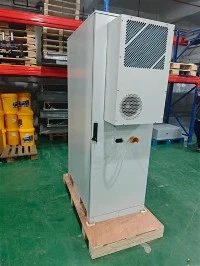
1. Executive Summary & Market Context
Commercial and Industrial (C&I) energy storage systems have transitioned from custom-engineered indoor battery rooms to standardized, pad-mounted outdoor all-in-one cabinets. In the 100kW–125kW power class, two nominal capacity benchmarks dominate current project procurement specifications: 241.15 kWh and 261.12 kWh.
While these two configurations appear numerically similar-differing by approximately 20 kWh (~8%) in nameplate storage capacity-they frequently represent distinct engineering philosophies:
The 125kW / 241kWh Cabinet: Typically built around high-density 280Ah/314Ah series cell strings with robust industrial HVAC/air-cooling or standard liquid cooling. It represents the industry's proven, cost-optimized workhorse for commercial peak shaving, factory demand management, and standard 2-hour discharge applications.
The 125kW / 261kWh Cabinet: Engineered with next-generation 314Ah high-capacity prismatic cells and dedicated closed-loop liquid thermal management. It maximizes energy density per square meter of footprint and delivers tighter cell-to-cell temperature uniformity ($\Delta T \le 2.5^\circ\text{C}$) for heavy daily cycling.
For EPC contractors, project developers, and facility energy managers, selecting between 241kWh and 261kWh requires balancing initial capital expenditure (CapEx), thermal parasitic loads, lifecycle degradation curves, and project investment payback horizons.
|
======================================================================================== CABINET BENCHMARK COMPARISON OVERVIEW ======================================================================================== [ MECC 125kW / 241.15kWh OUTDOOR BESS CABINET ] • Architecture: Turnkey Outdoor All-In-One Cabinet (Side-Mounted 125kW Hybrid PCS) • Battery Pack: 241.15 kWh High-Voltage LiFePO4 (Modular Series Architecture) • Primary Advantage: Outstanding CapEx cost-effectiveness, fast simple payback, versatile factory deployment. • Ideal Scenario: Industrial peak shaving, 2-hour TOU arbitrage, backup power, transformer relief. -------------------------------------------------------------------------------------- [ MECC 125kW / 261.12kWh OUTDOOR LIQUID-COOLED BESS CABINET ] • Architecture: High-Density Outdoor Enclosure with Automotive Liquid Chiller • Battery Pack: 261.12 kWh Tier-1 314Ah Prismatic LiFePO4 High-Voltage Racks • Primary Advantage: Maximum thermal uniformity (Delta T <= 2.5°C), lower HVAC parasitic draw, extended 15-year life. • Ideal Scenario: Multi-cycle daily arbitrage, extreme climate environments (-30°C to +55°C), space-constrained urban pads. ======================================================================================== |
2. Cell Electrochemistry & Internal High-Voltage Architecture
The fundamental difference between 241.15kWh and 261.12kWh cabinet capacities stems from cell capacity ratings and internal pack grouping topologies.
|
+---------------------------------------------------------------------------------------+ | ELECTRICAL & PACK ARCHITECTURE BREAKDOWN | +---------------------------------------------------------------------------------------+ | | | 1. 241.15 kWh High-Voltage Battery Configuration: | | - Cell Selection: 3.2V 280Ah or 314Ah Prismatic Lithium Iron Phosphate (LiFePO4) | | - Series Configuration: ~240S (Nominal DC Bus Voltage: ~768V DC) | | - Nominal Energy Calculation: 240 cells * 3.2V * 314Ah = ~241.15 kWh | | - Operating DC Voltage Range: 672V DC (Cut-off) to 864V DC (Max Charge) | | | | 2. 261.12 kWh High-Voltage Battery Configuration: | | - Cell Selection: 3.2V 314Ah Tier-1 Prismatic LiFePO4 Cells | | - Series Configuration: ~260S (Nominal DC Bus Voltage: ~832V DC) | | - Nominal Energy Calculation: 260 cells * 3.2V * 314Ah = ~261.12 kWh | | - Operating DC Voltage Range: 728V DC (Cut-off) to 936V DC (Max Charge) | | | | >> Engineering Takeaway: Higher string voltage (832V vs 768V) slightly reduces | | current draw (Amperes) for the same 125kW output, lowering I^2*R resistive losses.| | | +---------------------------------------------------------------------------------------+ |
Both configurations utilize intrinsically safe Lithium Iron Phosphate (LiFePO4) chemistry, offering thermal runaway onset temperatures exceeding $270^\circ\text{C}$ (compared to $150^\circ\text{C}$ for legacy NMC chemistries) and zero risk of toxic gas self-propagation when paired with NFPA 855-compliant cabinet spacing.

3. Thermal Management: Air-Cooling / Industrial HVAC vs. Precision Liquid Cooling
The choice of thermal management directly governs battery degradation rates, auxiliary auxiliary (parasitic) power consumption, and system Round-Trip Efficiency (RTE).
|
+---------------------------------------------------------------------------------------+ | THERMAL MANAGEMENT ARCHITECTURE COMPARISON | +---------------------------------------------------------------------------------------+ | | | [ INDUSTRIAL DUAL-ZONE HVAC / AIR COOLING (Standard 241kWh Option) ] | | • Mechanism: High-efficiency top-mounted or side-mounted industrial air conditioning | | circulating chilled air through guided internal ductwork. | | • Temperature Uniformity: Cell-to-cell temperature differential (Delta T) <= 4.0°C. | | • Maintenance Profile: Highly serviceable; standard HVAC technician serviceable. | | • Parasitic Load: Represents ~3.5% to 5.0% of daily throughput energy. | | | | [ CLOSED-LOOP LIQUID THERMAL MANAGEMENT (261kWh / Liquid 241kWh Option) ] | | • Mechanism: Dedicated external liquid chiller circulating ethylene glycol-water | | mix through aluminum micro-channel cold plates embedded beneath each battery module.| | • Temperature Uniformity: Cell-to-cell temperature differential (Delta T) <= 2.5°C. | | • Maintenance Profile: Sealed closed-loop circuit; annual coolant pH check. | | • Parasitic Load: Represents ~1.8% to 2.5% of daily throughput energy. | | | +---------------------------------------------------------------------------------------+ |
The Impact of Thermal Gradient on Cell Degradation
In lithium-ion battery strings connected in series, the overall pack capacity is throttled by the weakest, warmest cell (the "barrel effect").
In air-cooled enclosures with a $\Delta T \approx 4.0^\circ\text{C}$, cells located in stagnant airflow zones operate slightly hotter, accelerating Solid Electrolyte Interphase (SEI) layer growth. Over 6,000 cycles, this thermal spread can lead to a 3%–5% wider capacity dispersion between modules.
In liquid-cooled cabinets with a $\Delta T \le 2.5^\circ\text{C}$, uniform heat rejection ensures that all 260 series cells age synchronously, maintaining higher system-level usable capacity at Year 10.
4. Comprehensive Engineering & Economic Comparison Matrix
|
Engineering & Financial Metric |
MECC 125kW / 241.15kWh Cabinet |
MECC 125kW / 261.12kWh Cabinet |
|
Rated Inverter Output Power |
125 kW (380V / 400V / 480V 3-Phase) |
125 kW (380V / 400V / 480V 3-Phase) |
|
Nominal Energy Capacity |
241.15 kWh |
261.12 kWh (+8.3% Stored Energy) |
|
Usable Energy (90% DOD, BoL) |
~217.0 kWh usable AC |
~235.0 kWh usable AC |
|
Continuous C-Rate @ 125kW |
0.52C (~1.93 Hours Discharge) |
0.48C (~2.08 Hours Discharge) |
|
Thermal Management System |
Industrial Smart HVAC / Dual Air-Flow |
Closed-Loop Precision Liquid Chiller |
|
Cell Temperature Spread ($\Delta T$) |
$\le 4.0^\circ\text{C}$ across modules |
$\le 2.5^\circ\text{C}$ cell-to-cell |
|
Auxiliary Parasitic Energy Consumption |
$\sim 3.8\%\text{--}4.5\%$ of daily throughput |
$\sim 2.0\%\text{--}2.5\%$ of daily throughput |
|
Cycle Life Warranty Benchmark |
$\ge 6,000\text{ Cycles}$ @ 80% DOD ($25^\circ\text{C}$) |
$\ge 6,500\text{ Cycles}$ @ 80% DOD ($25^\circ\text{C}$) |
|
Turnkey Hardware CapEx Index |
Baseline (Most Cost-Effective) |
+7% to +10% CapEx Premium |
|
Footprint Dimensions ($W \times D \times H$) |
$1350 \times 1300 \times 2200\text{ mm}$ |
$1300 \times 1350 \times 2200\text{ mm}$ |
|
Total System Weight |
$\sim 2,850\text{ kg}$ |
$\sim 3,100\text{ kg}$ |
|
Enclosure Ingress Protection |
IP55 Outdoor Enclosure |
IP55 / IP65 Outdoor Enclosure |
|
Typical Simple Payback Horizon |
2.6 – 3.2 Years |
3.0 – 3.6 Years |

5. Economic & Project Payback Modeling: Factory Case Comparison
To illustrate the economic trade-offs, we model both systems deployed at an identical medium manufacturing facility operating under standard commercial time-of-use (TOU) tariffs:
|
Facility Baseline Parameters: - Peak Demand Spike: 420 kW (Occurs weekdays 14:00 - 16:00 during machinery operation) - Target Grid Demand Limit: 300 kW (120 kW peak shaving required) - Utility Demand Charge: $24.00 / kW / month - TOU Peak-to-Valley Tariff Spread: $0.18 / kWh ($0.28 on-peak vs $0.10 off-peak) - Operating Profile: 300 working days/year (1 full cycle per working day) |
|
======================================================================================== FINANCIAL PERFORMANCE COMPARISON: 1. MECC 125kW / 241.15kWh Deployment: - Peak Shaving Capacity: 120 kW shaved for 1.8 hours = 216 kWh usable required. - Monthly Demand Charge Savings: 120 kW * $24.00/kW = $2,880 / month ($34,560 / year). - Annual TOU Arbitrage Value: 217 kWh * $0.18/kWh * 0.88 RTE * 300 days = $10,312 / year. - Total Annual Value Generated: $44,872 / year. - Turnkey System Cost (Hardware + Installation): ~$122,000. >> Simple Project Payback: ~2.72 Years (Net 10-Year Cumulative Cash Flow: ~$326,000) 2. MECC 125kW / 261.12kWh Deployment: - Peak Shaving Capacity: 120 kW shaved for 1.95 hours = 234 kWh usable delivered. - Monthly Demand Charge Savings: 120 kW * $24.00/kW = $2,880 / month ($34,560 / year). - Annual TOU Arbitrage Value: 235 kWh * $0.18/kWh * 0.91 RTE * 300 days = $11,547 / year. - Total Annual Value Generated: $46,107 / year. - Turnkey System Cost (Hardware + Installation): ~$134,000. >> Simple Project Payback: ~2.91 Years (Net 10-Year Cumulative Cash Flow: ~$348,000) ======================================================================================== |
Strategic Financial Takeaway
Choose 241kWh if: Your primary goal is achieving the fastest simple payback (<2.8 years) on pure 2-hour peak shaving with minimal upfront capital expenditure.
Choose 261kWh if: Your investment horizon is 10 to 15 years, you cycle the battery 1.5–2 times daily for heavy arbitrage, or your local climate experiences extreme ambient temperatures ($>40^\circ\text{C}$).
6. Application Decision Matrix: When to Specify 241kWh vs. 261kWh
|
[ Project Pre-FEED Sizing ] │ ┌──────────────────────────┴──────────────────────────┐ ▼ ▼ [ Primary Operational Objective ] [ Site Environmental Conditions ] │ │ ┌────────────┴────────────┐ ┌────────────┴────────────┐ ▼ ▼ ▼ ▼ [ 2-Hour Peak Shaving ] [ Heavy 2x Daily ] [ Moderate Climate ] [ Extreme Hot/Cold ] [ Budget Constrained ] [ Maximum Lifetime ] [ (-10°C to +35°C) ] [ (>40°C or <-20°C) ] │ │ │ │ ▼ ▼ ▼ ▼ >>> SPECIFY 241kWh >>> SPECIFY 261kWh >>> SPECIFY 241kWh >>> SPECIFY 261kWh (Lowest Initial CapEx, (Liquid Uniformity, (Cost-effective HVAC, (Automotive Chiller, Fastest ROI Payback) Max 10-Yr Energy Yield) Proven Reliability) Active Heating/Cooling) |

7. Multi-Cabinet Paralleling & Electrical Balance of System (BOS)
Both the 241.15kWh and 261.12kWh cabinets support modular parallel scaling up to 10 units in parallel on a single facility low-voltage substation, scaling capacity from 125kW/241kWh up to 1.25 MW / 2.41 MWh.
|
======================================================================================== MODULAR C&I PARALLEL EXPANSION TOPOLOGY (UP TO 10 UNITS) ======================================================================================== [ Central SCADA / Plant-Level Energy Management System (EMS) ] │ (Modbus TCP / RS485 Bus) ┌───────────────────────┼───────────────────────┐ ▼ ▼ ▼ [ Cabinet 1 ] [ Cabinet 2 ] [ Cabinet N (Up to 10) ] 125kW / 241kWh 125kW / 241kWh 125kW / 241kWh Hybrid PCS + Battery Hybrid PCS + Battery Hybrid PCS + Battery │ │ │ └───────────────────────┴───────────────────────┘ │ ▼ (400V/480V 3-Phase AC Parallel Collector Bus) [ AC Combined Switchgear & Disconnect ] │ ▼ [ Facility Main Switchboard (MDP) ] |
8. Featured Solution: MECC 125kW / 241.15kWh Outdoor BESS Cabinet
For industrial manufacturing plants, commercial warehouses, and retail facilities seeking an optimal balance between capital cost and industrial performance, review the MECC 125kW / 241.15kWh Commercial & Industrial Energy Storage Cabinet:
|
+───────────────────────────────────────────────────────────────────────────────────────+ | SYSTEM SPECIFICATIONS AT A GLANCE | +───────────────────────────────────────────────────────────────────────────────────────+ | • Inverter Output Power: 125 kW (380V / 400V / 480V 3-Phase, 50/60 Hz) | | • Nominal Energy Capacity: 241.15 kWh (Modular High-Voltage LFP Prismatic Racks) | | • Max Solar PV DC Input: Up to 150 kWp (Multi-MPPT DC 500V - 850V DC) | | • Thermal Control System: Industrial Smart HVAC Dual-Zone Air Conditioning | | • Cycle Life Expectancy: >= 6,000 Cycles @ 80% DOD (25°C ambient) | | • Enclosure Protection: IP55 Outdoor Corrosion-Resistant Powder Coating (C4/C5)| | • Fire Safety Standard: Aerosol Fire Suppression + Deflagration Relief Panels | | • Unit Dimensions (W x D x H): 1350 mm x 1300 mm x 2200 mm (~2,850 kg) | | • Modular Scalability: Up to 10 Cabinets in Parallel (1.25 MW / 2.41 MWh) | +───────────────────────────────────────────────────────────────────────────────────────+ |

125KW 241kWh Battery Energy Storage System Cabinet
The BESS 125KW 241kWh Lithium Battery Energy Storage Cabinet is a high-power, large-capacity integrated energy storage solution engineered for medium-to-large commercial, industrial, and utility-scale applications. It integrates a 125kW high-performance bidirectional inverter, a 241kWh lithium iron phosphate (LiFePO4) battery bank, and a full-featured intelligent energy management system (EMS) into a modular cabinet design. This system enables efficient renewable energy storage, peak shaving, load shifting, grid frequency regulation, and emergency backup power supply. Ideal for large factories, shopping malls, industrial parks, utility-scale solar/wind farms, and microgrids, it enhances energy independence, reduces high grid demand charges, and supports the stable integration of high-penetration renewable energy into the grid.