


Controller selection is usually framed as a vendor comparison - features, protocols, price, support. That framing skips a decision that constrains every one of those criteria, and which is much harder to change later: the control topology. Where does the intelligence sit? In one supervisory brain, in each asset's own controller negotiating with its neighbours, or in a hierarchy of local loops under a supervisory arbiter?
The answer determines latency, failure domains, cabling cost, cyber attack surface, and how easily a second vendor's equipment can be added in year four. It is also invisible in most datasheets, because topology is a design choice the integrator makes - often by default, often by reusing whatever they built last time.
This is the architectural companion to our guide on controller selection criteria, which covers evaluation and contracting. Here the question is narrower and earlier: which control architecture fits a C&I site, and what does each one cost you in ways the quotation does not show?

Why Topology Comes First
Three properties of a microgrid are set by topology and cannot be recovered by better software.
Latency. The time from a load step to a corrective response. Local loops close in milliseconds; a supervisory loop that polls devices over a network closes in hundreds of milliseconds to seconds. For peak shaving at a charging hub, that difference decides whether the interval average holds.
Failure domain. What stops working when one component fails. Centralised designs fail globally; distributed designs fail locally; hierarchical designs fail in whichever layer lost its redundancy.
Extensibility. How much work it takes to add an asset. A distributed architecture adds a peer; a centralised one adds I/O and logic; a hybrid adds a device and a supervisory configuration. The costs differ by an order of magnitude, and they land in year three when nobody is watching the budget.
Centralised Supervisory Control
One controller, home-run communications to every asset, all logic in one place.
What it does well. A single model of the whole site means the tariff logic, interconnection limit and dispatch priority are computed with complete information - no negotiation, no emergent behaviour. Global optimisation is straightforward. Cybersecurity has one perimeter to defend. And commissioning is conceptually simple: one program, one point map, one set of traces.
Where it hurts. The controller is a single point of failure: if it goes down, the site loses coordination, and depending on the design may lose islanding capability entirely. Scan times grow with device count and point count, so a site with twelve assets and a thousand points may see supervisory loops measured in seconds - fine for tariff optimisation, too slow for transient cover.
Cabling and communications infrastructure are also concentrated: every device needs a path to one location, which in a retrofit across multiple buildings can dominate the installation cost. And logic centralisation tends to produce vendor lock-in, because the site's operating intelligence lives in one supplier's proprietary environment.
Best fit. Single-building sites with a handful of assets, short communication distances, and no stringent islanding requirement. Also greenfield sites where the communications infrastructure can be designed in from the start.

Distributed and Peer-to-Peer Control
Each asset controller runs its own local logic and exchanges a small set of signals with its peers - typically a power setpoint, an availability flag, and a mode indication.
What it does well. No single point of failure: lose one controller and the rest continue, degraded but operating. Local loops stay fast because they never leave the device. Expansion is genuinely incremental - add a peer, configure its signals, done. And the architecture tolerates vendor diversity, which matters on sites assembled over years.
Where it hurts. Emergent behaviour. Peer-to-peer systems can oscillate in ways no single device's documentation predicts, because each device responds rationally to signals the others are also responding to. Enforcing a hard constraint - the interconnection limit - becomes a negotiation rather than a command, and negotiations can be lost.
Debugging is also materially harder. When the site's demand exceeds its limit, the question "which controller decided that" has no clean answer, because the outcome was nobody's decision. And global optimisation is sacrificed: each asset optimises locally, and the sum is rarely optimal.
Best fit. Sites with many similar assets from a single family, geographically spread, where local autonomy matters more than global optimality - and where the interconnection limit can be enforced by a separate, hard-wired device rather than by negotiation.
Hierarchical Hybrid: The Usual Answer
A supervisory controller owns the slow, global decisions - tariff logic, demand setpoint, reserve allocation, mode management - while local controllers own the fast loops and execute setpoints within their own equipment.
This is what most well-designed C&I microgrids actually are, whether or not the vendor calls it that. Its virtue is that it puts each decision where the information and the timescale fit: global optimisation at the top, millisecond response at the bottom.
What it does well. It degrades gracefully. Lose the supervisory layer and the local controllers hold their last setpoints, keeping the site stable while the fault is fixed. Lose a local controller and the supervisor reallocates. Latency is appropriate per function rather than uniformly compromised. And the site retains an upgrade path, because the supervisory layer can be replaced without touching the assets.
Where it hurts. Complexity moves into the interface. The critical design artefact is a decision-rights matrix: which entity owns which decision, at which timescale, with which fallback. Projects that skip it produce controllers fighting each other - the supervisory layer issuing a setpoint that the local layer rejects for a protection reason, repeatedly, with no record of why.
Redundancy also has to be designed rather than assumed. A hierarchical system with a single supervisory controller is a centralised system with extra steps; the graceful degradation only materialises if the local layer has defined autonomous behaviour.
Best fit. Most C&I sites with three or more asset types, any islanding requirement, or a realistic expectation of expansion. It is also the only topology that comfortably accommodates a mix of vendors.
The Decision Inputs
Five site characteristics push the choice.
Asset count and diversity. Two or three assets from one vendor: centralised is adequate and cheapest. Five or more, or a mix of vendors: hierarchical, with a documented interface standard.
Transition and islanding requirements. If the site must island, and especially if it must black start, the local layer must be able to operate autonomously, which rules out a purely centralised design with no local fallback.
Geography. Assets in one electrical room favour centralised; assets across a campus favour hierarchical with local loops.
Retrofit or greenfield. Retrofits inherit communications constraints and existing vendor controllers, which usually means hierarchical by necessity.
Cyber posture. Centralised control offers one defended perimeter but a single high-value target. Distributed control spreads the attack surface but limits the consequence of any single compromise. Hierarchical needs a defined boundary between the supervisory network and the asset networks - a segmentation requirement that should be written into the specification.
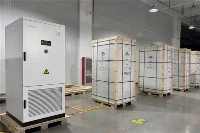
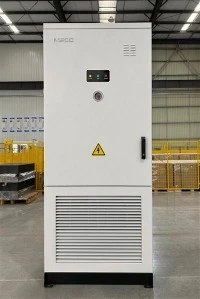
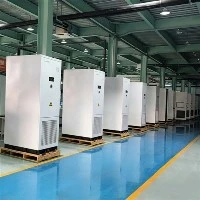
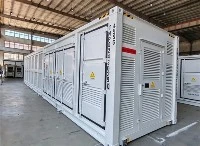
Liquid Cooling 125KW 261kWh Lithium Battery Energy Storage Cabinet
The IP55 Protected All-in-One Solar Energy Storage Cabinet is a high-performance, integrated energy solution engineered for outdoor commercial, industrial, and utility-scale solar applications. It integrates a 125kW Power Conversion System (PCS), a 261kWh lithium iron phosphate (LiFePO4) battery bank, an advanced liquid cooling system, and a intelligent Battery Management System (BMS) into a single cabinet with IP55 weatherproof protection. Designed to withstand harsh outdoor environments while delivering efficient energy conversion and storage, it supports solar energy absorption, peak shaving, load shifting, grid auxiliary services, and emergency backup power. Ideal for utility-scale solar farms, industrial parks, large commercial complexes, and remote microgrids, it provides a reliable, space-saving, and low-maintenance solution for large-scale renewable energy integration.
