


MECC Solar has completed the commissioning of a hybrid battery energy storage setup at a photovoltaic farm in Ełk, Poland, addressing a key operational challenge for local solar asset owners: consistent power supply when the public grid goes offline. The integrated solution combines MECC industrial storage units with backup generators, supporting off-grid standby power, intelligent load shifting and energy price arbitrage. This hybrid architecture maintains continuous operation of site equipment during grid interruptions while improving the overall energy efficiency of the PV installation.
Grid instability remains a frequent concern for distributed solar farms across central and eastern Europe. Rural and semi-rural zones in Poland often face unplanned outages, voltage fluctuations and restrictive grid connection limits, which can halt monitoring, tracking and auxiliary loads at PV sites. Without a reliable standby power scheme, operators risk lost data recording, suspended asset management and missed revenue from optimised solar generation. The Ełk project demonstrates a practical hybrid framework where battery storage and diesel generators work in tandem, rather than as isolated backup options, to stabilise power flow for long-duration solar farm operation.

Core Project Configuration and Operational Logic
The site is equipped with four MECC industrial energy storage units, including two sets of MECC-50-61 and two sets of MECC-61. Together, these systems form a coordinated energy pool that balances stored solar power, grid feed and generator output according to real-time site conditions.
When the public grid is available, the BESS absorbs surplus energy generated by the PV array. The EMS platform prioritises charging the batteries during periods of low electricity prices or high solar yield. This stored energy can be dispatched later for load shifting or price arbitrage, helping the asset owner capture better economic returns from on-site solar production. Once a grid outage is detected, the system switches seamlessly into off-grid backup mode. Batteries supply critical site loads first; if the discharge duration cannot meet the required runtime, the control system triggers the backup generator automatically to sustain the circuit.
This staged hybrid sequence reduces unnecessary generator runtime, cuts fuel consumption and lowers carbon emissions compared with generator-only backup. It also avoids abrupt load drops that may damage sensitive monitoring and communication hardware at the PV farm. For Polish solar developers, EPC contractors and asset operators, this operating model offers greater predictability for sites exposed to unreliable distribution grid infrastructure.
Technical Advantages of the MECC Industrial Storage Solution
The MECC-50-61 and MECC-61 series are built for rugged, continuous industrial deployment, designed to handle the wide temperature swings seen in north-eastern Poland. The LFP cell chemistry delivers stable cycling performance and enhanced thermal safety, which is essential for unmanned PV farm installations that often operate with limited on-site maintenance.
A built-in battery management system tracks cell voltage, temperature and state of charge across all parallel units. It balances charge distribution and activates protection protocols in the event of overload, overheating or abnormal current. The site-level energy management system acts as the central brain, communicating with inverters, PV meters, generator controllers and grid relays. It executes pre-configured rules for grid-tied charging, off-grid islanding, load priority and generator co-ordination.
Scalability is another core benefit. The modular design allows integrators to expand storage capacity by adding extra MECC-50-61 or MECC-61 cabinets without full redesign of the control architecture. This suits phased solar farm upgrades, where operators start with a smaller backup system and scale storage capacity as the PV plant expands or commercial arbitrage opportunities improve. All units support remote monitoring, so engineering teams in Poland or regional service hubs can review performance logs, adjust setpoints and diagnose faults without regular site visits.
Unlike residential or light commercial batteries optimised for self-consumption alone, these industrial models are tuned for three distinct operating modes required by PV farms: peak shaving and load shifting under grid-connected conditions, seamless off-grid backup during outages, and scheduled discharge for energy arbitrage when local market prices favour battery dispatch. This multi-mode capability makes them well suited for hybrid generator-storage schemes common across the Polish renewable sector.

Target Application Scenarios for Central European Solar Assets
The Ełk PV farm project represents a high-growth use case for MECC BESS across Poland, Lithuania, Latvia and other Baltic and central European markets. Many ground-mounted PV installations are located away from strong urban grid nodes, leaving them vulnerable to supply interruptions caused by weather damage, scheduled utility maintenance or network congestion.
Beyond PV farm backup, the same hybrid configuration works for agricultural solar sites, remote industrial loads, water pumping stations and small commercial microgrids. Farms and food processing facilities in Poland frequently require uninterrupted power for ventilation, refrigeration and irrigation controls, where even short blackouts can create financial losses. Energy arbitrage also becomes increasingly attractive as Poland's wholesale electricity market continues to present price gaps between daytime solar generation and evening peak demand periods.
For EPC partners and regional distributors, the MECC modular portfolio simplifies project quoting and delivery. Standardised cabinet designs reduce custom engineering work, while pre-tested EMS and generator integration logic cuts commissioning time on site. This is valuable for contractors managing tight construction windows on distributed solar projects across rural Poland.
Market Value for Polish Solar Operators and EPC Partners
Poland continues to expand its renewable energy rollout, but grid capacity constraints and supply reliability issues create barriers for many distributed PV projects. Pure generator backup carries high fuel costs and ongoing maintenance overhead, while battery-only systems face runtime limits during extended outages. The hybrid battery-generator model adopted in Ełk strikes a balanced middle ground, combining the low operational cost of stored solar energy with the unlimited runtime of a fuel-backed generator.
This setup helps asset owners satisfy grid operator requirements for fault ride-through and islanding capability on selected PV connections. It also supports compliance with local environmental targets by reducing annual generator operating hours. For investors, the dual revenue stream from backup reliability plus energy arbitrage improves the business case for adding storage to existing and new PV farms.
MECC Solar's deployment in Ełk also creates a local reference case for Polish stakeholders. Field data collected from the four-unit installation will inform further tuning of EMS algorithms to match local grid codes, typical outage durations and Polish wholesale price patterns. Local distributors and installers can use this project to demonstrate real-world hybrid backup performance to their own clients.
Outlook
MECC Solar will continue supporting hybrid PV and storage deployments across Poland and the wider CEE region, focusing on applications where off-grid resilience, load shifting and energy arbitrage are core priorities. The company will maintain technical collaboration with local EPC firms to provide pre-sales load analysis, generator integration guidance and after-sales remote support for MECC-50-61 and MECC-61 installations.
As more Polish solar asset owners seek ways to protect revenue streams against grid instability and capitalise on flexible energy trading, hybrid BESS-generator configurations will grow in adoption. MECC Solar aims to deliver modular, robust industrial battery storage that gives regional operators greater control over their on-site energy, whether the grid is available or offline.
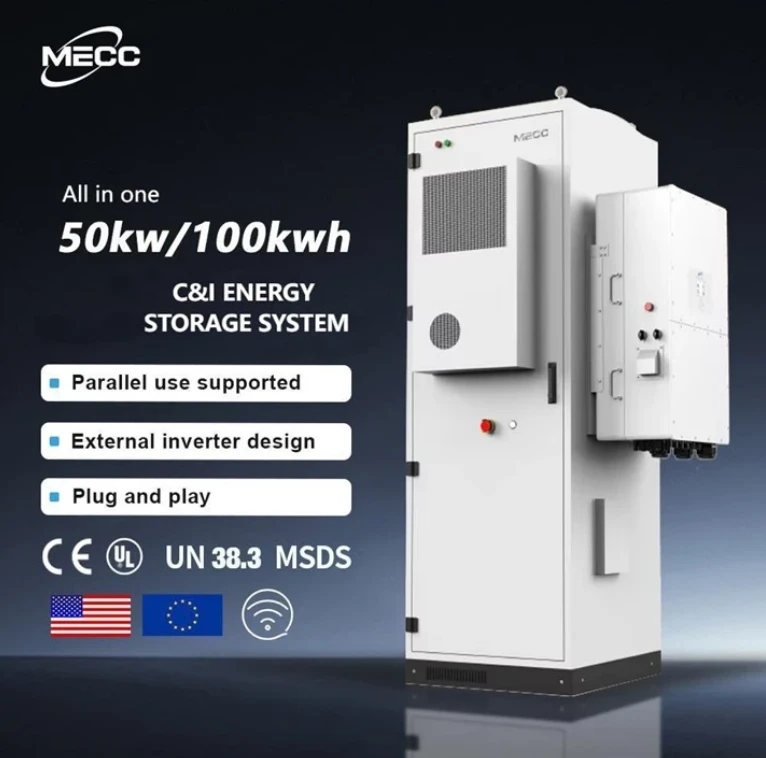
MECC 50KW 112KWH BESS Battery Energy Storage System
The MECC 50kw 112kWh Battery Energy Storage Cabinet is a high-capacity energy storage solution designed for industrial and commercial applications. Featuring 358V, 314Ah lithium iron phosphate (LiFePO4) battery, it ensures long-lasting, safe, and efficient energy storage.
High-efficiency 50kW/112kWh Industrial and Commercial Energy Storage System (C&I ESS). Features LiFePO4 battery, peak shaving, and smart EMS. Reduce operational costs and ensure power backup. Inquire for custom BESS solutions.
Designed with a compact footprint of less than 1.2 square meters, this 112kWh cabinet features a pre-integrated all-in-one design, reducing on-site installation time by 40% compared to modular rack systems.