


When a bus company, a logistics operator or a delivery fleet commits to electrification, the conversation is usually about vehicles - which models, what range, what subsidy. The conversation that actually decides the project timeline happens between the fleet manager and the utility, and it is about one number: how many kilowatts the site can draw.
A depot that runs 40 electric buses needs charging power measured in megawatts. The medium-voltage feeder serving a depot that historically hosted diesel pumps was designed to deliver a few hundred kilowatts. The gap between those two numbers is the single largest source of delay in fleet electrification, and closing it through a utility upgrade can take one to three years of studies, applications and civil works.
A battery buffer does not eliminate the gap, but it changes the arithmetic. Instead of waiting for the grid to catch up, the site charges a battery slowly from the connection it already has, and the battery serves the charging load fast when the vehicles come in. This article covers how to size that buffer, how fleet depot charging actually behaves as a load, and where storage fits alongside the charging management software that modern depots need anyway.

The Capacity Gap, in Actual Numbers
Start with the demand side. A fleet's charging requirement is not vehicles multiplied by charger rating - that is the mistake that inflates every early estimate. What matters is energy per vehicle per night, the charging window, and the coincidence of charging sessions.
A delivery van that drives 150 km needs roughly 40 to 60 kWh to recharge. Forty vans need around 2 MWh per night. If the charging window is eight hours, the average power is 250 kW - but the peak is not the average. Vehicles arrive in waves at the end of shifts, drivers plug in immediately, and chargers deliver at full rate until batteries fill. Without coordination, a 40-van depot with 50 kW chargers can easily hit a 1.5 to 2 MW peak for an hour after the evening wave arrives.
Now the supply side. A depot on a 400 A three-phase connection at 400 V has roughly 275 kVA of usable capacity, less what the site's own loads consume - office, lighting, workshop, compression. Many depots discover their headroom is 100 to 150 kW, which would charge five vans comfortably and forty vans not at all.
That gap - between a megawatt-scale peak and a few hundred kilowatts of headroom - is the problem. Three solutions exist, and they are not mutually exclusive.
Utility service upgrade: the definitive fix, slow and expensive, and in many districts the queue alone rules it out for the first two years.
Managed charging: spreading sessions across the window with a depot management system reduces the peak significantly, and should be implemented regardless. But managed charging cannot compress eight hours of needed energy into six, and if the fleet's dwell time is short, software alone leaves a residual gap.
Battery buffer: absorbs the difference between what the site can import and what the chargers need to deliver, recharging slowly during quiet hours.

What the Buffer Actually Does
A depot battery serves three overlapping roles, and the mix determines its sizing.
The first role is peak buffering. The battery sits between the incomer and the chargers, importing at the grid's limit continuously and discharging to make up the shortfall when chargers demand more. In this role it behaves like any peak-shaving battery, but with a duty cycle that is unusual: a daily deep cycle, precisely timed around the arrival wave, at high C-rate for the discharge window. Thermal design and cycle warranty need to reflect a real 1C-class duty, not an arbitrage profile.
The second role is deferred capacity. Every kilowatt of buffer extends the fleet the existing connection can support. A site with 275 kVA of import capacity and a 500 kW buffer can, in effect, run chargers as if the connection were 775 kVA - enough to add fifteen to twenty vans without touching the utility agreement. For a fleet operator, that is not an energy purchase; it is a way to buy time and avoid a service upgrade that may cost more than the battery and arrive years later.
The third role is energy cost management. Depots charge at night, when tariffs are usually lowest, which limits arbitrage value compared with a commercial building. But demand charges still apply in many markets, and a buffer that caps the billed peak while the fleet grows protects the site's cost structure through the transition years. In markets with dynamic pricing, the battery can also shift charging away from price spikes - which matters more as depot loads grow and start to shape local grid peaks themselves.
The sizing exercise needs all three roles quantified separately, because the binding one differs by site. A depot with a 2028 utility upgrade date sizes the buffer to bridge the gap until then. A depot with no upgrade in prospect sizes for the full fleet at maturity. A depot with flat tariffs sizes purely for the capacity gap and ignores arbitrage.
Coordination: The Battery Is One Player in a Larger System
A buffer battery on its own is a blunt instrument. The value appears when it is coordinated with the chargers, the vehicles and the grid connection in one control layer - increasingly called a depot management system, and functionally an energy management system with charging-specific inputs.
Four inputs drive the dispatch.
Vehicle departure schedule: which buses leave at 5:40 am, which vans at 6:15, and what state of charge each needs at departure. This turns the charging window from a free-for-all into a deadline-driven optimisation, and it is why fleet depots need vehicle-level data integration rather than simple charger timers.
Connection limit: the hard import cap, monitored at the incomer, that the system must never breach - and the softer contractual cap below it that avoids demand charges.
Charger availability: faults, derating in hot weather, and cable limits, which the scheduler needs to know before assigning vehicles to chargers.
Battery state: how much buffer energy remains, and what the import rate needs to be overnight to recharge it before the next evening wave.
The dispatch logic is straightforward in principle - serve deadline-critical vehicles first, fill surplus capacity with flexible vehicles, use the battery to bridge the moments when demand exceeds import - but the failure modes are operational, not mathematical. A bus that departs undercharged is a service failure, and the control system needs guardrails that prioritise departure SLAs over cost optimisation when they conflict. This is the same dispatch philosophy described in our AI dispatch article, applied to a load with hard deadlines instead of price signals.
Backup, V2G, and the Things That Sound Better Than They Pay
Two adjacent topics come up in every depot project and deserve a sober treatment.
Backup power: a depot battery can keep charging a subset of vehicles during an outage, or power depot loads. For essential-service fleets - ambulances, utility response vehicles - this resilience role may justify capacity that pure economics would not. For a parcel depot, it is a nice-to-have, and sizing a larger battery for it is rarely justified. Also worth noting: a depot battery with grid-forming capability can support islanded operation, following the same principles as our microgrid article, but only if the site's wiring allows the chargers to be islanded with it.
Vehicle-to-grid: the idea that the fleet itself is the battery. Technically real, commercially early. V2G requires bidirectional chargers, vehicle-side support, and warranty terms from the OEM that most fleet operators cannot yet obtain. Treat it as a future option that the depot's electrical design should not preclude - leave space, spare conduit, and a control architecture that could incorporate it - rather than a revenue line in the current business case.
Layout, Safety, and the Physical Plan
Depots have space, which is their advantage over urban buildings, but the space is operational - parking bays, turning circles, wash bays - and giving any of it to a battery enclosure has operational cost.
The battery needs separation from the charging area consistent with local fire code, vehicle impact protection (bollards or barriers at minimum), and access for service vehicles. Outdoor enclosures rated for the local corrosion and ingress environment follow the specification logic in our IP rating and corrosion guides. Cable runs from battery to charger switchboard should be short; voltage drop on low-voltage distribution at MW scale is real money in copper.
Fire response planning matters more at a depot than at most commercial sites because the fuel is parked in quantity. The battery's fire separation, detection and any suppression must integrate with the depot's existing emergency plan, and the authority having jurisdiction should be engaged early - the same advice as for indoor installations in commercial buildings, but with the advantage that depots can usually meet separation distances outdoors.
A Practical Sequence
Fleet operators who navigate this transition smoothly follow the same order of operations.
Start with data: twelve months of interval data at the depot, plus the operational schedule - vehicles, routes, departure times. Model the charging load at maturity and at each interim fleet size. File the utility upgrade enquiry early, regardless of whether the battery makes it unnecessary; the answer defines the timeline that everything else plans around. Deploy managed charging first, since software is cheap and defers hardware. Size the buffer for the gap that remains, with a clear view of which role - bridging to an upgrade, or permanent capacity - it is playing. Then expand chargers in step with fleet arrivals, using the buffer to absorb each increment.
The order matters because the utility queue is long and the fleet arrival dates are fixed by vehicle procurement. The buffer is the only element of the solution the operator can procure on its own timescale.
Depot electrification stalls when operators treat it as a vehicle problem with an electrical footnote. In reality it is an electrical infrastructure project with vehicles attached, and fleet depot charging works when the import limit, the buffer and the scheduling software are designed together as one system from the first study onward.
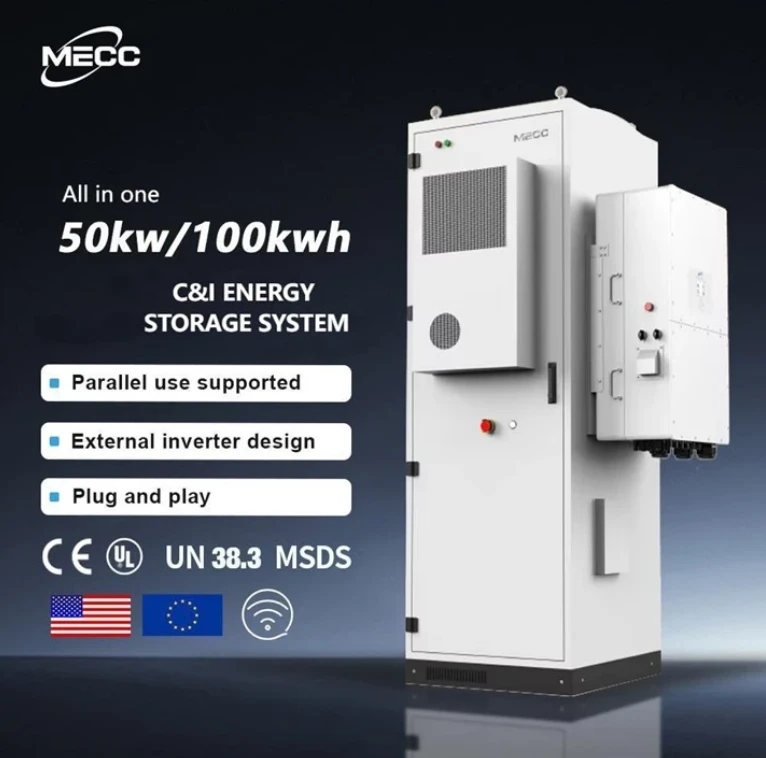
MECC 50KW 112KWH BESS Battery Energy Storage System
The MECC 50kw 112kWh Battery Energy Storage Cabinet is a high-capacity energy storage solution designed for industrial and commercial applications. Featuring 358V, 314Ah lithium iron phosphate (LiFePO4) battery, it ensures long-lasting, safe, and efficient energy storage.
High-efficiency 50kW/112kWh Industrial and Commercial Energy Storage System (C&I ESS). Features LiFePO4 battery, peak shaving, and smart EMS. Reduce operational costs and ensure power backup. Inquire for custom BESS solutions.
Designed with a compact footprint of less than 1.2 square meters, this 112kWh cabinet features a pre-integrated all-in-one design, reducing on-site installation time by 40% compared to modular rack systems.