


The development of any product cannot deviate from the ultimate goal of achieving higher cost performance. In the process, although there may be a counter trend of high price with high experience brought by technological breakthroughs, the final trend is still to achieve high cost performance with the popularization of new technologies.
So, where is the technological development of energy storage products headed?

Energy storage systems mainly consist of four major components: batteries, battery management systems, thermal management systems, and safety systems. Next, let's discuss these four major components:
1. Battery
It was discussed previously in "Next Generation Energy Storage Products" and "The Dispute over Five Specification Routes of Energy Storage Batteries" that the power capacity of both electric energy storage cell products and system products is taking "bigger is better" as the future development direction. However, the size of battery products is ultimately limited. After the battery capacity reaches a certain level, efforts still need to be made to develop the intrinsic safety of the cells and improve cell performance utilization.
Moreover, it is necessary to differentiate battery products according to the application scenarios in various subdivided fields and specific regions, so as to more fully meet the needs of different applications.


2. Battery Management System
At present, the battery management system is mainly engaged in the monitoring of battery voltage, temperature, current, and so on. It mainly monitors the data that has already occurred and conducts power off protection and other operations from the anomalies that have already occurred.

What we expect from the battery management system is:
a. It can proactively monitor the battery state and predict the future battery state through the data that has been generated in the past.
b. The battery management system can be used to fully utilize the performance of the battery throughout its entire life cycle and independently adjust the abnormal performance states of the battery.
3. Thermal Management System
The battery thermal management system has evolved from the initial natural cooling to forced air cooling and to the current mainstream liquid cooled plate form. However, it is still found that it cannot provide a satisfactory working temperature environment for batteries. This is mainly manifested in high battery temperatures (around 37℃), large temperature differences between batteries (5 - 8℃), and large temperature fields inside battery cells (15 - 20℃).
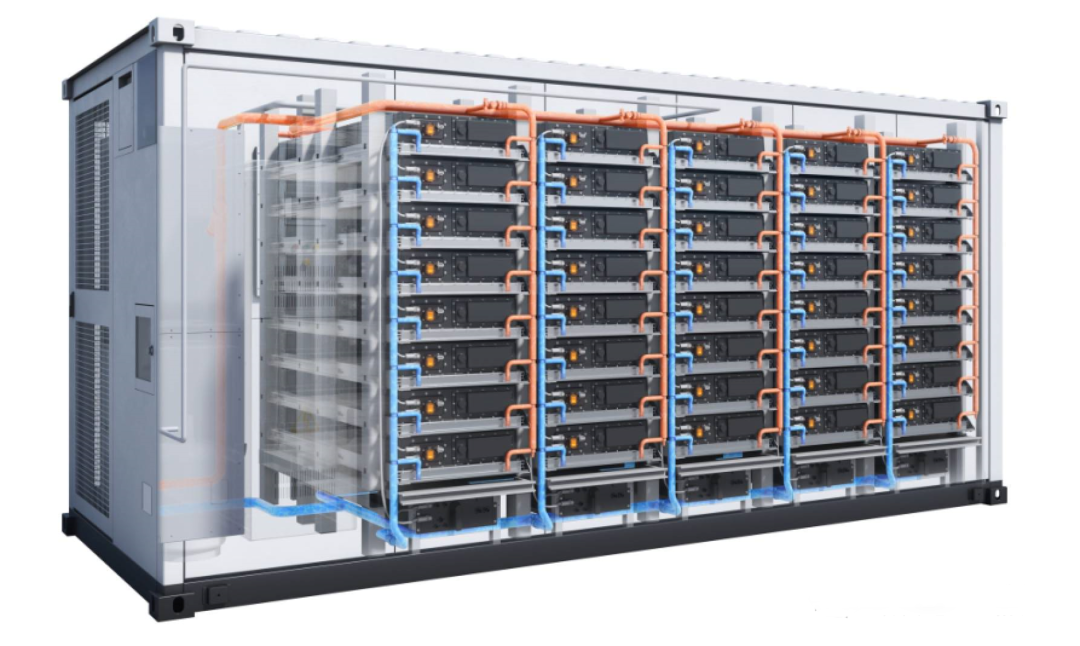
The industry is also actively exploring new type thermal management methods. Recently, the much hyped fully immersed liquid cooling method, as shown in the figure, places the battery cells in a liquid cooling tank and then injects the cooling liquid into the tank to completely immerse the batteries, achieving multi directional and multi angular contact for heat dissipation.
The main advantages are as follows:
a. The cooling liquid directly contacts the battery cells, having a higher heat exchange efficiency compared with the liquid cooling plates of indirect cooling, and being able to cool down or heat up quickly.
b. The battery cells will dissipate heat in all directions when fully immersed, and the temperature at each point inside the battery cells is more uniform (about 3℃) compared with that of the liquid cooling plate type.
c. After the battery cells are fully immersed, a high degree of temperature uniformity among the batteries can be achieved by controlling the temperature difference between the liquid inlet and the liquid outlet.
d. When the battery cells are fully immersed in the cooling liquid, the blank areas between the battery cells are filled with the cooling liquid and separated by gaps. In case of thermal runaway of a single battery cell, the temperature can be quickly taken away by the cooling liquid, the diffused temperature is isolated by the cooling liquid and will not form thermal diffusion. The electrolyte ejected due to thermal runaway will also be absorbed and discharged by the cooling liquid, and the high temperature gas ejected from the battery cells will be isolated by the cooling liquid, thus improving the battery safety.
There are many benefits of immersion type liquid cooling, but its development is not smooth:
a. The cooling liquid needs to fully immerse the batteries and have good fluidity and high safety, so it is difficult to select the cooling liquid.
b. There are a large number of batteries in the system, and it is difficult to design the flow channels in the case of full immersion. Corners are often likely to appear, resulting in large temperature differences.
Recently, through data research and comparison of various cooling methods, it is found that semiconductor type cooling products can be directly attached to the surface of battery cells for use. However, due to low power and inconvenience for large scale application, they are currently mainly used in small sized dehumidifiers, water dispensers and other products.
As mentioned above, regarding the recent development of thermal management technologies, in the long run, intelligent thermal management is the ultimate direction of battery thermal management. Through intelligent thermal management, the optimal working temperature environment of batteries can be maintained with the minimum energy consumption to the greatest extent.

Intelligent thermal management is a comprehensive balance that takes into account external environmental factors such as temperature, humidity, wind speed, illumination, geothermal heat, as well as internal components such as batteries, electrical components, cables, and thermal management. It integrates the prediction of the external environment to anticipate in advance whether heating or cooling is needed and the corresponding power. This ensures that the system's batteries have an optimal temperature environment and fluctuate within a relatively small range.
4.Safety System
The battery safety system is the bottom line of the system.

At present, the perfluorohexanone fire protection system is the mainstream in the industry, and some manufacturers use aerosols, etc. The main difference lies in the agents, which leads to changes in the fire protection host, while other detections and alarms are quite similar.
At present, gas type or gas-like agent fire protection such as perfluorohexanone and aerosol mainly rely on the agent concentration for fire protection. When the gas concentration decreases over time, the battery pack still has the risk of reignition.
Therefore, at present, some energy storage enterprises adopt liquid full immersion fire protection.

The basic principle is: by fully immersing the battery cells in the battery pack with a liquid medium, the liquid medium surrounds the cells completely, quickly reducing the temperature generated after the cell failure, isolating the combustible high temperature and high pressure gases generated after the failure through the liquid medium, and the electrolyte ejected after the cell failure can be absorbed and carried away by the liquid medium.
However, at present, the detection section of the safety system of the energy storage system in the industry is independent of the battery management system. Generally, a multi-in-one probe integrating temperature, gas, VOC, etc. is set at a certain position of the battery pack, with extremely limited accuracy, not to mention sensitivity.
In the entire process of protecting battery safety, there is only the distinction between failure and non-failure, completely missing the high - temperature stage before battery failure.
Therefore, what should be done first at present, and what many enterprises are doing, is to link the safety management system with the battery management system. After all, the battery management system monitors the voltage and temperature of each cell in real time.
5. Intelligent Integrated System
At present, in the new energy industry, especially in the power field, intelligent development is advancing rapidly. This paper holds that the development of battery systems must also involve the comprehensive intelligence of battery management systems, thermal management systems, and safety systems.
The safety system uses the monitoring data of the battery management system and combines it with the intelligent prediction data of the thermal management system to complete early warning, alarm, and fire fighting before the battery cells fail, minimizing losses. Among them, in the high temperature stage before the battery cells fail, the safety system can start the high power cooling of the thermal management to suppress the failure reaction of the battery cells. In addition, through big data monitoring and comparison, the occurrence time and type of battery abnormalities can be predicted in advance, and corresponding treatment methods can be made as early as possible.