


Most of the money in commercial & industrial energy storage is made on the user side of the utility connection - not in giant grid-scale farms, but in the basement, rooftop, or parking lot of a real facility. That is behind-the-meter (BTM) energy storage: a C&I battery energy storage system (BESS) installed on your premises, wired after the utility meter, and controlled by you. This guide explains what BTM storage is, how it differs from front-of-meter projects, and the concrete value streams it captures.

What "Behind-the-Meter" Actually Means
A behind-the-meter system sits between your facility and the grid connection point. It charges from the grid, from on-site commercial solar plus storage, or both, then discharges to serve your own load. Because it operates on the user side of the meter, the savings show up as lower bills and avoided penalties rather than as energy sold to the market.
By contrast, front-of-meter or utility-scale storage is owned by a utility or developer and sells services back to the grid. For a factory, warehouse, or campus, the practical question is almost always BTM: how do I cut my costs?
How BTM Differs from Grid-Scale Storage
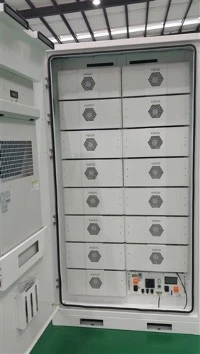
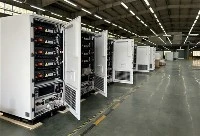
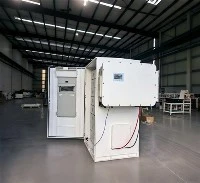
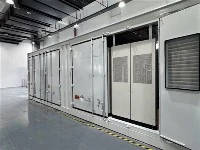
Scale is the obvious difference - a 215 kWh commercial energy storage cabinet or a containerized C&I BESS 20ft versus megawatt-hour utility arrays. But the deeper difference is purpose. Grid-scale projects chase capacity markets and frequency regulation; a commercial battery storage solution chases your demand charges, your time-of-use windows, and your resilience. The technology is shared - lithium iron phosphate (LFP) cells, a power conversion system (PCS), a battery management system (BMS), and an AI-based energy management system (EMS) - but the business case is local.

The Value Streams BTM Storage Captures
The first and largest is peak shaving. By discharging during your highest-load windows, the battery trims the peak that sets your demand charge - often the single biggest line on a C&I bill. The second is time-of-use arbitrage: charge when power is cheap overnight, discharge when it is expensive in the afternoon, banking energy arbitrage revenue from the price spread.
The third is demand response. Many utilities pay commercial sites to shed or shift load during grid stress; a BTM battery delivers that instantly without disrupting operations. The fourth is solar self-consumption - pairing commercial solar plus storage lets you use midday PV in the evening instead of exporting it at a low rate. The fifth is resilience: in a microgrid or backup configuration, the system keeps critical loads running through an outage. Stacking several of these is what lifts battery storage ROI for businesses above a single-use case.
How a BTM System Works
A typical grid-tied BTM system connects through the PCS, which inverts DC battery power to AC for the site. The BMS protects the cells; the EMS watches your live load and the tariff clock, then decides when to charge and discharge. Most modern units run at 1500V DC and ship in all-in-one or modular C&I BESS form factors, with liquid-cooled vs air-cooled options depending on climate. Because everything is on your side of the meter, you control dispatch priorities - bill savings first, resilience second, or however your site needs it.
Sizing and Site Assessment
Sizing starts with 12 months of interval billing data. A C&I energy storage sizing calculator used during a free site assessment sets the right C-rate and duration for your peak windows and TOU periods - this is the core of how to size a commercial battery system. A site with one short daily spike needs a high-C-rate, short-duration unit; a site with long expensive evenings needs more duration.
Cost and Payback
Buyers ask two things: what does it cost, and when do I break even? The commercial energy storage cost per kWh varies by cooling, certification, and form factor, but the C&I energy storage payback period is driven by how many value streams you stack - demand-charge reduction, arbitrage, demand response, and any financing / tax incentives. Well-designed BTM systems routinely clear a multi-year payback, and adding solar usually shortens it.
Safety and Compliance
Any BTM system must clear the same bar as products from top C&I BESS manufacturers. Confirm UL 9540 / UL 9540A, NFPA 855, and IEC 62619 with regional CE / UKCA marks. Built-in fire suppression and thermal runaway prevention are non-negotiable for a system inside or adjacent to an occupied building.
Choosing a Supplier
Compare best commercial energy storage systems 2026, evaluate OEM/ODM energy storage manufacturer partners for custom builds, and decide between turnkey C&I energy storage and wholesale supply. Ask each vendor for a site assessment, a stacked-value savings model, and a transparent BESS price quote request process.
Want to see your own behind-the-meter savings? Request a free on-site assessment - we'll model your demand charges, TOU windows, and solar potential, then show the projected payback across every value stream.
Liquid Cooling 125KW 261kWh Lithium Battery Energy Storage Cabinet
The IP54 Protected All-in-One Solar Energy Storage Cabinet is a high-performance, integrated energy solution engineered for outdoor commercial, industrial, and utility-scale solar applications. It integrates a 125kW Power Conversion System (PCS), a 261kWh lithium iron phosphate (LiFePO4) battery bank, an advanced liquid cooling system, and a intelligent Battery Management System (BMS) into a single cabinet with IP54 weatherproof protection. Designed to withstand harsh outdoor environments while delivering efficient energy conversion and storage, it supports solar energy absorption, peak shaving, load shifting, grid auxiliary services, and emergency backup power. Ideal for utility-scale solar farms, industrial parks, large commercial complexes, and remote microgrids, it provides a reliable, space-saving, and low-maintenance solution for large-scale renewable energy integration.
