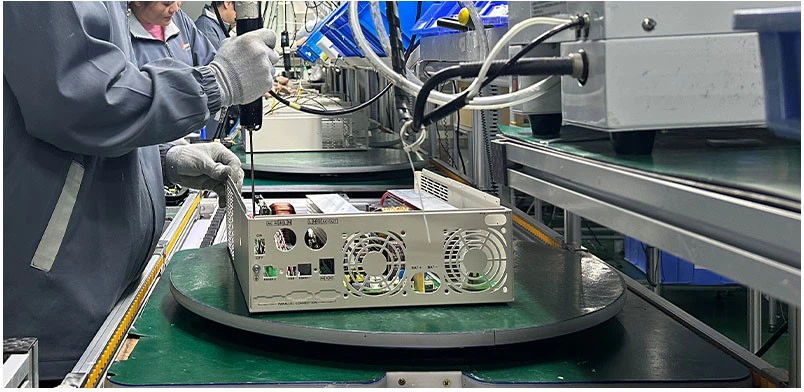
Testing and Calibration Equipment Setup: Before the final assembly, comprehensive testing and calibration setups are prepared. Precision power analyzers, oscilloscopes, and multimeters are used to measure key parameters such as voltage, current, power factor, and frequency. These instruments are connected to the inverter under test, and automated test scripts are often run to ensure consistency and accuracy in the measurement process. Calibration is carried out to adjust the inverter's output to meet the specified tolerances, ensuring reliable performance in the field.
Inverter Housing Design and Fabrication: The inverter housing is designed to protect the internal components from environmental factors such as dust, moisture, and mechanical shock. It is typically made of plastic or metal, with proper sealing and gasketing. Injection molding is a common process for plastic housings, allowing for complex shapes and features. Metal housings may involve processes like sheet metal fabrication, including cutting, bending, and welding. The housing design also takes into account factors like heat dissipation, ease of installation, and access for maintenance.
Quality Control and Inspection Procedures: Stringent quality control procedures are implemented throughout the production process. Visual inspections are conducted at multiple stages to check for component placement errors, soldering defects, and physical damage. Functional tests are performed to verify the inverter's ability to convert power correctly, handle different loads, and respond to fault conditions. Statistical process control methods may be used to monitor and analyze production data, ensuring that the manufacturing process remains within acceptable quality limits.

|
Model |
S6-EH3P10K02-NV-YD-L |
Battery type |
Lead acid or lithium battery |
|
Mains mode |
Max. charge current | 220A | |
|
Nominal input voltage |
380/400V |
Charge voltage range |
40 –60Vdc |
|
Frequency |
50Hz/60Hz (Auto detection) |
Solar charge |
|
|
Max. efficiency |
97.6% |
PV operate voltage range |
200Vdc~800Vdc |
|
Inverter mode |
MPPT voltage range | 200Vdc~800Vdc | |
|
Output voltage waveform |
Pure sine wave |
Max. PV input power/current |
16000W/40A |
|
Nominal output power(VA)/(W) |
10000W |
Charge current range |
220A |
|
Nominal output voltage (Vac) |
380/400V |
Certification |
|
|
Peak power |
20000VA |
EMC certification level |
NRS 097-2-1, IEC 62116, IEC 61727, IEC 60068, IEC 61683, EN 50530, SriLanka, EN 50438L, Vietnam, PEA\MEA, IEC/EN 62109-1/-2, IEC/EN 61000-6-1/-3 |
|
Protection |
IP66 |
Operate temperature range |
-40 to +60℃ |
|
Battery voltage range |
40.0Vdc~60Vdc |
communicate |
RS485/CAN |
|
Mains charge |
Humidity range | 5% to 95%(Conformal coating protection) | |

Comparison Of Protection Levels
IP66 VS IP65
Dustproofcapability: Dustproof capability:
Completely dust-proof, no particles enter Completely dust-proof, no particles enter
Waterproofcapability: Waterproofcapability:
Protect against strong water column impact, twice Protect against low pressure water column impact
the water proof capacity of IPx5
Absolute advantage:
Dust-proof , IP66 can withstand strong currents, use is wider inthe environment of strong
convective weather like typhoon, rainstorm frequent have stronger adapt ability