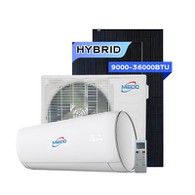
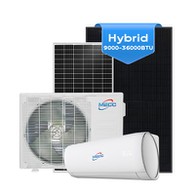
System Integration & Power Dynamics: The setup combines three key components to power air conditioning units (ranging from 9000BTU to 24000BTU, depending on space size):
Solar Panels: A grid-tied solar array (typically 1.5–4kW, based on AC capacity) consisting of high-efficiency monocrystalline panels (22–23% conversion rate). For example, a 12000BTU (≈3.5kW) AC requires 2–3kW of panels (5–8 x 400W modules) to cover 60–80% of its daytime energy needs.
Grid-Tied Inverter: Converts DC solar power to AC, directly feeding the AC unit and synchronizing with the grid. It prioritizes solar energy first, using grid power only when solar output is insufficient (e.g., cloudy weather, evenings).
Compatible AC Unit: A high-efficiency air conditioner (EER ≥3.0) with inverter technology to adjust power consumption based on cooling demand, minimizing energy waste.
During peak sunlight, the solar array generates enough power to run the AC continuously, with excess energy fed back to the grid (via net metering) for credits. After sunset or in low light, the system relies entirely on grid power, ensuring uninterrupted cooling.
Efficiency & Cost Savings: By leveraging solar energy, the system reduces grid electricity usage for cooling by 50–80% during daylight hours. For a 12000BTU AC running 6 hours daily in sunny conditions:
Standard grid-only operation costs ≈$0.80–$1.20/day (based on $0.15/kWh).
With solar, daily costs drop to $0.15–$0.40, saving $200–$400 annually.
Net metering amplifies savings: excess solar energy exported to the grid earns credits, offsetting evening or cloudy-day grid usage.
Performance & Reliability: The system delivers consistent cooling performance, matching the AC's rated capacity (e.g., 9000BTU cools 10–18㎡, 24000BTU cools 30–45㎡) regardless of solar input. The grid-tied inverter ensures stable power flow, preventing voltage fluctuations that could damage the AC. Solar panels are built to withstand harsh weather (hail, high winds) with 25-year warranties, while the inverter and AC unit offer 5–10 year warranties for long-term reliability.


● AC/DC auto-balance


FAQ
Q: What is the difference between a split-system and a window-unit version of them?
A: A split-system version consists of an indoor unit and an outdoor unit. The indoor unit is installed inside the room or building and contains components like the evaporator coil and the fan. The outdoor unit houses the compressor, condenser coil, and other parts. This design allows for quieter operation indoors, as the noisy compressor is located outside. It also provides more flexibility in installation, as the two units can be placed in different locations to optimize space and airflow. A window-unit, on the other hand, is a self-contained unit that is installed in a window or through a wall opening. It's more compact and easier to install in some cases, especially for small rooms or apartments. However, it can be noisier since all components are in one enclosure, and it might not offer as much cooling capacity as a split-system for larger spaces.
Hot Tags: on grid solar energy air conditioner system, China on grid solar energy air conditioner system manufacturers, suppliers