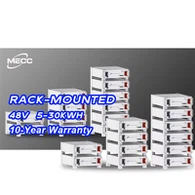
5-30KWH Stacked Lithium Batteries
48V Efficiency & 15KWh Capacity for Heavy-Duty Loads
Operating at 48V with 15KWh capacity, this battery delivers enough energy to power a large home (HVAC, appliances, lighting) for 24+ hours, a small farm's irrigation pump (1.5kW) for 10 hours, or a café's refrigeration and POS systems for 16+ hours. The 48V design reduces energy loss in 20+ meter cable runs (common in farms or commercial spaces) by 40% compared to 12V/24V systems, ensuring more stored energy reaches critical loads. Its 300A continuous discharge rate (600A surge for 15 seconds) handles sudden high-demand spikes-such as a home's AC kicking in or a farm's grain dryer starting-without voltage drops that could damage equipment.
Stacked Modularity for Scalable Growth
The battery's stacked design lets users start with 15KWh and expand incrementally:
Add 5KWh modules to reach 20KWh+ for larger farms or multi-unit residences.
Stack units in parallel/series to hit 30KWh+ for community microgrids or event venues.
Each module (55cm×40cm×20cm) fits into standard 19-inch racks or wall-mounted enclosures, saving 50% of floor space vs. non-stacked batteries. Quick-connect busbars simplify expansion-no rewiring required-making it easy to scale as energy needs grow (e.g., adding more solar panels to a home).
Integrated BMS: Smart Control for Reliability
The built-in Battery Management System (BMS) acts as the "brain" of the system, with features tailored to dynamic use:
Multi-Layer Protection: Guards against overcharging, over-discharging, short circuits, and thermal runaway-critical for stacked setups where one faulty module could affect the entire system.
Cell & Module Balancing: Ensures uniform charge/discharge across all cells and stacked modules, extending overall lifespan by 30% compared to unmanaged systems.
Adaptive Performance: Adjusts to temperature extremes (-20°C to 60°C), slowing charging in cold weather to prevent lithium plating and optimizing efficiency in hot climates (e.g., desert farms).
Data Integration: Connects to solar inverters, grid meters, or SCADA systems via RS485/Wi-Fi, providing real-time data (state of charge, module health) for remote monitoring-ideal for farmers or business owners managing systems off-site.
- Are there any environmental concerns related to lithium - ion batteries?
Yes, improper disposal can cause environmental pollution, especially if the heavy metals and chemicals in them are not properly handled.
- What are the common applications of lithium - ion batteries?
They are widely used in mobile phones, laptops, and electric vehicles.
- What are the unique features of lithium polymer batteries?
They have a flexible and thin - film design, which allows for more shape versatility.
- How is the manufacturing process of lithium polymer batteries different?
It often involves different techniques to incorporate the polymer electrolyte.
- Are lithium polymer batteries safer than other lithium batteries?
They can have better safety features due to the nature of the polymer electrolyte.
- Can lithium polymer batteries be made in custom shapes?
Yes, their flexible design enables custom shaping for specific applications.