




With the rapid development of the photovoltaic industry, the quality and performance testing technology of solar cells is also constantly improving. I often hear others talk about photovoltaic PL and photovoltaic EL, but what are they used for? There should also be many people who have only a partial understanding of it, know its nature, do not know its reasons, and do not understand its principles, structure, and uses. These are two non-destructive optical detection technologies widely used in the manufacturing process of photovoltaic cells. They play a crucial role in improving the manufacturing accuracy and product quality of solar cells.
1. What is the PL of photovoltaics?
The PL of photovoltaic cells is also known as photoluminescence.
① PL principle:
Photoluminescence refers to the phenomenon in which electrons in a solar cell are excited to a higher energy state when exposed to laser or strong light. When these electrons return from a high energy state to a low energy state, they release photons, which is known as photoluminescence.

② Application scenarios of PL
In the production process of photovoltaic cells, PL technology is widely used in the following aspects:
Material quality testing: PL can help identify crystal defects, impurities, and unevenness in solar cell materials. High quality crystalline materials are the foundation of efficient solar cells, and PL can detect these potential defect areas through changes in their luminescence intensity and spectrum.
Carrier lifetime analysis: Carrier lifetime is one of the important indicators for measuring the performance of solar cells. Through PL detection, the lifetime distribution of charge carriers in the material can be obtained, thereby evaluating the photoelectric conversion efficiency of the material.
Bandgap energy measurement: PL technology can also be used to measure the bandgap energy of semiconductor materials, which is of great significance for designing and optimizing the optoelectronic performance of solar cells.

③ The advantages of PL technology
The biggest advantage of PL technology is that it is a non-destructive detection method that can provide detailed material information without damaging the material or battery structure. This makes PL a fast and effective quality control tool in the photovoltaic industry.

2. What is photovoltaic EL?
The EL of photovoltaic cells, also known as electroluminescence, is the full name of electroluminescence.
① The working principle of EL
Electroluminescence (EL) refers to the recombination of electrons and holes at the PN junction in a solar cell when a forward voltage is applied, resulting in photon emission. These photons are usually in the near-infrared region and cannot be seen by the naked eye, but can be detected by specific imaging devices. The brightness and distribution of EL images can directly reflect the internal structure and defects of the battery.

② Application scenarios of EL
EL technology has a wide range of applications in finished product testing and quality control of solar cells:
Defect detection: EL images can clearly display defects such as cracks, hidden cracks, short circuits, and open circuits in solar cells. Through these images, manufacturers can identify and eliminate defective battery cells before leaving the factory, thereby ensuring product quality.
Efficiency evaluation: EL can also be used to evaluate the overall efficiency of solar cells. If certain areas in the battery show reduced brightness or dark spots, it usually means that these areas have issues with efficiency loss or high electron recombination rate.
Component uniformity detection: When assembling battery components, EL images can help ensure consistent performance of each battery cell, avoiding the impact of poor performance of certain cells on the output power of the entire component.

③ The advantages of EL technology
EL technology can provide detailed defect information without disassembling the battery, which is particularly important for the inspection of finished batteries. In addition, EL images have high resolution and clarity, which can accurately locate the location and nature of defects, making EL a key tool for quality control of photovoltaic cells.
MECC Mono Solar Panels:

MECC410W-B

MECC550W-BI

MECC550W-MO

MECC580W-B

MECC590W
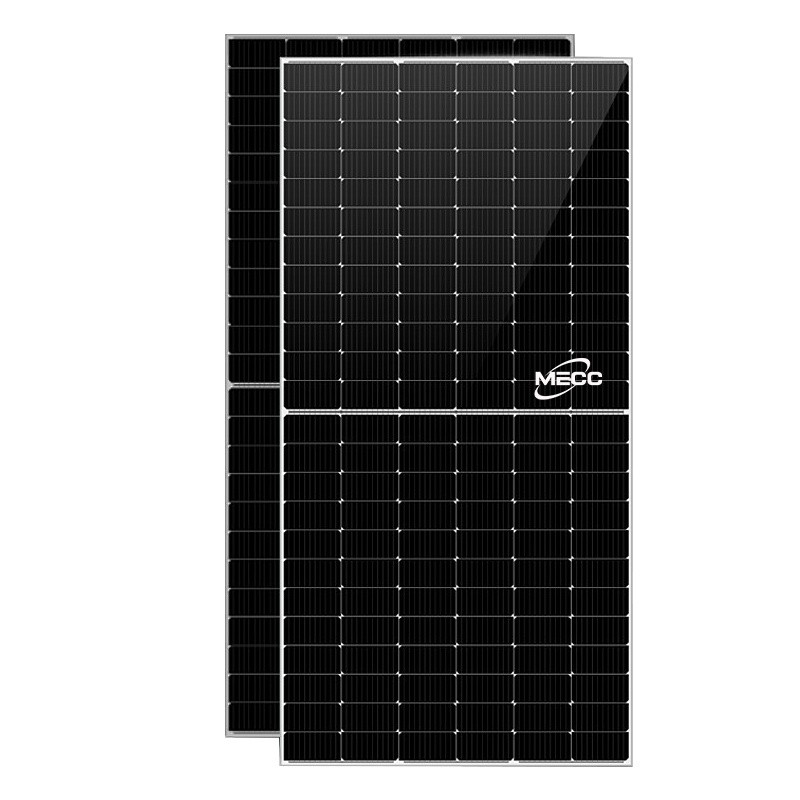
MECC600W-BI
The difference and connection between PL and EL
Although PL and EL are both non-destructive optical detection technologies, their working principles and application scenarios are different:
The excitation methods are different: PL excites photons through external light source irradiation, while EL generates photons inside the battery by applying voltage.
Different application stages: PL is usually used for early detection of materials, evaluating crystal quality and material properties; EL is more commonly used for quality inspection and defect localization of finished batteries.
Different detection targets: PL is mainly used to analyze the physical properties of materials, such as carrier lifetime and bandgap energy; EL is used to discover structural defects and performance inconsistencies within the battery.

Photoluminescence (PL) and electroluminescence (EL) technologies provide powerful tools for the production and quality control of photovoltaic cells. PL focuses on early detection of materials, while EL focuses on defect identification of finished batteries. Their respective advantages and application scenarios complement each other, jointly ensuring the efficient production and stable performance of photovoltaic cells. In today's continuously developing photovoltaic industry, the importance of PL and EL technologies will become increasingly prominent, continuing to safeguard the promotion and application of clean energy worldwide.