


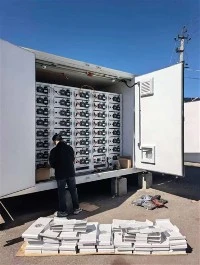
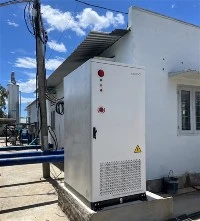
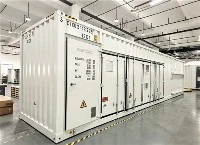
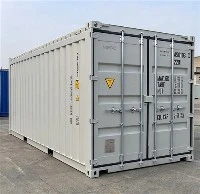
The energy storage system has evolved from centralized systems in the early days to string systems today, solving the barrel effect and expanding from DC compartments to AC/DC integration, reducing the efficiency loss of multi-level conversion on the DC side.
Every innovation in the architecture and integration technology of energy storage systems essentially solves the efficiency and safety contradiction of traditional architectures through modular decoupling, functional integration, intelligent collaboration, and so on.
However, with the continuous emergence of large capacity battery cells, how can traditional 20 foot containers achieve the ultimate accommodation of battery cells in limited space? How to further balance the balance between energy conversion and safety?
In this context, the industry has higher expectations for the next generation of energy storage architectures and integrated technologies.
Recently, American integrator Fluence has introduced the disruptive energy storage container product Smartstack, which breaks down battery energy storage systems into units that are easy to transport in terms of weight and size, reducing transportation restrictions and simplifying complex installation processes.
Not only that, this product not only integrates AC and DC, but also separates the traditional container 3S system from the highly coupled design of the battery, achieving simple expansion without the need for overall system replacement or more complex modifications.
From the mainstream size perspective, energy storage containers generally adopt international standard container sizes (such as 20 foot or 40 foot specifications) to ensure compatibility with existing sea, rail, and road transportation systems.

However, a consensus issue is that the number of battery cells that can be accommodated in the existing 20 foot container is limited. To truly achieve further expansion of system capacity, a comprehensive upgrade of battery cells and energy storage devices is required.
From the perspective of battery cell upgrades, there have been 20 foot energy storage containers with capacities of 314Ah, 560Ah, 587Ah, 625Ah, 688Ah, etc. The system capacity is constantly breaking through to 5MWh, 6MWh, 7MWh, and even 10MWh.
How to upgrade energy storage devices?
One is to reshape the traditional design of energy storage containers. Fluence's Smartstack separates the battery compartment from the electrical system, bringing different design languages.
The second is to simplify the coupling method of the energy storage system. Last year, Haichen Energy Storage innovatively proposed the concept of using PACK as the basic product platform, which is configured outside of a 20 foot container, transforming the strong coupling relationship of electricity, heat, control, fire protection, power, etc. into a weak coupling relationship, unlocking more new forms of energy storage systems. In fact, the innovation of energy storage systems is closely related to the development of high-capacity energy storage cells.
In 2024, major battery manufacturers will launch 314Ah battery cells in order to comply with the 36276 national standard requirement that the charging and discharging capacity at the Pack and Rack levels must be greater than or equal to the rated capacity.
The reason is that the 314Ah battery cell is exactly at the lower capacity limit of this standard, and has achieved a capacity increase under the limitation of the number of mainstream system battery cells, gradually replacing the 280Ah battery cell as the new mainstream product.
On the one hand, the 314Ah energy storage cell has the same size and material system as the 280Ah cell, reducing the number of PACKs and sharing the system cost.
On the other hand, the 314Ah battery cell production line can basically continue to use 280Ah, and the compatibility of the production line reduces the cost of production line renovation to a certain extent. Battery cell enterprises also have more flexibility in expanding production capacity in the future.
In fact, as long as the basic premise of "the charging and discharging capacity of Pack and Rack levels must be greater than or equal to the rated capacity" is met, the theoretical upper limit of energy storage cell capacity is very large.

The new product launched by Fluence is a major attempt for energy storage systems to move from "fixed integration" to "dynamic assembly", reshaping the design of energy storage systems and breaking the boundaries of the form and coupling of energy storage containers. Its core value lies in the optimization of full lifecycle costs and unlimited adaptation to different scenarios.
Specifically, Fluence Smartstack is divided into two parts: Smart Skid and Smart Pods, which separates the battery cabinet from the 3S system and breaks away from the design of integrating mainstream energy storage cabinet batteries and 3S into a single cabinet.
Among them, Smart Pods are modular and independent battery compartments that only include battery modules, local BMS sensors, and basic temperature control units, which can support batteries from different suppliers.
The Smart Skid electrical control cabin is centrally deployed with 3S core equipment, integrating cooling systems, fire protection devices, cables, and other intelligent control and monitoring systems. It is responsible for energy conversion, scheduling, and safety control, and can be connected to the battery compartment for rapid installation and predictive maintenance without the need for downtime.

If Fluence is a decoupling and deconstruction design based on battery compartments, it has achieved a picture of a 7.5MWh capacity. The unit anchored by Haichen Energy Storage is smaller, and decoupling is achieved based on PACK as the basic unit. By flexibly configuring different numbers of PACK, breakthroughs in system capacity of 7MWh+or even 8MWh+can be achieved.
It is worth mentioning that both companies' solutions can be achieved by adding battery modules PACK, Or compatible with different batteries to achieve longer energy storage time. Customization can be completed according to customer needs in the future to achieve performance upgrades similar to building LEGO.
It should be noted that the integrated innovation of energy storage systems is still driven by economic efficiency. Whether the mainstream "20 foot container" position can be shaken depends on the follow-up of leading enterprises, and market follow-up is only a matter of time.
In addition, the energy storage industry is still policy driven, and the current level of marketization cannot support the diversified and differentiated development of terminal equipment.
I believe that with the gradual improvement and maturity of energy storage electricity market transactions, improving energy storage utilization and economy, the contradiction between traditional energy storage system architecture and large capacity demand will be eliminated in the future.