





Ask any facility manager today what chemistry is inside their commercial battery storage system, and the answer is almost always lithium iron phosphate. LFP has earned that dominance - it is safe, cheap, well-understood, and backed by a mature global supply chain. But it is not the only answer, and it will not be forever.
Two technology families are moving from the laboratory and the pilot site toward real industrial energy storage projects: sodium-ion batteries and flow batteries. Neither is a drop-in replacement for LFP today. Both solve specific problems that LFP handles poorly - extreme cold, very long discharge durations, and supply-chain concentration. If you are planning a C&I energy storage project with a 15- to 25-year horizon, it is worth understanding where these emerging options fit before you lock in a chemistry.

Why Industrial Storage Is Looking Beyond Lithium
Three pressures are pushing buyers to evaluate alternatives.
The first is duration. Peak shaving and TOU arbitrage typically need one to four hours. But an increasing number of industrial sites want eight, ten, or twelve hours of discharge - to ride through a full production shift, to shift solar generation from midday to a night shift, or to displace diesel backup entirely. Lithium gets expensive fast when you stack hours onto it.
The second is temperature. LFP cells lose usable capacity in freezing conditions and require heating, which eats into round-trip efficiency and adds parasitic load. Many industrial sites sit in exactly those climates - cold storage warehouses in northern latitudes, mines, remote processing plants.
The third is supply chain and safety optics. Lithium, cobalt, nickel, and graphite supply is geographically concentrated and price-volatile. Some industrial insurers and owners simply prefer a chemistry whose electrolyte is water-based and cannot enter thermal runaway.
That is the opening for sodium-ion and flow.
Sodium-Ion: The Drop-In Contender
Sodium-ion batteries work on the same intercalation principle as lithium-ion. Sodium ions shuttle between a cathode and a hard-carbon anode, separated by a liquid electrolyte. The manufacturing process is strikingly similar to lithium-ion - which is the whole point. Sodium-ion cells can be produced on existing lithium-ion lines with modest retooling.
The advantages for industrial storage are concrete:
Cold-weather performance. Sodium-ion retains a much larger share of its capacity at temperatures below freezing, and several designs continue to operate down to −30°C. For cold-climate industrial sites, this can eliminate or drastically shrink the HVAC and heating load that lithium systems carry.
Material abundance. Sodium is roughly a thousand times more abundant than lithium and is not geographically concentrated. Cathodes can be built from iron, manganese, and prussian-blue analogues - no cobalt, no nickel.
Safety. Cells can be shipped and stored at zero volts, which removes a major transport and installation hazard. Thermal runaway behaviour is generally more benign than high-nickel chemistries.
Fast charge capability. Sodium-ion accepts high charge rates well, which suits sites with short, intense charging windows - think charging electric yard trucks or material-handling fleets between shifts.
The limitations are equally real. Energy density is meaningfully lower than LFP, so a sodium-ion container occupies more space per kWh. Cycle life has improved rapidly but the longest-lived commercial cells still trail the best LFP products. And the supply chain is young - bankability, warranty depth, and third-party certification history are still being built.
Where sodium-ion fits best today: commercial and industrial energy storage in cold climates, sites with constrained safety envelopes, fleet-charging buffers, and buyers who want to hedge away from lithium price exposure. Treat it as an emerging option to pilot, not yet a default specification.

Flow Batteries: Built for Long Duration
Flow batteries take a fundamentally different approach. Instead of storing energy inside sealed cells, they store it in two tanks of liquid electrolyte that are pumped through a stack of electrochemical cells. Power output is set by the size of the stack; energy capacity is set by the size of the tanks. The two scale independently.
That decoupling is flow's superpower. Need ten hours instead of four? Add electrolyte - or a bigger tank - without touching the power electronics. This is why flow batteries are the leading candidate for long-duration storage at industrial scale.
The main flow chemistries you will encounter:
Vanadium redox flow (VRFB). The most commercially mature. Vanadium electrolyte can be rebalanced and reused almost indefinitely, giving VRFB systems a service life of 20 years or more with negligible capacity fade. It is also fully non-flammable. The catch: vanadium is expensive and its price is volatile.
Zinc-bromine. Higher energy density than VRFB and lower electrolyte cost, with a hybrid design that plates zinc during charging. Bromine handling requires care.
Iron-based and zinc-iron flow. Attractive on raw material cost and supply-chain security, with several designs now targeting commercial deployment. Iron electrolyte is cheap and abundant; the trade-offs are in round-trip efficiency and system maturity.
Organic flow. Water-soluble organic molecules replace metals entirely, which could unlock very low electrolyte costs. Still largely at the demonstration stage.
Flow's weaknesses are also structural. Round-trip efficiency typically lands in the 60–75% range, well below LFP's 85–90%. That means higher charging costs for the same delivered energy - a real LCOS penalty. Footprint is large, the electrolyte is heavy, and the balance of plant - pumps, stacks, sensors, controls - introduces more maintenance touchpoints than a sealed lithium container.
Where flow wins: sites that need six to twelve hours of duration, have available land or rooftop space, place a premium on non-flammable chemistry, and can tolerate lower round-trip efficiency in exchange for 20-year asset life and stable long-term economics.
How to Choose: A Practical Decision Frame
Rather than asking which technology is "best," ask what your project actually needs.
Start with duration. Under four hours, LFP remains the rational default. Four to eight hours, sodium-ion becomes interesting if the economics improve or if you are in a cold climate. Beyond eight hours, flow deserves a serious line in your comparison.
Then look at climate and site constraints. Cold sites should quantify the heating load a lithium system would carry. Space-constrained urban sites will struggle to fit flow. Sites with strict fire-separation rules may find aqueous, non-flammable electrolytes easier to permit under NFPA 855 and local fire codes.
Then examine duty cycle. High-frequency, shallow cycling favours a system with high round-trip efficiency. Once-per-day, deep cycling on a long-duration duty favours a technology with low degradation and long calendar life.
Finally, model LCOS, not capex. Upfront cost per kWh is the number everyone quotes, but it hides augmentation, HVAC load, efficiency losses, and replacement cycles. A flow system with a higher sticker price and a 20-year life can beat a cheaper lithium system that needs a mid-life augmentation. Conversely, a low-efficiency system can be expensive to operate even if it is cheap to buy.
Where This Is Heading
Sodium-ion is the more immediately disruptive of the two for commercial-scale projects, because it slots into existing manufacturing infrastructure and existing system architectures. Expect it to win first in cold-climate and safety-sensitive niches, then expand as cycle life improves and volume drives cost down.
Flow batteries will remain a specialist tool for long-duration storage, but that niche is growing as industrial sites electrify more of their thermal load and push for genuine multi-hour resilience rather than a token hour of backup.
The practical takeaway for anyone specifying industrial energy storage in the next few years: keep LFP as your baseline, but build the evaluation criteria - duration, climate, efficiency, LCOS, and certification pathway - so that when sodium-ion or flow becomes the better answer for your site, you recognise it. The chemistry decision is no longer a one-time default. It is a design choice.
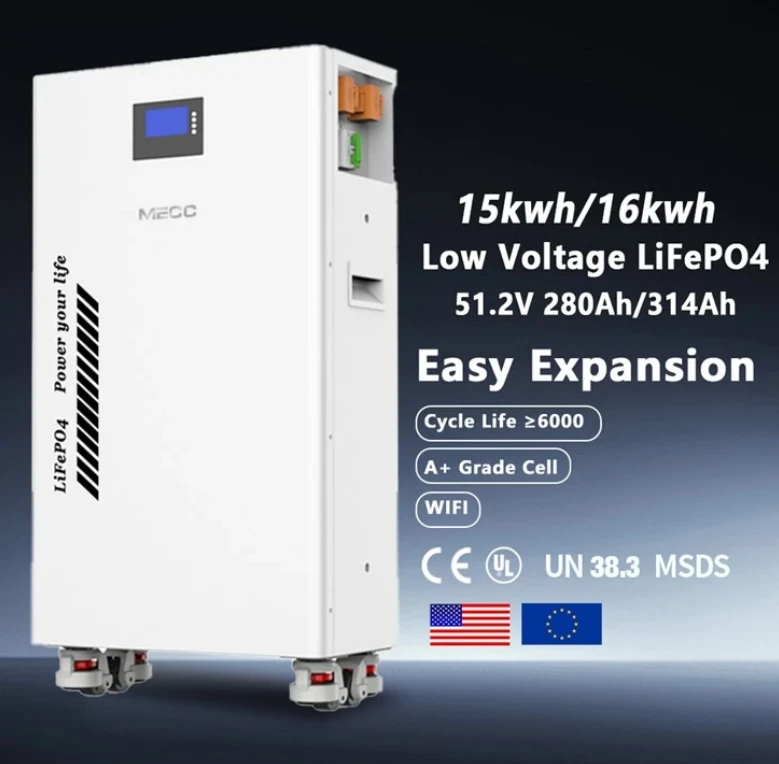
51.2V 314AH LiFePO4 Lithium Battery For Residential Energy Storage System
Our 51.2V 314Ah energy storage battery is a high-performance power solution designed for demanding residential applications. Built with advanced lithium iron phosphate (LFP) technology, it delivers exceptional energy density, long cycle life, and unmatched safety.
Detailed Product Features:
Massive Capacity: Store abundant energy to power your operations during peak demand or grid outages.
Long Cycle Life: Enjoy thousands of cycles without significant capacity degradation, ensuring long-term reliability and cost-effectiveness.
Superior Safety: LFP chemistry provides inherent safety, preventing thermal runaway and fire hazards
Scalable System: Easily combine multiple units to create customized energy storage solutions for any scale.
Efficient Charging and Discharging: Optimize energy utilization and minimize charging times.
Robust Construction: Built to withstand harsh environments and heavy-duty use.