


Main keyword: IP rating battery cabinet
Every outdoor battery storage cabinet on the market carries an IP rating on its datasheet - IP54, IP55, IP65 - and for most buyers those two characters after "IP" are the least scrutinized specification in the entire proposal. That is a mistake. The ingress protection rating determines how dust, rain, hose spray, and years of weather interact with everything inside the enclosure: cells, busbars, inverters, and control electronics. Choosing the right IP rating for a battery cabinet is not about picking the biggest number; it is about matching protection to the installation environment, the cooling design, and the service strategy - because the rating is always a trade, and its costs hide in places datasheets don't show.
This article decodes the IP system under IEC 60529, compares the three ratings that dominate outdoor BESS enclosures, explains how cabinet cooling interacts with the rating, and gives a practical selection framework by site environment.

Decoding the IP Code
"IP" stands for Ingress Protection, defined by international standard IEC 60529. The code has two digits, and each answers a different question.
The first digit covers solids: 4 means protection against objects and wires thicker than 1 mm; 5 means dust-protected (dust may enter in small quantities but never enough to interfere with operation); 6 means dust-tight (no ingress at all, tested against talcum powder under vacuum).
The second digit covers water: 4 means splashing water from any direction; 5 means water jets - a 6.3 mm nozzle at roughly 30 kPa from any direction, essentially a pressurized hose; 6 means powerful jets - a 12.5 mm nozzle at higher pressure and volume, closer to heavy marine washdown. Note what is not in any of these ratings: submersion (that is digit 7 or 8) and environmental corrosion (that is a separate salt-spray or C-class rating).
Two practical points matter for reading datasheets. First, the rating applies to the enclosure as tested, as built - gaskets, cable glands, door seals, and louvers all count, and any field modification (drilling a conduit hole, adding an antenna) can void the rating at that penetration. Second, a rating is a design and test claim, not a guarantee; real-world performance depends on maintenance of the seals over the cabinet's life.
IP54: Dust-Protected and Splash-Resistant
IP54 is the entry point for outdoor enclosures: good solid protection (digit 5, dust-protected) paired with the weakest water rating in this comparison (digit 4, splashing only).
In storage cabinets, IP54 almost always signals a specific design choice: active ventilation. Cabinets that exchange air with the outside - pulling ambient air through filters to cool electronics - cannot be sealed tight, and IP54 is the realistic rating for filtered-air designs. This is common in lower-power enclosures and some electronics compartments where air-to-air cooling is the cheapest thermal answer.
The trade-off is environmental exposure. An IP54 compartment breathes: dust accumulates on filters and internal surfaces, humid air enters and condenses when temperatures swing, and corrosive coastal air will work its way in. IP54 designs therefore demand disciplined filter maintenance and are best treated as indoor-quality electronics housed outdoors - acceptable in mild, clean environments; risky in dust storms, salt spray, or heavy industrial air.

IP55: The Workhorse of Outdoor BESS
IP55 upgrades the water protection from splashing to jets - the difference between rain and a fire-hose-adjacent blast. Why does that matter for something sitting on a pad? Because outdoor equipment gets hosed: firefighting response, near-miss water events, pressure-washing during maintenance of adjacent equipment, and wind-driven rain during storms all produce jet-like exposure. An IP54 door seal that survives ten years of rain may fail the first time a hose sweeps past a gasketed seam.
IP55 is where the mainstream outdoor battery storage cabinet market has settled, and for good reason:
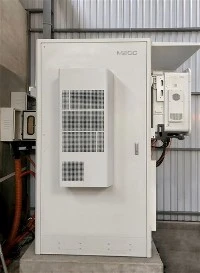
It matches sealed forced-air or liquid cooling. Most modern outdoor BESS cabinets use closed-loop cooling - air-to-air heat exchangers or liquid cooling with external dry coolers - which keep the enclosure sealed while still moving heat. A sealed loop makes IP55 achievable without sacrificing thermal performance.
It survives real-world water events. Jet protection covers firefighting, storm-driven rain, and maintenance washdowns - the scenarios that actually occur in a 15-year service life.
It keeps dust out with tolerable cost. Dust-protected (not dust-tight) still allows trace ingress, but with a closed cooling loop and gasketed seams, internal dust accumulation is minimal and manageable.
The maintenance cost of IP55 lives in the gaskets: door seals, louver covers, and gland plates are the rating's weak points, and a preventive schedule that inspects and replaces seals is what keeps a year-10 cabinet at its year-1 rating.
IP65: Dust-Tight, and What It Costs
IP65 completes the pair: dust-tight (digit 6) plus powerful jets (digit 6). On paper it is strictly superior - no dust ingress at all, higher water exposure tolerance. In practice, the market has been cautious, and the reasons illuminate the physics.
Sealed enclosures must dump heat another way. A dust-tight, jet-proof cabinet cannot ventilate, so all internal heat must exit through the enclosure walls or via liquid cooling infrastructure. For battery compartments with moderate heat output, that is manageable. For power electronics compartments with heavy inverter losses at full load, fully sealed designs require larger liquid cooling capacity or bigger heat-exchanger surface - added cost and parasitic load that run continuously.
Seals become single points of failure. The tighter the rating, the more the enclosure depends on the integrity of its gaskets, glands, and latches. An IP65 cabinet with one degraded door seal quietly behaves like IP54 - but unlike the ventilated design, it may also be losing its condensation control, since fully sealed boxes rely on breathers or dehumidifiers to manage trapped moisture.
Verification is harder. Dust-tight claims require vacuum-powder testing of the actual design; buyers should ask which variant and components were tested, not just the catalog rating.
IP65 earns its cost in the harshest environments: deserts with sand-laden winds, coastal salt atmospheres, mining and cement sites with abrasive dust, and anywhere washdown or flood-adjacent spray is routine. In mild climates, the premium over IP55 is usually money spent protecting against events that will not occur.
One Cabinet, Two Ratings: Reading BESS Sub-Compartment Specs
A detail that trips up many buyers: modern outdoor BESS containers often carry different IP ratings per compartment. The battery compartment - lower heat density, less service access needed - is commonly IP55 or IP65 with sealed liquid cooling. The power electronics compartment - inverters, transformers, switchgear - may be IP54 or IP55 with its own cooling strategy, balancing heat rejection against protection.
This is legitimate engineering, not corner-cutting, but it changes how you read a proposal: a headline "IP65" on the container means nothing if the inverter bay is IP54 and your site is a desert. Ask for the rating per compartment, ask which cooling design accompanies it, and ask how penetrations (cable entries, coolant lines) are sealed in each.
A Selection Framework by Environment
Condense the decision into your site's reality:
Mild, clean, inland climates with good drainage: IP54–IP55 with filtered or closed-loop cooling is sufficient; prioritize thermal efficiency and filter serviceability over the last digit.
Standard outdoor industrial sites - the majority case: IP55 with closed-loop air or liquid cooling, backed by a gasket inspection and replacement schedule. This is the proven mainstream.
Deserts, coasts, mining/cement zones, washdown-prone or flood-adjacent pads: IP65 (dust-tight) for the compartment that needs it, verified by test certificates per compartment, with liquid cooling sized for the sealed-enclosure heat duty.
Everywhere: treat the rating as a maintained property, not a purchased one. Seals, glands, and drainage are consumables; write their inspection into the O&M plan from day one.
The Bottom Line
IP54, IP55, and IP65 are not better-versus-worse choices - they are three different bargains between environmental exposure, thermal design, and maintenance cost. For most outdoor battery storage cabinets, IP55 with a closed cooling loop is the rational center of gravity; IP54 suits mild climates and ventilated electronics bays; IP65 pays for itself where dust, salt, or washdown exposure is real. What matters most is not the number on the datasheet but the system behind it: the cooling design the rating forces, the compartment-level truth of what was actually tested, and the seal maintenance that keeps the rating alive for fifteen years. Ask those questions, and the IP code becomes what it should be - a meaningful, verifiable contract with the weather.

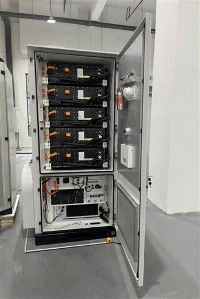
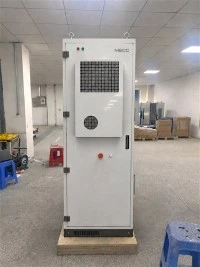
125KW 241kWh Battery Energy Storage System Cabinet
The BESS 125KW 241kWh Lithium Battery Energy Storage Cabinet is a high-power, large-capacity integrated energy storage solution engineered for medium-to-large commercial, industrial, and utility-scale applications. It integrates a 125kW high-performance bidirectional inverter, a 241kWh lithium iron phosphate (LiFePO4) battery bank, and a full-featured intelligent energy management system (EMS) into a modular cabinet design. This system enables efficient renewable energy storage, peak shaving, load shifting, grid frequency regulation, and emergency backup power supply. Ideal for large factories, shopping malls, industrial parks, utility-scale solar/wind farms, and microgrids, it enhances energy independence, reduces high grid demand charges, and supports the stable integration of high-penetration renewable energy into the grid.