


Balcony photovoltaics are driving the transition of household energy systems from "grid dependence" to "partial autonomy". Through the combination of "photovoltaic power generation+energy storage backup+intelligent control", households can maintain basic electricity consumption even in the event of power outages or high electricity prices, and even achieve the goal of "zero electricity purchase" for energy independence. The global project aims to reshape the relationship between households and energy by adapting to different layouts, optimizing energy storage configurations, and simplifying management processes, making "balcony power stations" a "buffer" for household energy security and a "throttle valve" for reducing electricity bills.
1 Small unit adaptation: Energy autonomy under limited space
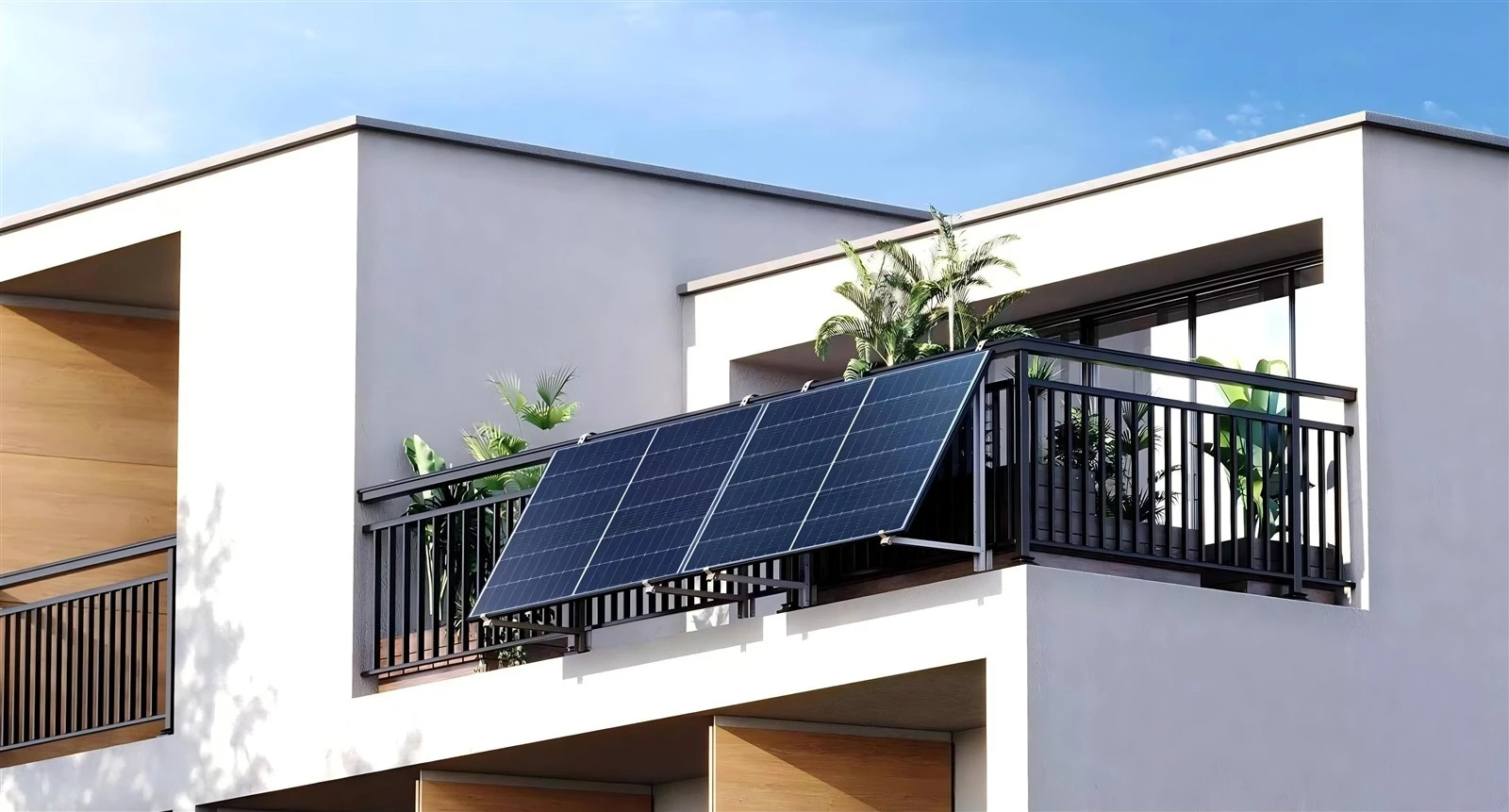
China's "Folding Photovoltaic+Mini Energy Storage" Solution. A certain brand has developed a 1.2-meter x 0.6-meter foldable photovoltaic panel (unfolded to cover the outside of the guardrail, with a thickness of 8cm after folding) for the balconies of small high-rise apartments in cities (with a width of 1-1.2 meters), combined with a 500Wh mini energy storage (with a volume similar to a suitcase and a weight of 5kg), to form a "plug and play" energy autonomous system. According to actual testing of a 90 square meter apartment in Shanghai, the system generates 1 kWh of electricity per day, meeting the basic needs of refrigerators (0.5 kWh/day), lighting (0.3 kWh/day), and mobile phone charging (0.2 kWh/day). In the event of a power outage, it can maintain basic power supply for 3 days, saving an annual electricity fee of 360 yuan and a payback period of 6 years.
Japan's innovation of "photovoltaic window film+wall energy storage". A certain apartment in Tokyo will cover the balcony glass with cadmium telluride photovoltaic window film (with a light transmittance of 60%, which does not affect lighting), generating a power of 100W. Thin energy storage batteries (with a thickness of 5cm and a capacity of 1kWh) will be installed on the walls to form an "invisible energy system". This plan does not require occupying balcony floor space and is suitable for extremely small households under 60 square meters. It generates an average of 0.8 kWh of electricity per day and, in conjunction with the "peak valley arbitrage" (valley charging, peak discharging), saves 24000 yen (about 1200 RMB) in annual electricity bills. At the same time, it can provide power for emergency lights and routers in case of power outages caused by typhoons, enhancing the sense of living security.
2 Medium to large sized units: Energy allocation with high self-sufficiency rate
The synergy of balcony photovoltaics and whole house energy storage in Europe. A 120 square meter apartment in Munich, Germany, is equipped with four 300W photovoltaic panels (with a total power of 1.2kW) on the balcony, paired with 5kWh energy storage batteries. Autonomy is achieved through a "whole house energy management system": during the day, the photovoltaic panels are prioritized for high-power equipment such as washing machines, ovens, and air conditioners, and the remaining electricity is charged into energy storage; Nighttime energy storage discharge meets the needs of lighting, television and other loads, and only purchases a small amount of electricity when the energy storage is insufficient. The photovoltaic self use rate of the system has reached 92%, and the annual purchased electricity has been reduced from 3000 kWh to 500 kWh, saving 1800 euros in electricity bills. At the same time, it participates in grid demand response (reducing purchased electricity during peak hours), with an additional annual income of 300 euros, achieving the dual goals of "basic energy autonomy+economic benefits".
The closed loop of "balcony photovoltaic+electric vehicle charging" in the United States. A villa in California has linked a 2kW photovoltaic system with a 10kWh energy storage and electric vehicle charging station on its balcony, forming a "light storage vehicle" energy loop: during the day, the photovoltaic system provides priority for household electricity and car charging (it takes 4 hours to fully charge one electric vehicle), while the remaining electricity is charged into energy storage; Nighttime energy storage provides power for households, while replenishing energy from the grid during low electricity prices (0.3 USD/kWh) to avoid deep discharge of energy storage. This closed loop reduces annual household electricity purchases by 70%, enables zero cost charging of electric vehicles, saves $2400 in annual comprehensive expenses, achieves an energy autonomy rate of 85%, and basically eliminates dependence on the power grid.

3 Extreme Scenario: The Security Value of Energy Autonomy
Off grid balcony photovoltaic autonomy in Africa. Nairobi slum households in Kenya have developed an off grid autonomous system using 100W balcony photovoltaics and 200Wh energy storage to meet their needs for mobile phone charging (2 units per day), LED lighting (3 units), and radio power supply, completely eliminating their dependence on expensive diesel generators ($0.8 per kilowatt hour). The system adopts a "waterproof and dustproof design" (IP65), adapted to the high temperature sand and dust environment in Africa, generating an average of 0.6 kWh of electricity per day, saving $144 in annual electricity bills (equivalent to 1.5 times the average monthly income of local households), and becoming the only energy source for households in war-torn areas where the power grid is completely paralyzed, ensuring basic living and communication needs.
Nordic winter energy autonomy optimization. A family in Oslo, Norway, installed adjustable angle photovoltaic panels on their balcony (with a winter tilt angle of 45 ° to enhance weak light absorption), paired with 2kWh of low-temperature energy storage (with a capacity retention rate of 80% at -20 ° C), using a "photovoltaic preheating+energy storage insulation" strategy: during the day, photovoltaic power generation prioritizes energy storage preheating (to avoid low-temperature capacity decay), and at night, when energy storage is discharged, it first provides basic heat for the indoor heating system (underfloor heating), and then meets other loads. Winter testing shows that the system reduces household winter electricity purchases by 40%, with an energy autonomy rate of 60%. At the same time, during the extreme night period (without photovoltaics), energy storage can maintain basic heating for 5 days, avoiding pipeline freezing and cracking, highlighting the energy security value under extreme weather conditions.
The "household energy autonomy" model of balcony photovoltaics is upgrading from "supplementary energy" to "core energy". In the future, with the application of perovskite flexible photovoltaics (efficiency exceeding 30%) and long-life energy storage (10000 cycles), the home energy autonomy rate will exceed 95%, and even achieve complete autonomy of "zero carbon and zero electricity purchase", making every household a "micro energy station" and promoting the transformation of the global energy system towards "distributed and decentralized".