


Walk into any modern utility-scale solar plant and you will find 1500V DC architecture. Transmission and distribution systems have run at medium voltage for a century. Yet most commercial and industrial battery storage projects are still designed at 1000V DC - or lower.
That gap is closing, and for good reason. The move from 1000V to 1500V DC is not a marketing preference. It is basic electrical engineering, and it produces measurable savings in copper, losses, floor space, and ultimately levelized cost of storage.

The Physics Behind the Shift
Power equals voltage multiplied by current. If you need a fixed amount of power, raising the voltage lets you reduce the current proportionally. A 1 MW DC bus at 1000V carries about 1,000 amps. The same 1 MW at 1500V carries roughly 667 amps.
That reduction in current cascades through the entire system:
Lower resistive losses. Cable losses scale with the square of current. Dropping current by a third cuts I²R losses by roughly 55% for the same conductor. Where you keep the same conductor size and accept shorter runs, that loss reduction translates directly into higher round-trip efficiency - and every percentage point of round-trip efficiency compounds across thousands of cycles.
Less copper. Alternatively, you can hold losses constant and shrink the conductor. A 1500V design typically needs significantly less copper cross-section for the same power transfer. Copper is expensive and its price is volatile. Fewer kilograms of it materially changes the bill of materials.
Fewer parallel strings. Higher voltage means more cells in series and fewer parallel paths. Parallel strings are where imbalance lives - circulating currents, uneven ageing, and additional fusing and monitoring hardware. Fewer of them means a simpler, more observable system.
Higher power density. Fewer cables, smaller busbars, and fewer combiner components mean a tighter physical layout. In containerised commercial storage, where every rack unit competes for space, that density advantage is real estate.
What Changes in the Architecture
A 1500V DC commercial storage system is not simply a 1000V system with a bigger number on the nameplate. Several design elements shift.
Cell count per string rises. More series-connected cells raise string voltage toward the 1500V ceiling, which means a higher string voltage and a narrower operating window for the DC bus. That places more weight on the battery management system to maintain cell balance across a longer string.
The PCS must be rated for 1500V DC input. Not all power conversion systems are. A 1500V-capable PCS typically uses higher-voltage semiconductors and wider-bandgap devices such as silicon carbide, which run cooler and more efficiently at high switching frequencies. Specifying the right PCS is the single most consequential decision in a 1500V architecture.
Insulation coordination becomes critical. At 1500V DC, clearances and creepage distances must be designed explicitly rather than inherited from low-voltage practice. DC arcs do not self-extinguish the way AC arcs do at zero crossing, so DC-rated protective devices, correct pole spacing, and validated insulation systems are mandatory.
Component availability narrows. DC breakers, fuses, contactors, surge protective devices, and connectors all need genuine 1500V DC ratings - not AC ratings, and not a 1000V part with margin assumed. Certified 1500V DC components exist and are increasingly common, but the selection is smaller and lead times can be longer than for 1000V equivalents.

Standards and Compliance
The regulatory picture matters, because 1500V DC sits right at the boundary of conventional low-voltage definitions. Under IEC practice, DC systems up to 1500V fall within the low-voltage band; above that, you cross into medium voltage and a very different set of requirements for equipment, switching, and personnel competence.
For commercial deployments, expect to work with:
UL 9540 for the energy storage system as a whole, and UL 9540A for cell-level thermal runaway evaluation where lithium cells are involved
UL 1741 and its supplements for the inverter and interconnection functions
NFPA 855 for installation requirements, including separation and fire protection
IEC 62933 for electrical energy storage systems, with IEC 62477 covering power electronic converter safety
Local electrical codes that may impose additional DC arc-fault detection or rapid shutdown requirements
Higher DC voltage raises the energy available in an arc fault. That is why DC arc-fault detection and rapid shutdown functionality move from optional to essential in a 1500V design, and why the fire authority having jurisdiction will want to see the documentation up front.
Where the Savings Actually Land
The business case for 1500V DC rests on five savings that compound.
Conductor and BOS cost. Less copper, fewer combiners, fewer fuses, fewer cables and trays. Balance-of-system cost drops measurably per installed kilowatt.
Efficiency. Lower I²R losses mean a higher round-trip efficiency figure. Over a fifteen-year asset life, each percentage point of efficiency is a large quantity of purchased energy not thrown away.
Installation labour. Fewer strings, fewer terminations, fewer components to mount and torque. Labour is a growing share of project cost, and it scales with part count.
Footprint. Denser architecture packs more capacity into the same container or the same pad. For sites with constrained real estate, that can be the deciding factor - or the difference between a feasible and an infeasible project.
Platform commonality. Because 1500V DC is already the standard in utility-scale solar, the supply chain for high-voltage DC components is mature and volume-priced. A commercial system built on the same voltage platform inherits that cost curve, and it integrates more cleanly with solar plus storage and DC-coupled architectures.
The Trade-offs You Should Not Ignore
Higher voltage is not free.
Granularity. Fewer, longer strings mean less modularity. A single string fault takes a larger share of capacity offline than it would in a lower-voltage, more parallel design. String-level monitoring and isolation become more valuable, not less.
Safety training. Personnel working on 1500V DC need proper qualifications, insulated tools, and lockout procedures built for DC. Some organisations find this a genuine cultural barrier, particularly where the electrical team's experience is in 480V AC distribution.
Compatibility with legacy equipment. If you are expanding an existing 1000V site, mixing voltage classes introduces complexity in protection coordination and control. Retrofits are rarely clean.
Component lead times and certification. The narrower supply base means less last-minute substitution freedom. Committing early to a 1500V component set reduces project risk.
Is 1500V Right for Your Project?
The threshold is roughly this: as system size and duration grow, the case for 1500V strengthens. Below a few hundred kilowatts, or in short-duration, space-unconstrained applications, a 1000V design may still be the pragmatic choice. Above that - and certainly for multi-megawatt commercial and industrial projects, sites integrating large solar arrays, and any deployment where container count drives cost - 1500V DC architecture usually pays for itself in copper and efficiency alone.
The direction of travel is clear. Utility-scale PV standardised on 1500V years ago, and the storage industry is following because the physics does not care about market segment. Higher DC voltage reduces current, current drives losses and material, and losses and material drive cost.
If you are specifying commercial storage today, ask a simple question: is the architecture 1000V, or 1500V? The answer tells you a great deal about the efficiency, the BOS cost, and the footprint you are about to buy.
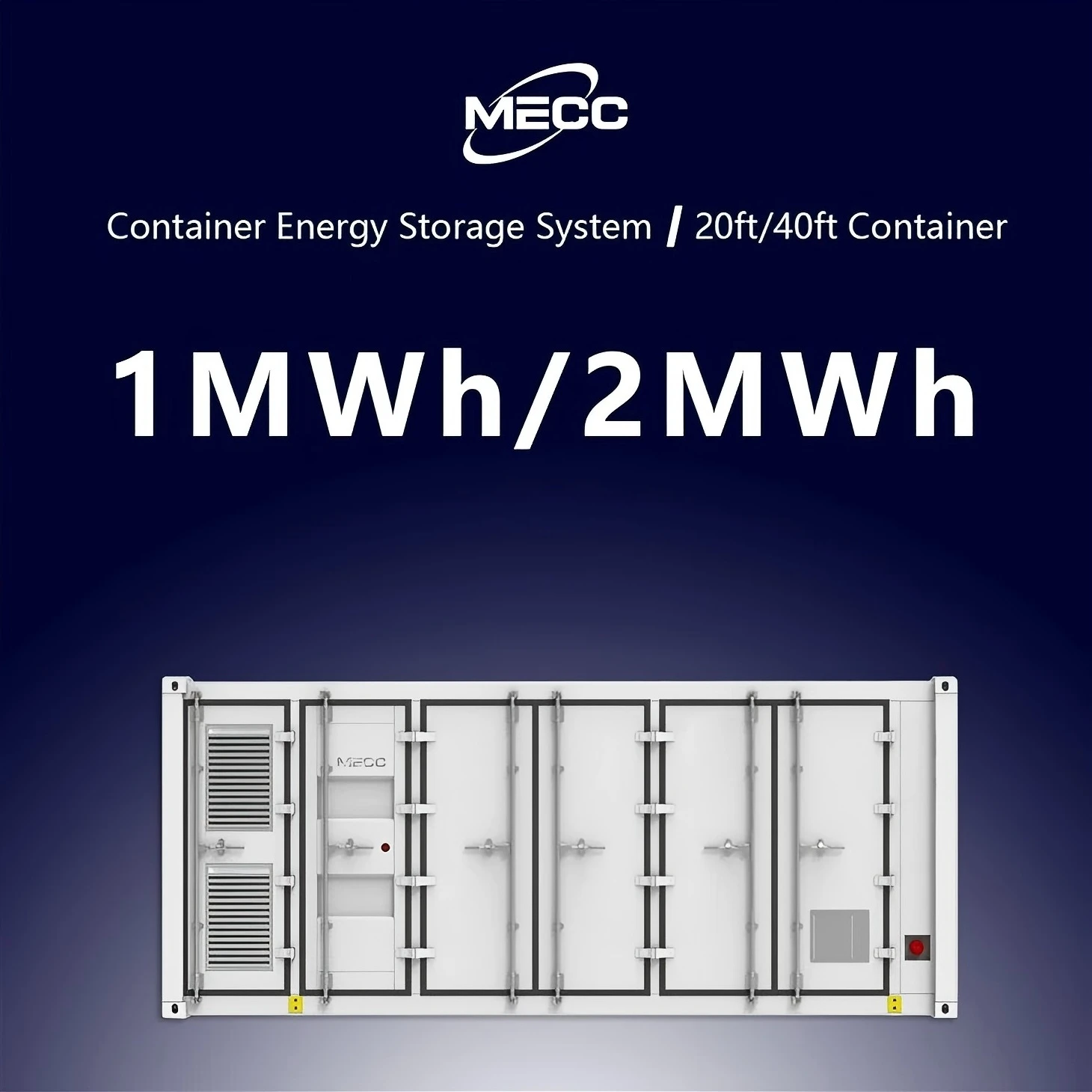
500KW/1MW 1MWh/2MWh Battery Energy Storage System Container
The 500kW/1MW 1MWh/2MWh Battery Energy Storage System Container is a turn‑key utility‑grade energy storage solution housed in standard 20ft or 40ft shipping containers, integrating bidirectional PCS, A‑grade LiFePO4 battery clusters, master BMS, liquid‑cooled thermal management, gas fire suppression, high‑voltage distribution and EMS energy management system with full factory pre‑assembly and pre‑commissioning. Requiring only foundation construction and high‑voltage cable connection for on‑site commissioning, it supports flexible power‑capacity configuration and multi‑container parallel expansion, delivering core capabilities of peak‑shaving and load shifting, renewable energy smoothing, frequency‑voltage grid support, islanded micro‑grid operation and large‑scale emergency backup. Featuring IP54 enclosure protection and comprehensive multi‑layer safety mechanisms, it adapts to diverse harsh outdoor environments, and is widely deployed for ground‑mounted PV power stations, industrial parks, mining operations, island microgrids and grid‑side auxiliary service projects to stabilize grid fluctuations, boost renewable energy utilization and reduce comprehensive energy costs.