Add: Room 1308, Building 4, Haichuang Technology Center, No. 1288, Wenyi West Road, Yuhang District, Hangzhou City, Zhejiang Province, China
Search
Production Insight: MECC 241kWh/125kW All-In-One Energy Storage Cabinet Full Manufacturing Process
Sep 08, 2026
Leave a message
FOR IMMEDIATE RELEASE
MECC, a professional manufacturer of high-performance commercial and industrial energy storage systems, publicly showcases the complete manufacturing workflow of its flagship 241kWh/125kW all-in-one energy storage cabinet. From rigorous cell screening and precision module assembly to systematic system integration and factory-level performance testing, every production link follows standardized industrial quality control procedures. This full-process transparent manufacturing mechanism delivers consistent, reliable and high-stability ESS products, providing trustworthy hardware solutions for global solar EPC contractors, commercial project developers and energy storage distributors.
For global B2B energy storage buyers, product reliability is fundamentally determined by factory production standards and process control capabilities. Many low-cost energy storage products on the market suffer from inconsistent cell matching, rough assembly processes and incomplete testing procedures, leading to uneven operational performance, frequent system faults and shortened service life in actual project operation. MECC opens the entire production chain of the 241kWh/125kW integrated energy storage cabinet, demonstrating professional manufacturing strength and strict quality management, helping overseas partners fully verify product quality and reduce project cooperation risks.
Strict Cell Screening and Precision Matching Lay Foundation for System Stability
The entire manufacturing process of the 241kWh energy storage cabinet starts with strict incoming cell inspection and classification matching. All adopted LiFePO4 cells are brand-new A-grade units, which undergo multi-dimensional performance tests including capacity calibration, voltage consistency detection and internal resistance screening before entering production. Only cells with highly consistent parameters can enter the module assembly link, effectively avoiding system imbalance caused by cell parameter differences during long-term cyclic operation.
Professional cell grouping technology ensures uniform charge and discharge status of each battery module. This standardized pre-production screening process greatly reduces later capacity attenuation and fault risks, laying a core foundation for the long-cycle stable operation of the 241kWh large-capacity energy storage system, and meeting the high-reliability requirements of global commercial and industrial energy storage projects.
Standardized Module Assembly and Structural Optimization
After cell screening, MECC adopts standardized automated assembly processes to complete battery module packaging. The production team follows unified operating specifications for cell stacking, busbar welding and insulating treatment, strictly controlling assembly precision and wiring standards. All internal wiring is neatly arranged and fixed with professional wire harnesses, realizing separation of strong and weak electricity and reducing hidden dangers of short circuits and poor contact.
Each assembled battery module undergoes independent performance testing, including voltage testing, internal resistance verification and insulation detection. Unqualified modules are eliminated on-site to ensure that every module integrated into the cabinet meets industrial-grade technical standards. The modular assembly mode improves product consistency and maintainability, facilitating later on-site inspection and maintenance for overseas engineering teams.
Full System Integration of 125kW Inverter and Auxiliary Systems
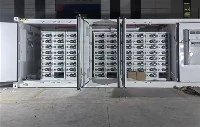
Different from ordinary split energy storage equipment, the MECC 241kWh/125kW cabinet completes full system integration in the factory. The high-efficiency 125kW hybrid inverter, intelligent BMS management system, thermal dissipation system and safety protection modules are precisely installed and matched with battery modules through standardized processes. Professional communication protocol debugging ensures seamless data interaction and collaborative operation between the inverter and battery system.
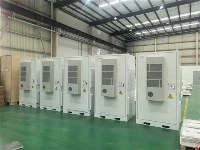
The integrated assembly process unifies the internal structural layout of the cabinet, optimizes heat dissipation paths, and avoids installation errors and matching failures caused by on-site manual assembly. All electrical connections and system debugging are completed in the factory, realizing true plug-and-play deployment, greatly simplifying on-site construction procedures for global projects and shortening commissioning cycles.
Before leaving the factory, each 241kWh/125kW energy storage cabinet undergoes comprehensive finished product testing covering electrical performance, safety protection and operational stability. The test items include full-capacity charge and discharge cycling, overcharge and over-discharge protection testing, high and low temperature adaptation testing, and communication function verification. Every equipment parameter is strictly calibrated to ensure compliance with international industrial energy storage standards.
Through multi-round aging and simulation operation tests, potential equipment faults are fully eliminated in the factory stage. This rigorous testing mechanism ensures that all delivered products have stable power output, sensitive safety response and reliable environmental adaptability, and can maintain consistent operational performance in different global climatic and grid environments.
B2B Value and Global Application Advantages
The transparent and standardized full-process manufacturing system enables MECC's 241kWh/125kW integrated energy storage cabinet to maintain stable quality in batch delivery. For global distributors and EPC partners, standardized production reduces product quality differences in batch orders, lowers after-sales maintenance costs and improves project operational stability.
The high-reliability industrial-grade energy storage cabinet is widely applicable to factory peak shaving, commercial building energy optimization, warehouse backup power and large-scale solar supporting storage projects. Stable product quality and mature manufacturing technology help overseas partners reduce project risk and improve end-user trust, forming stable market competitiveness in the global C&I energy storage market.
Industry Outlook
With the continuous upgrading of global commercial energy storage quality standards, standardized, transparent and high-precision manufacturing processes have become the core guarantee of product competitiveness. MECC will continue to optimize production processes and quality control systems, maintain strict full-link manufacturing standards, and provide more high-quality and reliable integrated energy storage solutions for global industrial and commercial energy transformation.
About MECC
MECC is a professional industrial and commercial energy storage system manufacturer with complete independent production and testing capabilities. Adhering to standardized production and strict quality control, the company independently completes the full process from cell screening, module assembly and system integration to finished product testing, providing high-stability integrated ESS products and professional technical support for global B2B partners.
125KW 241kWh Battery Energy Storage System Cabinet
The BESS 125KW 241kWh Lithium Battery Energy Storage Cabinet is a high-power, large-capacity integrated energy storage solution engineered for medium-to-large commercial, industrial, and utility-scale applications. It integrates a 125kW high-performance bidirectional inverter, a 241kWh lithium iron phosphate (LiFePO4) battery bank, and a full-featured intelligent energy management system (EMS) into a modular cabinet design. This system enables efficient renewable energy storage, peak shaving, load shifting, grid frequency regulation, and emergency backup power supply. Ideal for large factories, shopping malls, industrial parks, utility-scale solar/wind farms, and microgrids, it enhances energy independence, reduces high grid demand charges, and supports the stable integration of high-penetration renewable energy into the grid.