


Project Overview
Elevate your business and factory‑site operations to new performance levels with stable, reliable and eco‑friendly energy systems.
System Configuration
- PV capacity: 100 kW
- Battery Energy Storage System (BESS): 261 kWh
24‑hour power backup: Greatly reduce reliance on utility grid power and keep offices, exhibition halls or factories running normally during grid outages.
Heavy‑load management: Support simultaneous operation of multiple air‑conditioners, heavy‑duty machinery, elevators and large‑scale lighting systems.
Peak‑load shaving: Generate solar power during daytime and draw energy from the BESS at night, delivering significant electricity‑cost reduction.
High daily energy yield: Produce substantial volumes of clean energy according to local solar irradiance conditions, lowering long‑term energy expenditure.
In real‑world commercial‑industrial deployments, even well‑sized PV‑storage hybrid systems encounter two common and critical operational pain points.

Key Technical Pain Points
Pain Point 1: Conflict between economic peak‑shaving operation and emergency backup power reserve
Most C&I sites expect one single PV‑storage system to achieve dual objectives: daily cost saving through peak‑shaving, and guaranteed backup capacity for unexpected power failures. Many conventional control systems apply fixed charge‑discharge logics. The battery may exhaust its stored energy for peak‑period arbitrage. When a sudden blackout strikes, there is no reserved energy left to sustain critical loads such as production machinery, office IT hardware and safety lighting. This brings direct business losses including work stoppage and interrupted customer services.
Pain Point 2: Impact of sharp heavy‑load surges on system stability and solar‑energy self‑consumption
Factories and mixed‑use commercial buildings frequently experience abrupt load spikes caused by simultaneous startup of heavy machinery, elevators and air‑conditioning units. Rapid power fluctuation may trigger voltage disturbance for hybrid PV‑storage systems. Without fast‑response coordinated control, excess midday photovoltaic power cannot be fully stored and gets wasted, while evening peak demand still relies heavily on expensive grid‑supplied electricity, limiting the return‑on‑investment of solar assets.
MECC Targeted Technical Solutions
Solution 1: Intelligent EMS dynamic reserve‑SOC management for both economic operation and backup security
MECC's energy management system supports user‑configurable state‑of‑charge reserve thresholds for emergency backup. Under normal grid‑connected conditions, the system prioritises peak‑shaving: it charges the 261 kWh BESS using surplus power generated by the 100 kW PV array during sunny daytime, and discharges stored energy to offset high‑cost grid power during evening peak hours.
Solution 2: Fast‑response power regulation for heavy‑load scenarios plus maximised solar utilisation

Related Products
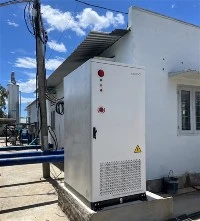
Liquid Cooling 125KW 261kWh Lithium Battery Energy Storage Cabinet
The IP55 Protected All-in-One Solar Energy Storage Cabinet is a high-performance, integrated energy solution engineered for outdoor commercial, industrial, and utility-scale solar applications. It integrates a 125kW Power Conversion System (PCS), a 261kWh lithium iron phosphate (LiFePO4) battery bank, an advanced liquid cooling system, and a intelligent Battery Management System (BMS) into a single cabinet with IP55 weatherproof protection. Designed to withstand harsh outdoor environments while delivering efficient energy conversion and storage, it supports solar energy absorption, peak shaving, load shifting, grid auxiliary services, and emergency backup power. Ideal for utility-scale solar farms, industrial parks, large commercial complexes, and remote microgrids, it provides a reliable, space-saving, and low-maintenance solution for large-scale renewable energy integration.
